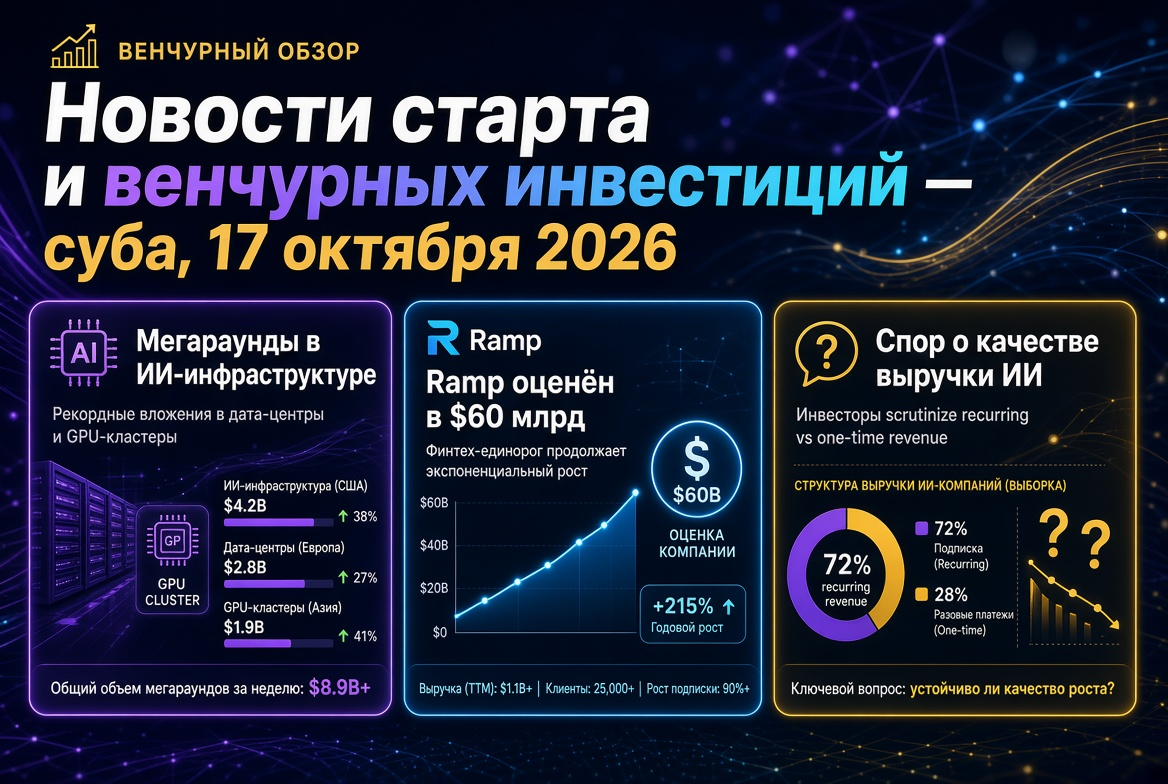
Startup and Venture Investment News for May 9, 2026: AI Mega-Rounds, Lime IPO, Deals with Sierra, Ramp, DeepInfra, Astranis, and New Venture Market Trends
The global startup and venture investment market enters mid-May 2026 with a distinct tilt towards artificial intelligence, infrastructure platforms, and companies capable of swiftly turning technological advantages into revenue. For venture capitalists and funds, the current agenda indicates a significant shift: capital is once again willing to take risks but is opting for a limited pool of startups with scalable products, sizable corporate clients, and clear exit trajectories rather than a broad basket of early-stage projects.
The main theme of the week is the concentration of venture capital around AI startups. Major rounds involving Sierra, DeepInfra, Blitzy, Tessera Labs, and Astrocade confirm that investors continue to pay premiums for companies that are building applied artificial intelligence, AI infrastructure, and vertical solutions for businesses. At the same time, Lime's IPO shows that the public offering market for technology companies is gradually reviving, although investors have become significantly more demanding regarding debt burdens, free cash flow, and business model resilience.
AI Startups Reemerge as the Center of Venture Market
The most significant signal for the startup market has been Sierra's round, a developer of AI tools for customer experience management. The company raised approximately $950 million at a valuation of around $15 billion. For venture funds, this isn't just another substantial deal in the AI sector, but rather a confirmation of a new investment logic: value is generated not only by foundational models but also by applied AI platforms that can be integrated into the processes of large corporations.
In light of Sierra, investors are increasingly segmenting the artificial intelligence market into several categories:
- AI infrastructure for training and inference of models;
- Vertical AI startups for specific industries;
- Agentic AI and autonomous systems capable of executing transactions;
- Corporate platforms for customer service, sales, finance, and software development;
- Security, identification, and action control tools for AI agents.
For venture investors, this means that the previous formula of "startup plus AI" is no longer sufficient. Companies that can demonstrate real monetization, high product usage frequency, and the capacity to replace or enhance costly corporate processes are securing capital.
This Week's Major Rounds: AI, Space, Biotech, and Insurance
The week concluded with a series of major deals that illustrate the direction of venture investments. In addition to Sierra, Astranis—a space startup developing high-orbit satellites—raised significant capital, totaling around $455 million with equity and credit line considerations. For funds, this is an important indicator: deep tech and space tech are once again becoming investment focal points where substantial checks are possible due to technological barriers and long-term demand.
Among the notable deals are:
- Anagram Therapeutics — approximately $250 million for developing a biotech solution in treating pancreatic diseases.
- Blitzy — around $200 million for an autonomous software development platform.
- Corgi Insurance — about $160 million for an AI-native insurance platform for startups.
- Panthalassa — approximately $140 million for a project related to marine energy and computing for AI inference.
- DeepInfra — around $107 million for cloud infrastructure aimed at high-performance AI inference.
This collection of deals indicates that the startup and venture investment market is no longer limited to classic SaaS sectors. The focus is now on infrastructure, AI products, biotech, space, insurance, and energy. These are sectors where the entry barrier is higher, but the potential exit value could also be significantly greater.
Lime's IPO as a Test for Technology Companies Outside AI
Lime, a micromobility company backed by Uber, has garnered separate attention in the venture market. The startup has filed for an IPO on Nasdaq under the ticker LIME. For investors, this serves as a significant test not only for Lime itself but also for the entire segment of technology companies that have remained out of the spotlight following a decline in interest in unprofitable growth assets.
Lime's financial picture is mixed. On one hand, the company's revenue surged to approximately $887 million in 2025, with free cash flow remaining positive for several consecutive years. On the other hand, the company is still unprofitable, carrying a substantial debt load and relying heavily on its partnership with Uber. For venture funds, this case is critical as an indicator of how willing the public market is to embrace startups with growth potential but lacking stable net profits.
If Lime's IPO is successful, it could open the door for other technology companies that may not be directly related to AI but possess scale, a recognizable brand, and proven revenue. If demand is weak, venture investors may further concentrate on AI startups and companies with more evident margins.
Ramp and the New Premium for AI-Driven Fintech
Fintech remains one of the most attractive segments for venture investments, especially when a company integrates financial infrastructure, corporate expenses, and artificial intelligence. Ramp, which operates in the realm of corporate expense management, is discussing a new round of approximately $750 million at a valuation exceeding $40 billion. Even if the terms of the deal change, the very fact that negotiations are underway indicates high investor demand for fintech startups with robust revenue and an AI component.
For funds, Ramp exemplifies a new type of fintech platform. The company not only automates business expenses but also incorporates AI agents that can identify fraud, block policy-violating expenses, and manage liquidity. This direction is particularly critical for the corporate market, where time savings, risk control, and the automation of financial operations directly translate into product value.
Agentic Commerce: Venture Funds Search for Autonomous Economy Infrastructure
Another significant theme of the week is the development of agentic commerce. Major corporate venture investors are increasingly seeking startups that create infrastructure for autonomous commercial operations: from digital identification and payment authorization to AI systems capable of independently planning trips, booking services, completing purchases, and managing complex scenarios on behalf of users.
For the startup market, this indicates the emergence of a new layer of investment opportunities. While investors financed generative AI as a tool for creating text, images, and code actively from 2023 to 2025, the focus in 2026 is shifting towards systems that can execute actions. Startups addressing three key challenges are generating the most interest:
- Trust and credential verification of AI agents;
- Secure execution of payments and transactions;
- Integration with corporate, banking, and consumer services.
This category could emerge as one of the main areas of venture investments in the coming quarters, especially at the intersection of fintech, e-commerce, travel tech, and corporate software.
Indian AI Startups Accelerate US Expansion
The global competition for AI startups is intensifying. Indian founders targeting the international market are increasingly receiving recommendations from venture funds to expand into the US early and establish physical presence in San Francisco. This represents a significant shift from the previous SaaS era, where many companies could build products in India for an extended period and only later establish a sales office in the US.
The reason lies in the rapid evolution of the artificial intelligence market compared to the classical software segment. For AI startups, proximity to clients, access to capital, engineering talent, partnerships, and swift feedback on product-market fit are critical. Venture investors are increasingly considering that presence in Silicon Valley enhances the likelihood of securing large corporate contracts and subsequent financing rounds.
This creates a new investment filter for global funds: a strong engineering team in India or Europe must be complemented by commercial presence in the US. Startups building products for the global market yet remaining distant from key clients may receive a more cautious assessment.
Crypto, AI, and New Funds: Capital Returns Selectively
Venture investments in the crypto and blockchain sector are also showing signs of revival, but this market remains significantly more selective than during the previous cycle. Haun Ventures has raised approximately $1 billion for new funds focused on crypto, blockchain, financial services, and specific AI directions. This is an important signal: institutional capital has not exited digital assets but is now seeking infrastructure and financial models with real applicability.
Startups emerging at the intersection of three areas—digital assets, regulated financial services, and artificial intelligence—appear the most promising. Venture funds are likely to adopt a more cautious approach towards speculative projects but may actively finance companies developing payment infrastructure, stablecoin services, digital banks, compliance tools, and AI agents for financial operations.
What This Means for Venture Investors and Funds
The current agenda as of May 9, 2026, indicates that the startup and venture investment market remains active but has become less uniform. Capital is concentrating in companies that meet several criteria simultaneously: a large addressable market, a technological barrier, rapid revenue growth, strong capital investors, and a clear exit scenario.
For venture investors, the key takeaways are as follows:
- AI remains the main magnet for capital, but the market is beginning to differentiate between infrastructure, applied, and speculative projects.
- Lime's IPO will serve as an important test for technology companies outside the artificial intelligence sector.
- Fintech startups are commanding a premium when they combine revenue growth, corporate demand, and AI automation.
- Deep tech, space tech, biotech, and energy infrastructure are again coming into the realm of large venture deals.
- Global AI startups are increasingly compelled to establish a commercial presence in the US at early stages.
Key Conclusion
Saturday, May 9, 2026, marks a market where venture capital is once again ready to invest heavily but is reluctant to finance uncertainty without proven dynamics. Startups are receiving high valuations only when they can demonstrate not only technological novelty but also real demand, infrastructural significance, and exit potential. For venture funds, this is a market of opportunities, but also a harsh selection process: investors who can distinguish between short-term AI hype and companies that are creating new technology infrastructure for the global economy will come out on top.