Current Startup and Venture Capital News as of May 12, 2026: Market Sets Record Capital Levels, Yet Money is Concentrating More Clearly Around AI, Robotics, Defense Technologies, and Companies with Clear Paths to IPO
By mid-May 2026, the global venture market has entered a phase that is increasingly difficult to describe simply as a recovery from a downturn. Venture investments are once again growing at record rates, the largest funds are returning to aggressive bets, and AI startups are securing funding rounds that, until recently, seemed unimaginable even for established tech companies. However, behind this external upswing lies a more complex picture: capital is being distributed unevenly, investors are becoming stricter in their selection processes, and the gap between market leaders and the rest continues to widen.
As of May 12, 2026, venture capital investors are focusing on several key themes:
- record concentration of capital in leading AI companies;
- rapid growth in interest in physical AI, robotics, and industrial automation;
- the transformation of defense technologies into a major investment sector;
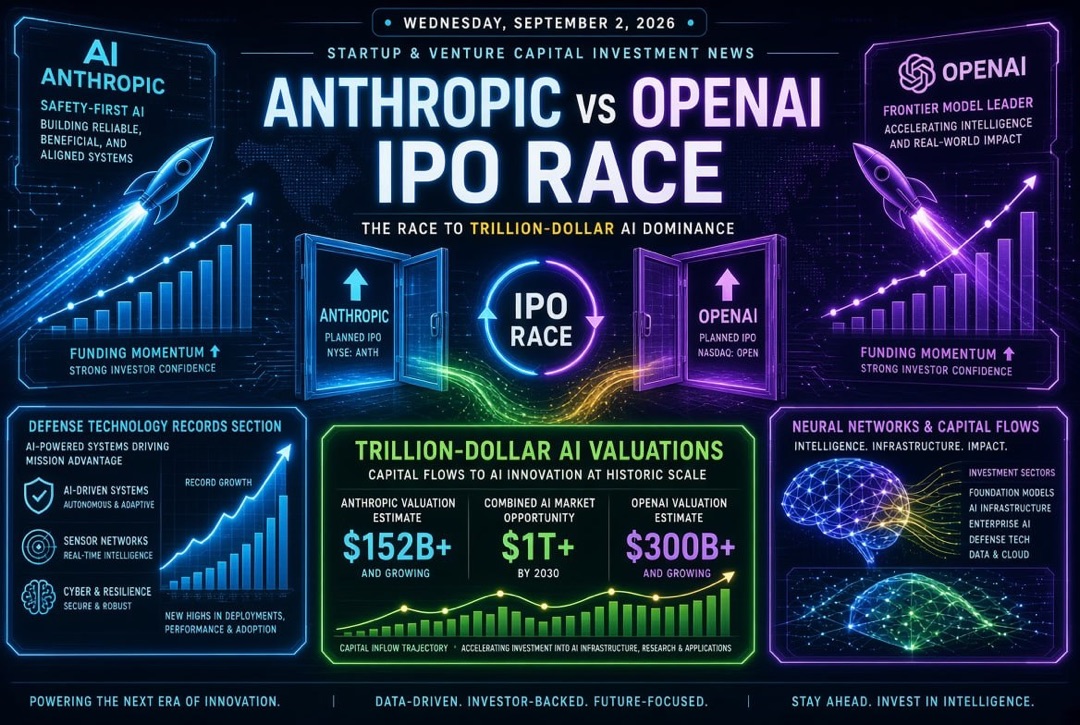
- renewed interest in IPOs and other exit options;
- the strengthening role of specialized funds that operate not "across the entire market" but on narrow technological theses;
- expansion of the geography of large deals beyond the U.S. — into Europe, India, South Korea, and China.
Venture Market Sets Records, but Becomes Increasingly Concentrated
The first quarter of 2026 marked a historic period for the global venture capital market. The volume of investments in startups around the world reached record levels, spurred on by the largest AI mega-rounds in the history of the market. However, the absolute volume of capital is less important than its structure: a significant portion of the funds has been allocated to a limited number of companies, primarily those developing large language models and AI infrastructure.
For venture funds, this signifies a transition to an even more pronounced power law model of the market, where a few winners are capable of shaping the results of the entire portfolio. In such conditions, news about startups is increasingly evaluated not by the number of closed deals but by the company's potential to dominate in a new technological chain — from computational infrastructure to corporate AI agents.
AI Mega-Rounds Set New Benchmarks for Late-Stage Investments
The main topic of the week remains artificial intelligence. The startup Sierra, operating in the corporate AI-agent sector, announced that it secured $950 million at a valuation exceeding $15 billion. This deal serves as another confirmation that venture investors are willing to pay a premium not only for foundational models but also for applied solutions that have already demonstrated early monetization capabilities in the corporate sector.
In parallel, the Chinese AI startup DeepSeek is negotiating external financing with a potential valuation of up to $50 billion. The mere fact that a company, which has long operated without external capital, is considering such a substantial raise indicates that the race for computational power, talent, and speed to market for new models is demanding increasing resources.
For funds, this presents two key conclusions:
- the market increasingly values not just an AI product but scalable infrastructure, data, and distribution channels;
- late-stage investments are becoming active again, but only for companies with potential for global leadership.
Robotics and Physical AI Become New Areas of Increased Demand
While 2024-2025 were periods of rapid growth for generative AI, in 2026 an increasing amount of capital is being directed towards physical AI — a combination of artificial intelligence, robotics, sensors, and industrial automation. The French startup Genesis AI unveiled its new GENE-26.5 model and humanoid robotic hand, already attracting attention from the European industry. The company had previously raised $105 million in one of France's largest seed rounds.
Investors are also focused on this direction: the fund Eclipse raised $1.3 billion to support startups in the field of physical AI, while BMW i Ventures launched a new $300 million fund focused on applying AI in the automotive industry, manufacturing, and supply chains.
Notably, the South Korean startup Config is building data infrastructure for robotics and has already secured support from Samsung, Hyundai, and LG. This sends a significant signal to the venture market: value is being created not just by manufacturers of end robots, but also by companies providing the "picks and shovels" for the future robotic economy.
Defense Technologies Transition from Niche Segment to Core Venture Agenda
Defense technologies are rapidly evolving from a specialized field into one of the central segments of the startup market. The German defense-tech startup Helsing is preparing a new round of approximately $1.2 billion at an estimated valuation of around $18 billion. Investor interest is fueled by rising military expenditures in Europe, demand for autonomous systems, and the accelerated implementation of AI in the defense industry.
Concurrently, the American startup Scout AI secured $100 million for developing autonomy models in the military sector, while HawkEye 360 successfully went public, achieving a valuation of around $3.15 billion after a strong debut. These deals demonstrate that venture investments in the defense sector are no longer limited to software: capital is flowing into drones, satellite analytics, autonomous platforms, sensors, and intelligent management systems.
For funds, this represents one of the most notable structural shifts of 2026. Defense technologies are now evaluated not only based on revenue growth but also on their strategic importance to states and large corporate clients.
The IPO Market is Reviving, but Investors Demand Proven Economics
After a prolonged period of a closed window for tech public offerings, the IPO market is once again showing signs of life. In recent days, several companies have expanded exit opportunities: HawkEye 360 had a successful debut on the New York Stock Exchange, and Lime filed for an IPO, showcasing strong revenue growth and positive free cash flow.
However, investors are no longer willing to finance the public market merely for the sake of growth stories. A notable case is Kodiak AI: the company raised $100 million but at a substantial discount to market price, serving as a reminder to maintain discipline regarding valuations. In 2026, IPOs of startups are once again feasible but under new rules: high revenue, clear margins, and a credible pathway to profitability have become essential requirements.
New Funds Bet on Narrow Technological Theses
Fundraising for venture funds has also revitalized, albeit unevenly. Those managers with clear specialization and strong reputations are attracting capital more confidently. Haun Ventures announced new funds amounting to $1 billion to invest in digital assets and blockchain infrastructure, a16z crypto raised $2.2 billion for the next cycle of development in the crypto sector, while corporate funds are ramping up their investments in AI, industrial sectors, and automation.
This suggests that the venture market is gradually moving away from a universal "invest in all tech" model. Institutional LPs are increasingly selecting managers who can articulate not only market size but also their competitive advantages: industry expertise, access to strategic clients, infrastructure competencies, or the ability to guide the portfolio to exit.
Europe and Asia Expand the Venture Growth Map
Although the U.S. still dominates in terms of total venture investments, the most interesting startup news is increasingly emerging from other regions. Europe is solidifying its position in robotics, climate technologies, and the defense sector. India continues to grow its number of rapidly expanding companies: the startup Pronto doubled its valuation in two months to $200 million, and Skyroot Aerospace became India's first space-tech unicorn following a new round of $60 million.
Asia, in general, is showcasing a broader spectrum of deals — from Chinese AI to South Korean robotics and the Indian space sector. For global funds, this widens the search field: the largest tech winners of the next cycle may emerge not only from Silicon Valley but also from Paris, Berlin, Bangalore, Seoul, or Shenzhen.
What This Means for Venture Investors and Funds
As of May 12, 2026, the venture market appears strong but not uniformly healthy. Money is once again available, valuations of top companies are rising, and large rounds are rekindling the feeling of a tech boom. However, behind the records lies a rigorous selection process: quality startups with strong technology, defensible advantages, and clear economics receive an excess of capital, whereas companies without a compelling growth model face pressure.
In the coming months, venture investors would be wise to closely monitor four key areas:
- how long the concentration of capital around leading AI companies will last;
- whether physical AI can transition from demonstrations to large industrial contracts;
- whether the accelerated growth of defense technologies will continue after the first significant exits;
- how sustainable the new IPO window for tech companies will prove to be.
The main takeaway for funds is clear: the startup market is growing again, but it now rewards precision in selection rather than broad risk. In 2026, the winners will not be those who merely invest in trendy sectors but those who effectively identify where the new infrastructure of the global economy is being formed.