Cryptocurrency News, Wednesday, April 15, 2026: Institutional Infrastructure Strengthens, and Stablecoins Become the New Growth Center
As trading begins on Wednesday, April 15, 2026, the cryptocurrency market appears markedly stronger than it did a week ago. The price recovery of major digital assets is not only accompanied by a rise in interest from private capital but also significant structural changes: traditional exchanges deepen their presence in the crypto industry, regulators send clearer signals to the market, and stablecoins emerge as one of the key tools in global financial competition. For investors, this signals a shift: the cryptocurrency market is increasingly driven by institutional architecture, payment infrastructure, and political decisions, rather than merely speculative impulses.
Market Enters Wednesday with Improved Sentiments
The cryptocurrency market approaches April 15 amidst noticeable revitalization. The total sector capitalization has stabilized above the $2.5 trillion mark, and daily trading volumes have surged sharply. This indicates that the momentum is driven not only by rising prices but also by increased trading activity, which is generally perceived as a healthier sign by the market than a local rebound on thin liquidity.
Bitcoin retains its dominant position, holding approximately 59% of the overall cryptocurrency market capitalization. This is an important indicator: capital continues to concentrate in the most liquid and institutionally recognized assets. Simultaneously, Ethereum is demonstrating more robust dynamics, suggesting that investors are beginning to return to the segment of infrastructure blockchain platforms, where not only price but practical application of the network are crucial.
Bitcoin Remains the Main Market Anchor
Bitcoin continues to serve as the primary barometer of risk appetite in digital assets. The current cycle is distinguished from previous ones by increasing support from infrastructural demand. Investors are now closely monitoring not just the actions of crypto exchanges and funds, but also the entry of major financial organizations, exchange operators, and payment participants into the sector.
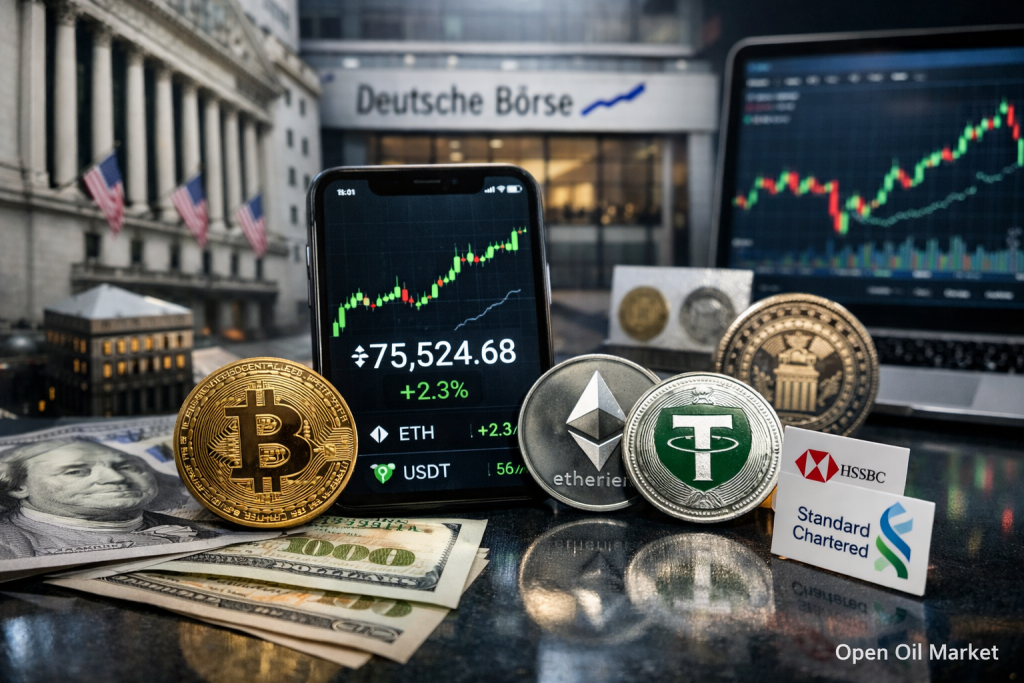
It is for this reason that the recent news of Deutsche Boerse acquiring a stake in Kraken is significant. For the market, this is not merely an investment in a single platform but a signal that European exchange infrastructure is placing a bet on the regulated crypto segment, tokenized markets, derivatives, and institutional liquidity. Practically, this reinforces the thesis that cryptocurrencies are increasingly embedded in the global financial system.
Ethereum Benefits from the Shift to Applied Crypto-Economics
Ethereum remains the second most significant asset and a key platform for most applied solutions in the digital asset market. In the current market phase, Ether is important not only as a speculative asset but also as an infrastructural bet on tokenization, decentralized finance, stablecoins, and new forms of digital payments.
For investors, this indicates that Ethereum is gradually regaining its status as a foundational asset for assessing the entire on-chain economy. When the market begins to discuss not only the price growth of Bitcoin but also the expansion of real use cases for blockchains, Ether typically finds itself in the spotlight. This is why its performance in the coming weeks may serve as an indicator of whether this current growth transitions from a short-term rebound into a more sustained movement across the market.
Stablecoins Become the Main Strategic Narrative of 2026
In previous years, the market focused on ETFs, meme stocks, and halving cycles; however, in 2026, the stablecoin segment is gaining increasing significance. Several events confirm that this is where the next level of institutional competition is forming.
- In Hong Kong, the first licenses for issuing fiat-backed stablecoins have been granted to HSBC and a joint venture with Standard Chartered.
- In Switzerland, six banks have begun testing scenarios for a stablecoin pegged to the Swiss franc.
- The banking sector in various jurisdictions is increasingly viewing stablecoins as a payment and settlement layer for cross-border operations.
This marks an important pivot for the global market. Stablecoins are no longer merely instruments for exchange liquidity; they are now tools of competition among banks, jurisdictions, and financial centers. For the crypto market, this is a positive development, as it expands the area of real demand and brings digital assets closer to international payments, trade financing, and corporate settlements.
Regulatory Agenda in the U.S. Gradually Clarifying
The American regulatory environment remains a key driver for the global cryptocurrency market. In recent weeks, several signals have emerged in the U.S. that investors are interpreting as cautiously positive.
- The SEC has issued clarifications on the classification of crypto assets and effectively reinforced its approach towards a more formalized categorization of digital tokens.
- The discussion around the Clarity Act bill remains at the forefront, as the market awaits clearer federal rules for digital assets.
- The SEC's position on certain interfaces and self-custody models has garnered additional interest, increasing predictability for some infrastructure players.
For institutional investors, predictability is more crucial than aggressive liberalization. Large capital does not require a complete absence of regulation; what it needs is a clear framework. Therefore, every new official clarification from the SEC or the U.S. Treasury Department acts as a factor for re-evaluating the entire sector.
Kraken and Traditional Finance: A New Signal of Integration
Another important topic is the deepening connections between the crypto business and the traditional financial system. Kraken remains in the spotlight not only due to its deal with Deutsche Boerse but also for gaining access to the key payment system of the U.S. Federal Reserve through a limited master account format. This presents a significant precedent for the market.
On one hand, this enhances trust in crypto infrastructure as a part of the financial system. On the other hand, such solutions evoke increased scrutiny concerning transparency, risk management, cybersecurity, and compliance with regulatory requirements. Thus, the market receives two signals: integration is accelerating, but alongside it rise the demands for the quality of the infrastructure.
What Does This Mean for Investors on April 15?
At this stage, it is important for investors to look not only at the price of Bitcoin or the dynamics of individual altcoins but also at a broader array of factors. In the coming sessions, the market will be sensitive to the following topics:
- Will Bitcoin maintain its dominance above 59%?
- Can Ethereum strengthen its relative strength amidst growing interest in infrastructure assets?
- Will stablecoin initiatives continue to develop in Asia, Europe, and the U.S.?
- Will the regulatory agenda in the U.S. move towards greater clarity?
- Will traditional financial institutions continue to increase their presence in the crypto sector?
It is this combination of factors that will determine whether the current momentum remains a local rebound or transitions into a new phase of broader growth in the cryptocurrency market.
Top 10 Most Popular Cryptocurrencies
At the time of this report, the top ten cryptocurrencies by market capitalization are as follows:
- Bitcoin (BTC) — approximately $75,524. The main reserve asset of the crypto market and a primary indicator of institutional demand.
- Ethereum (ETH) — approximately $2,376. The foundational infrastructure for DeFi, tokenization, and stablecoins.
- Tether (USDT) — approximately $1.00. The largest stablecoin and a crucial source of dollar liquidity within the crypto ecosystem.
- XRP (XRP) — approximately $1.38. An asset that the market continues to see as a bet on payment solutions and cross-border transfers.
- BNB (BNB) — approximately $619.94. The key token of the Binance ecosystem and one of the largest exchange assets globally.
- USD Coin (USDC) — approximately $1.00. The second-largest stablecoin, particularly important for the institutional segment and regulated settlements.
- Solana (SOL) — approximately $86.51. One of the main blockchains for high-speed applications and an active ecosystem.
- TRON (TRX) — approximately $0.321. Maintains strong positions due to its use in payment flows and stablecoin circulation.
- Dogecoin (DOGE) — approximately $0.096. A meme asset with sustained liquidity and constant attention from retail capital.
- Hyperliquid (HYPE) — approximately $44.18. One of the most notable new large assets of the current cycle, reflecting market interest in new trading infrastructures.
Conclusion
As of April 15, 2026, the cryptocurrency market appears more mature and institutional than in previous phases of the cycle. The growing role of stablecoins, the involvement of banks and exchange operators, the gradual tuning of regulation, and the concentration of capital in major assets create a new landscape for investors: the crypto market can no longer be analyzed solely as a speculative sector. It is increasingly becoming part of the global financial architecture.
For investors, the main takeaway on Wednesday is clear: the market retains growth potential, but now the key drivers are not just emotions, but infrastructure, regulation, and the quality of capital flowing into digital assets.