Current Cryptocurrency News as of April 2, 2026: Institutional Demand for ETFs and Key Trends in the Top 10 Cryptocurrencies for Investors
The key feature of the current moment is that cryptocurrency news is increasingly driven not by isolated price movements, but by the quality of capital inflow. Investors are assessing not only the dynamics of Bitcoin and Ethereum but also the sustainability of interest from exchange-traded funds (ETFs), custodians, payment infrastructure, and large financial institutions.
Against this backdrop, the cryptocurrency market is taking on a more complex structure. Bitcoin continues to maintain its status as the foundational indicator of sentiment, but now accompanying signals are also essential:
- the stability of inflows into ETFs;
- whether regulatory clarity is strengthening in major jurisdictions;
- which blockchains and tokens are benefiting from the growth of real-world use;
- whether liquidity is flowing from safe assets into riskier market segments.
This is why cryptocurrency news for Thursday, April 2, 2026, should be viewed not as a collection of individual information points but as an indicator of a new cycle in digital assets.
Bitcoin Remains the Key Barometer of the Market, but Investors Await Confirmation of Sustainable Demand
Bitcoin retains its critical role in the global structure of digital assets. It remains the largest cryptocurrency by market capitalization, shaping the overall market temperature and determining investor risk appetite. However, what matters now is not just Bitcoin’s leadership status but the resilience of its dominance amid a changing macroeconomic and regulatory environment.
For institutional players, Bitcoin continues to be the primary entry point into cryptocurrencies. Fundamental strategies for allocation, hedging, and long-term positioning revolve around it. This dual role makes the first cryptocurrency both a safe haven asset within the digital sector and the main channel for the inflow of new capital.
For investors, this means the following:
- Bitcoin remains the chief benchmark for assessing the entire cryptocurrency market.
- Any renewed interest in ETFs boosts confidence across the entire digital segment.
- Even with the rise of altcoins, the market still seeks confirmation of strength solely from Bitcoin.
ETF Inflows Restore Institutional Support for Cryptocurrencies
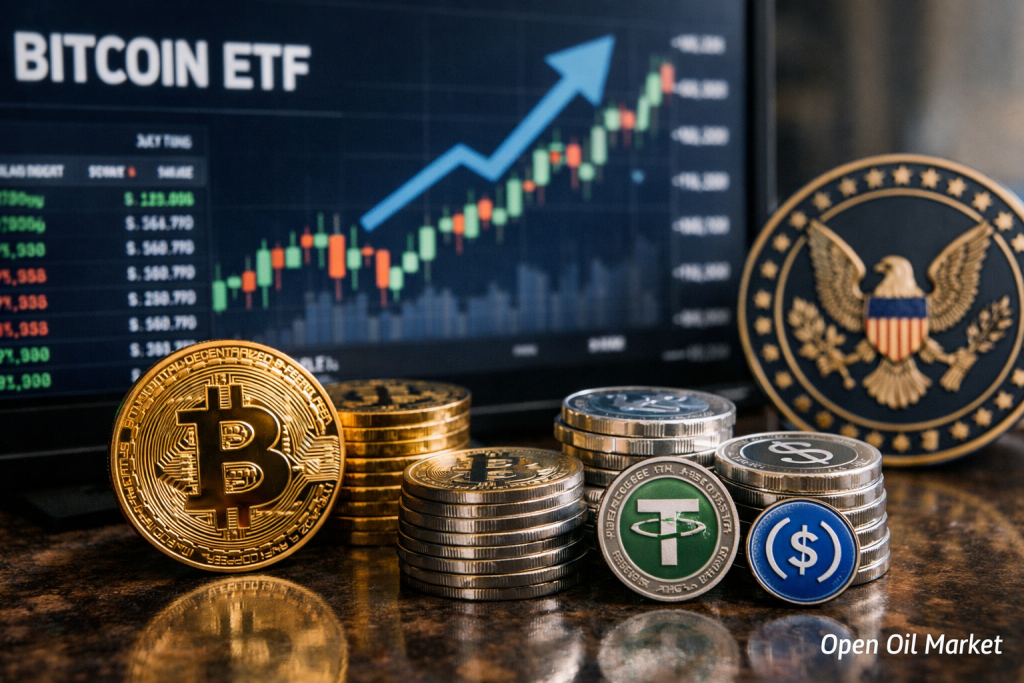
One of the most significant events of recent days is the renewed interest in spot Bitcoin ETFs in the United States. Following a period of weak inflows, the market received a signal that large capital is once again prepared to view Bitcoin as a liquid and acceptable tool for strategic entry. This is a crucial factor for the entire sector, as ETFs create a clear and regulated access channel to cryptocurrencies for fund managers and conservative investors.
The return of positive momentum for ETFs changes the market's tone. Previously, traders feared that digital assets would once again be isolated from large capital, but now a more constructive scenario is emerging: demand might recover not only from retail investors but also from the institutional base.
For the market, this has several implications:
- pressure on Bitcoin as an exclusively speculative asset is diminishing;
- trust in legal and transparent crypto instruments is strengthening;
- the likelihood of a gradual revival of appetite for major altcoins is increasing.
Regulation Becomes a Driver, Not Just a Limitation
Another important development for the cryptocurrency market is the changing attitude towards regulation. Previously, stringent oversight in the U.S. and other major jurisdictions was viewed as the primary risk for the industry, but investors are increasingly looking at regulatory clarity as a factor for long-term growth.
In practice, this means that a strong regulatory framework can enhance trust in cryptocurrencies, improve conditions for listing, institutional custody of assets, issuance of stablecoins, and operation of regulated trading platforms. This is especially important for the global market, as capital prefers predictable rules of the game.
In 2026, the topic of regulation no longer seems secondary. It directly affects project valuations, liquidity distribution between Bitcoin, Ethereum, and other major assets, as well as the speed of integrating digital assets into the traditional financial system.
Top 10 Most Popular Cryptocurrencies: Where Capital Attention is Focused
As of early April, investor interest is concentrated on the largest cryptocurrencies by market capitalization. The top 10 defines the overall market structure, the sentiment of trading participants, and liquidity distribution between defensive and more aggressive segments.
The global market is focused on:
- Bitcoin
- Ethereum
- Tether
- BNB
- XRP
- USDC
- Solana
- TRON
- Dogecoin
- Cardano
This structure indicates several trends. First, investors continue to bet on the combination of the two largest networks—Bitcoin and Ethereum. Second, the high positions of stablecoins indicate that a significant portion of capital is taking a wait-and-see approach and is ready to quickly reallocate at changes in market sentiment. Third, the presence of Solana, XRP, TRON, Dogecoin, and Cardano shows that altcoins remain an essential part of the investment landscape, but not as a unified class, rather as varying narratives with distinct growth drivers.
Ethereum and Major Altcoins: The Market Seeks Real Use Cases, Not Hype
Ethereum continues to play a central role in the cryptocurrency market infrastructure. For investors, it is valuable not only as the second-largest cryptocurrency by market cap, but also as a fundamental platform for tokenization, DeFi, stablecoins, and digital financial services. Against this backdrop, Ethereum is becoming an indicator of how the crypto market is capable of moving from narrative to real-world application.
Among altcoins, the most notable attention is drawn to those projects offering clear specialization:
- Solana - as an infrastructure for fast and low-cost transactions;
- XRP - as a narrative around cross-border payments and regulatory clarity;
- TRON - as a network with a strong presence in stablecoin circulation;
- Cardano - as a project with a long-term horizon and focus on ecosystem architecture;
- Dogecoin - as an indicator of speculative demand and retail investor sentiment.
This indicates that the altcoin market is becoming more selective. Capital is no longer distributed evenly across the segment, but is concentrated in assets with high liquidity, strong branding, and a clear investment narrative.
The Role of Stablecoins is Strengthening: Liquidity, Protection, and Readiness for the Next Move
The high positions of Tether and USDC within the global capitalization structure demonstrate that stablecoins remain a critical element of the cryptocurrency ecosystem. For investors, they serve multiple functions: allowing for quick exits from volatile assets, retaining liquidity within the digital infrastructure, and enabling a swift return to the market when opportunities arise.
The enhancing role of stablecoins also indicates that the market has become more institutionalized. Major participants prefer not to exit the crypto environment entirely but temporarily shift capital into digital dollar instruments. This creates deeper and more mobile liquidity, thereby making the cryptocurrency market less fragmented than before.
What This Means for Investors on April 2, 2026
The cryptocurrency market enters April with a more mature agenda. Cryptocurrency news for Thursday, April 2, 2026, highlights that global investors are now more focused on sustainable demand, regulatory frameworks, and the quality of major digital assets rather than short-term volatility spikes.
Key points to watch in the near term include:
- whether the positive trend for Bitcoin ETFs will continue;
- whether interest in Ethereum as an infrastructure asset will strengthen;
- whether the inflow of capital into the top 10 cryptocurrencies will persist;
- how quickly regulatory clarity will begin to transform into new institutional demand.
For investors, this means one thing: the cryptocurrency market remains volatile, but its quality is gradually changing. It is becoming less chaotic, more capital-intensive, and more closely linked to the global financial system. In such an environment, it is not random movements that prevail, but discipline, understanding of market structures, and the ability to distinguish temporary noise from long-term trends.