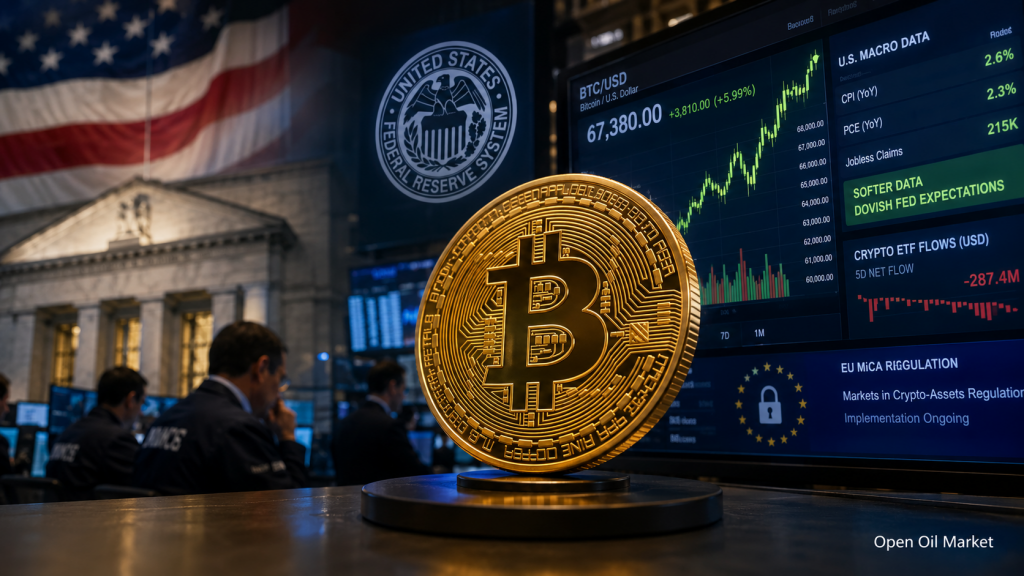
Cryptocurrency News for Saturday, July 4, 2026: Bitcoin Recovers Amid Fed Expectations, ETF Flows Show Instability, and MiCA Regulation Reshapes Global Crypto Landscape. A Review of the Top 10 Cryptocurrencies for Investors
Cryptocurrency news for Saturday, July 4, 2026, presents a mixed landscape for investors. On one hand, Bitcoin has regained ground, trading above $62,000 following weak macroeconomic data from the U.S., which has heightened expectations for a more accommodative Federal Reserve policy. On the other hand, institutional demand via spot cryptocurrency ETFs remains erratic, while the European MiCA regulation significantly increases requirements for exchanges, brokers, custodians, and stablecoin issuers.
This is a pivotal moment for the global cryptocurrency market: digital assets are moving beyond being merely speculative and are increasingly influenced by interest rates, capital flows, regulatory frameworks, ETF liquidity, the U.S. dollar, and the behavior of large institutional investors. Consequently, the cryptocurrency market on July 4, 2026, should not be viewed as a short-term rebound for Bitcoin, but rather as a test of the robustness of the entire digital asset infrastructure.
Key Topic of the Day: Bitcoin Seeks Recovery After a Weak First Half of the Year
Bitcoin remains the primary indicator of sentiment in the cryptocurrency market. Following a marked decline in the first half of 2026, the largest cryptocurrency found support in the macroeconomic backdrop: weak U.S. labor market data has intensified expectations that the Fed will not rush to tighten monetary policy. For risk assets, including Bitcoin, Ethereum, Solana, and other cryptocurrencies, this has temporarily improved the risk appetite among investors.
However, the recovery can’t yet be classified as a full trend reversal. Investors note that Bitcoin remains below the highs of 2025, and a significant portion of buyers who entered the market through ETFs at elevated levels are still in the zone of paper losses. This limits the strength of the rally and makes the market sensitive to any signs of renewed capital outflows.
- Key positive: expectations for a more accommodative Fed policy.
- Key risk: weak ETF flows and institutional investor fatigue.
- Key level of focus: Bitcoin's ability to hold above the $60,000 mark.
ETFs Remain the Primary Channel for Institutional Demand
Spot cryptocurrency ETFs have become a central element of the digital asset market. In 2024-2025, they provided capital inflows into Bitcoin and aided in legitimizing cryptocurrencies in the eyes of institutional investors. The situation evolved in 2026: ETF flows became more volatile, with June demonstrating even large funds couldn't shield the market from sell-offs.
For investors, this signifies that cryptocurrency analysis can no longer be confined to Bitcoin's chart. It is crucial to monitor:
- net inflows and outflows from spot Bitcoin ETFs;
- the dynamics of Ethereum ETFs;
- interest in new products based on Solana, XRP, and other altcoins;
- activity among major asset management firms;
- the correlation of cryptocurrencies with Nasdaq, USD, and bond yields.
If ETF flows stabilize, Bitcoin could receive support as a long-term digital asset. Conversely, if outflows continue, the cryptocurrency market will maintain heightened volatility even amidst moderately positive macroeconomic conditions.
Ethereum: Pressure Persists, but Infrastructure Role Strengthens
Ethereum remains the second most significant cryptocurrency and the primary blockchain for smart contracts, DeFi, asset tokenization, stablecoins, and Layer 2 ecosystems. However, in 2026, ETH is trading considerably weaker than many investors anticipated. The pressure stems from multiple fronts: reduced activity in DeFi, competition from Solana and other networks, caution among institutional investors, and weak flows in Ethereum ETFs.
Nonetheless, fundamentally, Ethereum remains a systemic asset in the crypto market. While Bitcoin is perceived as digital gold, Ethereum serves as the infrastructure platform for the digital economy. For investors, it is essential not just to consider ETH prices but also network metrics: transaction fees, staking volumes, developer activity, stablecoin issuance, and growth in tokenized real-world assets.
MiCA in Europe: Global Cryptocurrency Regulation Enters a New Phase
As of July 1, 2026, the transition period for the European MiCA regulation has concluded. This is one of the most significant events for the global cryptocurrency market this year. Now, cryptocurrency companies operating with clients in the EU must have the corresponding authorization or cease operating in the region.
For investors, this signifies a transition from a fragmented market to a more stringent and transparent model. In the short term, MiCA may lead to a reduction in the number of platforms, restrictions on certain products, and a redistribution of clients among licensed players. In the long term, regulating might bolster trust in cryptocurrencies, particularly from banks, funds, payment companies, and major fintech platforms.
Geographically, MiCA’s influence extends beyond Europe. Asia, the Middle East, the UK, and the US will likely consider European experiences when developing their own rules for cryptocurrencies, stablecoins, exchanges, and custodial services.
Stablecoins: A Liquidity Center and New Regulatory Zone
Stablecoins remain the foundational settlement infrastructure of the cryptocurrency market. USDT and USDC are used for trading, settlements, transfers, DeFi operations, and storing dollar liquidity outside the traditional banking system. This is precisely why regulators are placing increasing attention on stablecoins.
For global investors, stablecoins matter for three reasons:
- they indicate liquidity levels within the crypto market;
- they reflect demand for dollar-denominated digital instruments;
- they serve as a bridge between traditional finance and blockchain infrastructure.
Tighter requirements regarding reserves, disclosure, and licensure could make the stablecoin market more institutional, while simultaneously increasing pressure on less transparent issuers. For investors, this means that when analyzing cryptocurrencies, it’s crucial not only to look at Bitcoin and Ethereum but also at the quality of dollar liquidity within the system.
Top 10 Most Popular Cryptocurrencies for Investors
As of July 4, 2026, global investors remain focused on the largest and most liquid cryptocurrencies in terms of market capitalization, recognition, and role in digital asset infrastructure:
- Bitcoin (BTC) — the primary reserve asset of the cryptocurrency market and a key indicator of institutional demand.
- Ethereum (ETH) — the main platform for smart contracts, DeFi, tokenization, and Layer 2 networks.
- Tether (USDT) — the largest stablecoin and the principal tool for dollar liquidity on crypto exchanges.
- BNB (BNB) — the Binance ecosystem token and one of the largest infrastructure assets in the market.
- USD Coin (USDC) — a regulated dollar stablecoin that is significant for institutional and payment scenarios.
- XRP (XRP) — an asset tied to cross-border payments and interest in specialized ETF products.
- Solana (SOL) — a high-performance blockchain competing in DeFi, meme coins, NFTs, and payment applications.
- TRON (TRX) — a network with a high role in stablecoin transfers and global retail crypto liquidity.
- Dogecoin (DOGE) — the largest meme coin, sensitive to retail demand and market sentiment.
- Cardano (ADA) — a blockchain project focusing on scalability, research, and long-term ecosystem development.
This list does not imply equal investment potential across all assets. Bitcoin and Ethereum remain the core holdings for institutional portfolios, stablecoins fulfill liquidity roles, and Solana, XRP, BNB, TRON, Dogecoin, and Cardano carry more pronounced technological, regulatory, and market risks.
Altcoins: Investors Seek Growth but Avoid Excessive Risk
Altcoins at the beginning of July 2026 appear heterogeneous. Solana retains its status as one of Ethereum's main competitors due to its high network speed and developer activity. XRP remains in the spotlight due to ETF narratives and cross-border payment themes. BNB’s fate hinges on the state of global exchange infrastructure, while Dogecoin and other meme coins continue to represent the most speculative part of the cryptocurrency market.
For investors, it is important to distinguish altcoins into three categories:
- infrastructure assets: Ethereum, Solana, BNB, Cardano;
- payment and settlement assets: XRP, TRON, stablecoins;
- speculative assets: Dogecoin and other meme coins.
In a climate of weak ETF flows and stringent regulations, investors are becoming more selective. Liquidity, transparency, real use cases, and ecosystem robustness rise to prominence.
Macroeconomics: Cryptocurrencies Again Depend on the Fed, Dollar, and Risk Appetite
The cryptocurrency market is becoming increasingly integrated into the global financial system. Bitcoin no longer moves in isolation: its dynamics are linked to expectations around Fed rates, U.S. Treasury bond yields, the dollar index, the stock market, and flows into the technology sector.
Should investors anticipate rate cuts or a more accommodative stance from central banks, demand for risk assets may recover. Conversely, if the dollar strengthens, yields rise, and liquidity drains into the money market, cryptocurrencies will again face pressure. Therefore, cryptocurrency news on July 4, 2026, should be read alongside the macroeconomic agenda of the U.S., Europe, and Asia.
What to Watch for Investors on July 4, 2026
The cryptocurrency market remains in a phase of reassessment. The short-term rebound in Bitcoin has buoyed sentiment but has not eliminated the principal risks: weak ETF flows, pressure on Ethereum, regulatory restructuring in Europe, and caution among institutional investors.
Investors should monitor several indicators:
- whether Bitcoin can hold above the $60,000 range;
- whether net inflows will return to spot Bitcoin ETFs;
- whether sustained demand for Ethereum ETFs will emerge;
- how EU platforms adapt to MiCA;
- which stablecoins will maintain dominance after regulatory tightening;
- whether capital will shift from Bitcoin to Solana, XRP, and other altcoins;
- how expectations regarding Fed rates change following new macro data.
The overarching conclusion for global investors is that cryptocurrencies remain a promising yet high-risk asset class. In July 2026, the digital asset market will hinge not only on technology and blockchain industry news but also on regulation, ETF liquidity, central bank policies, and the ability of major cryptocurrencies to demonstrate their investment resilience.