Global Cryptocurrency Market as of July 6, 2026: Bitcoin, Ethereum, Solana, XRP, USDT, USDC, and ETFs
The cryptocurrency market enters a new week cautiously recovering from a volatile first half of the year. For global investors, Monday, July 6, 2026, marks a significant point of reevaluation: Bitcoin attempts to stabilize above psychologically significant levels, Ethereum remains under pressure from institutional flows, and the altcoin market seeks its own drivers in Solana, XRP, BNB, TRON, Dogecoin, and Cardano.
The main topic of the day is not just price dynamics, but also the quality of demand. In 2026, cryptocurrencies are increasingly perceived not as isolated speculative assets, but as being increasingly influenced by liquidity, Federal Reserve policy, ETF flows, stablecoin regulation, institutional demand, and the global stance of regulators towards digital assets.
Overall Picture of the Cryptocurrency Market: Recovery Without Euphoria
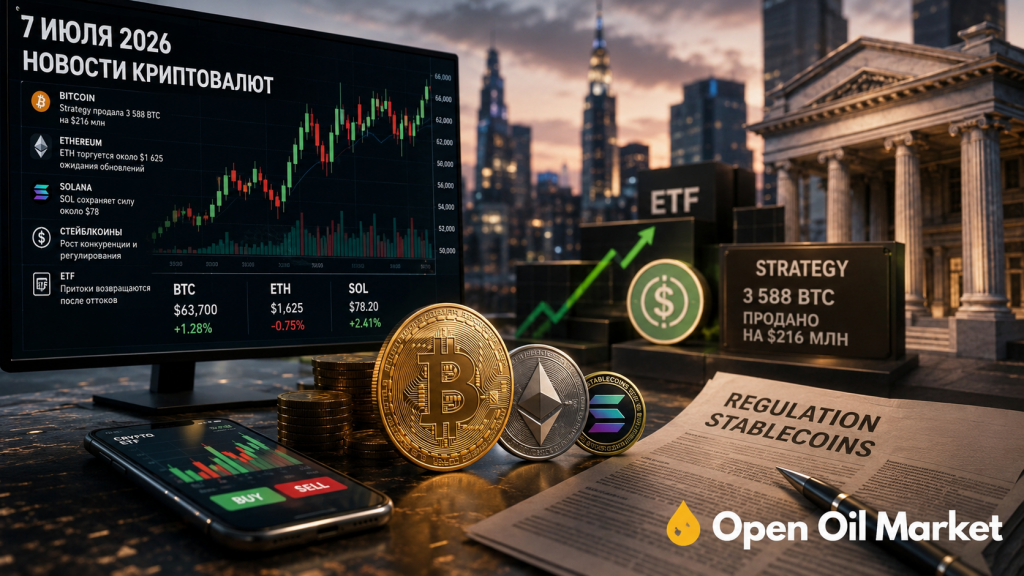
At the start of the week, the cryptocurrency market appears more resilient than it did at the end of June; however, it is premature to speak of a full reversal just yet. Bitcoin is trading around $62,000-$63,000, Ethereum is hovering around $1,600, Solana is holding near $78, and XRP is at approximately $1.06. These levels indicate a partial recovery in demand, but do not negate the main fact: investors remain selective.
Unlike previous cycles, where Bitcoin's rise automatically triggered a massive rally across the market, capital is being distributed more cautiously today. Investors are categorizing cryptocurrencies into several groups:
- reserve digital assets — Bitcoin and Ethereum;
- infrastructure blockchains — Solana, BNB Chain, TRON, Cardano;
- payment and settlement tokens — XRP, USDT, USDC;
- high-risk speculative assets — Dogecoin and other meme tokens.
For investors, this means that the "buy the market" strategy is becoming less effective. Analysis of liquidity, regulatory risks, and actual utilization of blockchain infrastructure is coming to the forefront.
Bitcoin: The Key Asset of the Market Under the Influence of ETFs and Macroeconomics
Bitcoin retains its status as the key indicator of the cryptocurrency market. Despite recovering in early July, the asset remains below the highs of the previous cycle. The pressure on BTC stems from several factors: outflows from spot Bitcoin ETFs, increased competition from the AI sector stocks, the strengthening role of stablecoins, and a decreasing appetite for high-risk assets.
Institutional investors are closely monitoring flows into Bitcoin ETFs. If inflows resume sustainably, this could support the market. Conversely, if ETFs continue to record outflows, Bitcoin risks remaining in a broad sideways range. For the market, not only the price direction is crucial, but also the buyer structure: long-term funds, retail investors, corporate treasuries, or short-term traders.
Key factors for Bitcoin as of July 6, 2026:
- dynamics of spot Bitcoin ETFs in the US;
- expectations regarding Federal Reserve rates and dollar liquidity;
- behavior of major BTC holders;
- corporate investor demand;
- interest ratio between Bitcoin and tech sector stocks.
Ethereum: The Market Awaits a New Catalyst
Ethereum remains the second most significant cryptocurrency and a fundamental infrastructure for DeFi, asset tokenization, stablecoins, and smart contracts. However, in 2026, ETH has encountered a weak investment impulse. Spot Ethereum ETFs have not become the powerful driver that many market participants had anticipated, and competition from faster and cheaper networks has intensified.
For Ethereum, it is critically important to demonstrate to investors that the network remains not just a technological platform but an economically significant infrastructure. The market will assess transaction fees, developer activity, DeFi volumes, ETF inflows, and Ethereum's ability to maintain its share in the tokenized asset segment.
While Ethereum maintains institutional legitimacy, it needs a new driver: an increase in DeFi activity, a heightened focus on real asset tokenization, capital inflows into ETFs, or improvements in the network's economic model.
Stablecoins: USDT and USDC Become the Center of Global Cryptocurrency Infrastructure
One of the main themes in the cryptocurrency market is the rising significance of stablecoins. Tether (USDT) and USD Coin (USDC) have long ceased to be mere trading tools on exchanges. They are becoming integral to the global settlement infrastructure, especially in countries with high inflation, currency restrictions, and limited access to the dollar banking system.
Regulation of stablecoins is coming to the forefront. The UK has eased some requirements for issuers, reducing capital standards for certain categories of stablecoins. This indicates that global financial centers are striving to balance risk control with competitiveness in digital finance.
For investors, this is an important signal. Stablecoins are transitioning from the periphery of the market to its foundation. Their role will grow in three directions:
- international settlements and cross-border payments;
- liquidity for crypto exchanges and DeFi protocols;
- tokenization of treasury bonds, funds, and other real assets.
Top 10 Popular Cryptocurrencies: What Matters to the Investor
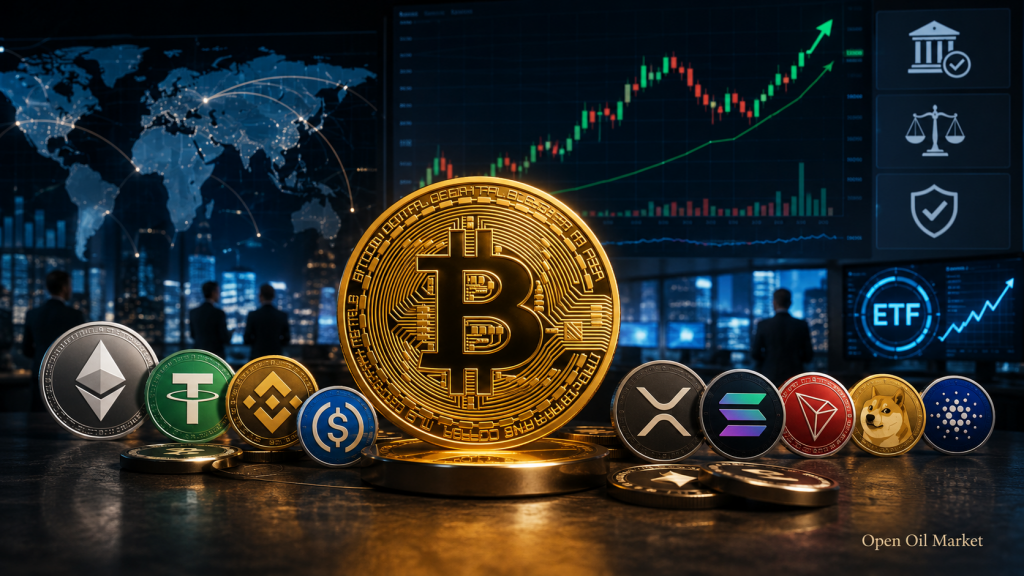
As of early July 2026, the global market remains centered around ten key cryptocurrencies: Bitcoin, Ethereum, Tether, BNB, USD Coin, XRP, Solana, TRON, Dogecoin, and Cardano. Their roles vary, so it is important for investors to assess not only the market capitalization but also the function of each asset.
- Bitcoin (BTC) — digital reserve asset and primary indicator of market risk.
- Ethereum (ETH) — foundational network for smart contracts, DeFi, and tokenization.
- Tether (USDT) — largest dollar stablecoin and a key source of liquidity.
- BNB (BNB) — token of the Binance ecosystem and BNB Chain.
- USD Coin (USDC) — regulated dollar stablecoin with institutional positioning.
- XRP (XRP) — asset for payment infrastructure and cross-border settlements.
- Solana (SOL) — high-performance network for DeFi, NFTs, meme tokens, and consumer applications.
- TRON (TRX) — network with a strong role in stablecoin turnover and international transfers.
- Dogecoin (DOGE) — meme asset highly influenced by market sentiment.
- Cardano (ADA) — blockchain platform focused on an academic approach and long-term development.
This structure highlights the market's maturity: Bitcoin and Ethereum account for the institutional segment, USDT and USDC provide settlement liquidity, Solana and TRON drive transactional activity, while XRP, BNB, DOGE, and ADA represent various demand segments.
Altcoins at the beginning of July appear heterogeneous. Solana remains one of the primary infrastructure competitors to Ethereum due to its speed, low fees, and high activity in user applications. XRP benefits from interest in payment solutions and ETF themes. BNB is contingent on the state of the Binance ecosystem and regulatory pressure on leading crypto platforms.
Dogecoin and other meme tokens remain the most speculative part of the market. Their dynamics can be sharp, but fundamental resilience is weaker than that of infrastructure networks. Cardano, in contrast, is perceived as a long-term project; however, the market needs confirmations of increased real-world utilization of its network.
Investors should categorize altcoins into three groups:
- infrastructure assets — Solana, BNB, Cardano;
- payment assets — XRP, TRON;
- speculative assets — Dogecoin and the meme segment.
Regulation: The US, UK, Europe, and India Formulate Different Models
The regulatory landscape of cryptocurrencies is becoming increasingly fragmented. The US is attempting to establish rules for ETFs, exchanges, stablecoins, and tokenized assets. The UK is moving towards comprehensive regulation of crypto companies by 2027 while easing some requirements to maintain London's competitiveness. Europe continues to develop its MiCA approach, prioritizing investor protection and issuer transparency.
India, on the other hand, maintains a strict stance. The Reserve Bank of India views cryptocurrencies as a potential risk to financial stability, the banking sector, and payment control. For the global market, this implies that there will be no unified regulations for digital assets in the near future.
For investors, the simple takeaway is that regulatory risk is becoming as significant as technological and market risk. The same asset may be perceived differently in the US, Europe, the UK, India, the UAE, Singapore, and Hong Kong.
Macroeconomics: The Cryptocurrency Market Depends on Rates, the Dollar, and Risk Appetite
Cryptocurrencies are increasingly integrated into the global capital market. When rate expectations become softer, Bitcoin and altcoins receive support. When the dollar strengthens, yields rise, and investors gravitate towards safe assets, the cryptocurrency market faces liquidity outflows.
In 2026, cryptocurrencies are competing not only against each other but also with AI company stocks, tech IPOs, bonds, and money funds. This changes investor behavior. Bitcoin no longer exists separately from the Nasdaq, ETF flows, and macroeconomic data.
Over the coming days, investors should closely monitor the following indicators:
- data on inflation and the US labor market;
- dynamics of the dollar index;
- yields on US treasury bonds;
- inflows and outflows from Bitcoin and Ethereum ETFs;
- trading volumes on stablecoins.
What Investors Should Focus on as of July 6, 2026
Monday, July 6, 2026, could be an important day for assessing the sustainability of the cryptocurrency market's recovery. If Bitcoin holds above the current range and ETF flows begin to stabilize, the market could have an opportunity for continued rebound. Conversely, if institutional demand remains weak, any growth may quickly transition into consolidation.
Key focal points for investors:
- Bitcoin — maintaining the $62,000-$63,000 zone and responding to ETF flows.
- Ethereum — demand from ETFs, DeFi, and asset tokenization.
- USDT and USDC — stablecoin turnover dynamics as a market liquidity indicator.
- Solana and XRP — pinpoint ideas in the altcoin segment and ETF themes.
- Regulation — new signals from the US, UK, EU, and India.
- Macroeconomics — the dollar, Federal Reserve rates, and global risk appetite.
The cryptocurrency market remains promising but is becoming more mature and demanding in terms of analysis. For global investors, the primary task now is not to attempt to predict short-term peaks or troughs but to assess the quality of liquidity, the resilience of infrastructure, and regulatory constraints. In 2026, not only the most volatile assets will thrive but also those cryptocurrencies that can demonstrate their role within the global financial system.