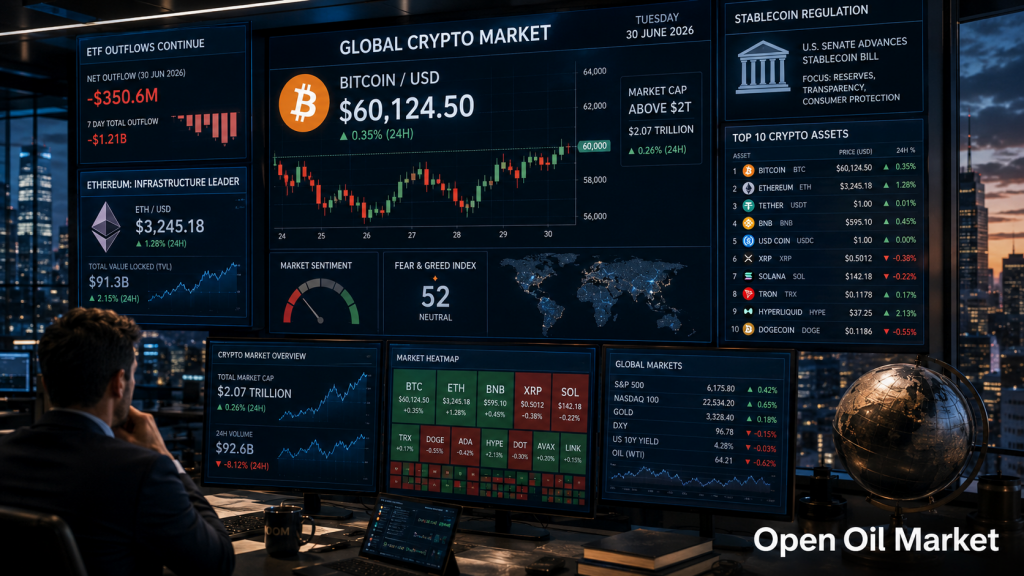
Cryptocurrency News for Monday, June 29, 2026: Bitcoin Holds Around $60,000 as Investors Monitor ETF Flows, Stablecoin Regulation, and the Dynamics of the Top-10 Cryptocurrencies
The cryptocurrency market enters Monday, June 29, 2026, in a phase of cautious recovery following a prolonged decline in the first half of the year. For investors worldwide, the pressing question now is not whether a new short-term momentum will emerge but whether the crypto market can regain the trust of institutional capital after outflows from ETFs, sluggish Bitcoin dynamics, and intensifying regulatory competition among the U.S., U.K., and European Union.
The main topic of the day is Bitcoin's retention near the psychologically significant zone of $60,000. As the largest cryptocurrency, Bitcoin remains the focal point, serving as a barometer for investors assessing the overall appetite for digital assets, risk-taking strategies, liquidity in the altcoin market, and the prospects for cryptocurrency ETFs. Ethereum, Solana, XRP, BNB, TRON, Dogecoin, and Cardano are navigating a more complex environment: capital has become more selective, and interest in high-risk tokens significantly lags behind the demand for liquid and regulated instruments.
The Big Picture: The Crypto Market Seeks Balance Between Correction and Institutional Demand
Cryptocurrency news on June 29 revolves around three factors: Bitcoin dynamics, ETF inflows, and stablecoin regulation. Following substantial declines in 2026, the digital asset market has become more sensitive to macroeconomic influences, central bank rates, dollar liquidity, and the behavior of large funds.
For global investors, this signifies a shift from a speculative model to a more mature market structure. While previous cycles saw cryptocurrencies primarily driven by expectations of technological breakthroughs and retail demand, the current dynamics are dictated by:
- Institutional flows into Bitcoin and Ethereum ETFs;
- Regulatory decisions regarding stablecoins and exchanges;
- The cost of capital and interest rate expectations;
- The resilience of major blockchain ecosystems;
- The liquidity conditions in the altcoin market.
The crypto market remains highly volatile, but its behavior increasingly resembles that of a market for speculative technology assets. Bitcoin, Ethereum, and Solana respond not only to internal industry events but also to capital movements among equities, commodity assets, bonds, and alternative investments.
Bitcoin: Holding Around $60,000 Becomes a Test of Trust
Bitcoin remains the primary indicator of the cryptocurrency market. At the time of this report, BTC was trading around $59,500 to $60,000, underscoring the importance of the current support zone. For investors, this is not merely a price level but a boundary between a stabilization scenario and the risk of a deeper reassessment of crypto assets.
In 2026, Bitcoin has faced pressure from multiple factors. Firstly, following strong growth in the previous period, some investors have taken profits. Secondly, the market has been impacted by outflows from Bitcoin ETFs. Thirdly, some capital has flowed into stronger investment themes—AI, semiconductors, commodity assets, and high-quality stocks.
For professional investors, three signals are currently crucial:
- Can Bitcoin establish a foothold above the $60,000 zone?
- Will stable inflows return to spot Bitcoin ETFs?
- Will pressure from miners and large corporate holders lessen?
If Bitcoin maintains its current range, the market could establish a foundation for technical recovery. However, if pressure from ETFs and macroeconomic factors intensifies, investors may consider more conservative scenarios and reduce exposure to risky altcoins in their portfolios.
Ethereum: Weak Dynamics, Yet Strategic Role Remains
Ethereum continues to be the second most significant cryptocurrency and serves as a key infrastructure for DeFi, asset tokenization, NFTs, stablecoins, and smart contracts. However, in the short term, ETH appears weaker than Bitcoin: the price of Ethereum holds around $1,570, and institutional interest in Ethereum ETFs remains less stable.
The primary issue for Ethereum is the disparity between the fundamental role of the network and the current market dynamics surrounding the token. The ecosystem continues to be utilized for the issuance of stablecoins, operation of DeFi protocols, and corporate blockchain solutions. Still, investors increasingly compare ETH with alternative networks that offer lower fees and faster growing user activity.
For investors, Ethereum remains an asset of dual nature:
- On one hand, it is an infrastructural bet on Web3, tokenization, and decentralized finance;
- On the other hand, it is a volatile asset dependent on ETF flows, Layer-1 competition, and overall risk appetite.
As of June 29, Ethereum remains in focus for long-term investors. However, for strong growth to resume, the market requires new drivers: increased network activity, a return of inflows to funds, and heightened demand for blockchain infrastructure from businesses.
Stablecoins: USDT and USDC at the Center of Regulatory Battles
Stablecoins have become one of the most important topics for the cryptocurrency market as of late June 2026. Tether USDT and USD Coin USDC rank among the top 10 largest cryptocurrencies and effectively serve as the settlement infrastructure for the entire digital asset market. A significant portion of liquidity on exchanges, within DeFi, and for cross-border payments flows through stablecoins.
Regulators are intensifying attention on this segment. In the U.S., the ongoing debate revolves around rules for stablecoins and cryptocurrency firms. The banking sector is concerned that digital dollars with programmable infrastructure could siphon deposits away from traditional banks. In the U.K., the Bank of England softened some regulatory approaches towards stablecoins but maintains a cautious model with limits and reserve requirements. The European Union has implemented MiCA—a comprehensive regulatory framework for crypto assets that intensifies demands on issuers, exchanges, and crypto service providers.
For investors, this constitutes an important structural signal. Stablecoins have ceased to be merely a supportive tool for crypto exchanges; they are becoming part of the global payment infrastructure, indicating increasing competition among banks, fintech companies, crypto exchanges, and governmental regulators.
Top 10 Most Popular Cryptocurrencies: Market Structure as of June 29, 2026
The most popular cryptocurrencies by market capitalization and investor attention continue to center around Bitcoin, Ethereum, major stablecoins, and liquid altcoins. The top 10 cryptocurrencies are as follows:
- Bitcoin (BTC) – the leading digital asset and primary indicator of cryptocurrency market health.
- Ethereum (ETH) – the largest smart contract platform and foundation for DeFi.
- Tether (USDT) – the largest dollar stablecoin and key liquidity instrument.
- BNB (BNB) – the ecosystem token for Binance and one of the largest exchange assets.
- USD Coin (USDC) – a regulated dollar stablecoin, vital for the institutional market.
- XRP (XRP) – a cryptocurrency associated with cross-border payments and payment infrastructure.
- Solana (SOL) – a high-performance blockchain network popular among developers and retail users.
- TRON (TRX) – a network with significant activity in the stablecoin transfer segment.
- Dogecoin (DOGE) – the largest meme cryptocurrency with high recognition among retail audiences.
- Cardano (ADA) – a blockchain platform focused on an academic approach and long-term development.
It is important to understand that the "popularity" of a cryptocurrency does not equal investment attractiveness. USDT and USDC are stablecoins primarily used as settlement tools and liquidity storage rather than growth assets. Dogecoin remains a highly speculative instrument. Bitcoin and Ethereum retain their status as foundational crypto assets for institutional portfolios, while Solana, XRP, BNB, TRON, and Cardano require more thorough risk assessments.
ETFs and Institutional Flows: The Primary Indicator of Market Trust
Spot Bitcoin ETFs and Ethereum ETFs remain one of the main channels for institutional capital entering cryptocurrencies. However, in June, the market faced notable outflows, putting additional pressure on Bitcoin and reducing interest in altcoins. For investors, ETFs have become not only a tool for accessing cryptocurrencies but also a gauge of market confidence.
When funds experience inflows, the crypto market receives confirmation of demand from asset managers, pension funds, family offices, and private banks. Conversely, when outflows occur, liquidity decreases, volatility rises, and sentiment in the altcoin market worsens.
In the coming days, investors should monitor the following indicators:
- Daily inflows and outflows in Bitcoin ETFs;
- The dynamics of Ethereum ETFs;
- The behavior of major funds, including BlackRock and Fidelity's products;
- Trading volumes on cryptocurrency exchanges;
- Changes in the share of stablecoins in market liquidity.
ETF flows could signal the transition of cryptocurrencies from a phase of pressure to a phase of recovery.
Altcoins: Solana, XRP, BNB, TRON, Dogecoin, and Cardano Under Selection Pressure
Altcoins enter Monday in a heterogeneous state. Solana holds around $71 and remains one of the most discussed networks due to its high transaction speed, active retail audience, and developer interest. XRP trades around $1.04, maintaining its investment narrative surrounding payment infrastructure and legal clarity. BNB’s fate is tied to the state of the Binance ecosystem, while TRON remains a significant network for stablecoin transfers.
Dogecoin and Cardano occupy a special position. Dogecoin still reflects retail speculative demand but remains a high-risk asset for institutional investors. Cardano maintains a long-term community; however, the market needs more notable signs of increased network usage.
The key takeaway for investors is that in 2026, altcoins can no longer be viewed as a homogeneous asset class. The market has become selective. Projects with liquidity, real users, clear token economics, and regulatory resilience are winning.
Regulation: The U.S., U.K., and E.U. Shape a New Crypto Market Architecture
The regulatory agenda has emerged as a primary long-term factor for cryptocurrencies. The U.S. is discussing rules for stablecoins and the market structure of digital assets. The U.K. is striving to find a balance between innovation and financial stability. The European Union, through MiCA, is already establishing unified rules for crypto companies, token issuers, and service providers.
For the global market, this indicates a gradual division of the crypto industry into two segments:
- regulated platforms operating with banks, funds, and institutional clients;
- unregulated or lightly regulated projects facing capital access limitations.
Investors need to evaluate not only the technology of a project but also its ability to operate in a regulated environment. Exchanges, stablecoins, DeFi protocols, and infrastructure companies will face more stringent compliance requirements. While this may dampen speculative activity, it could enhance the long-term resilience of the industry.
What Matters for Investors on June 29, 2026
The cryptocurrency market remains in a transitional phase. Bitcoin is holding around a key level, Ethereum is seeking fundamental momentum, stablecoins are becoming the object of global regulatory competition, and altcoins are undergoing stringent selection based on liquidity and real usage.
For investors on Monday, June 29, 2026, the key benchmarks are as follows:
- Bitcoin: Holding the zone around $60,000 and market reaction to ETF flows.
- Ethereum: Demand for ETH ETFs and activity in the DeFi sector.
- Stablecoins: Regulation of USDT, USDC, and competition among the U.S., E.U., and U.K.
- Solana and XRP: Their ability to maintain liquidity in a weak market.
- BNB, TRON, Dogecoin, and Cardano: The resilience of their ecosystems and interest from retail investors.
- Macroeconomics: Dollar liquidity, interest rates, and demand for risky assets.
The baseline scenario for the crypto market at the start of the week is cautious stabilization without signs of a full turnaround. For sustainable recovery, three conditions are needed: cessation of significant outflows from ETFs, Bitcoin securing levels above key thresholds, and a reduction in regulatory uncertainty surrounding stablecoins. Until these conditions are met, cryptocurrencies remain an opportunity market, but only for investors prepared to navigate high volatility, strict risk management, and a long-term perspective.