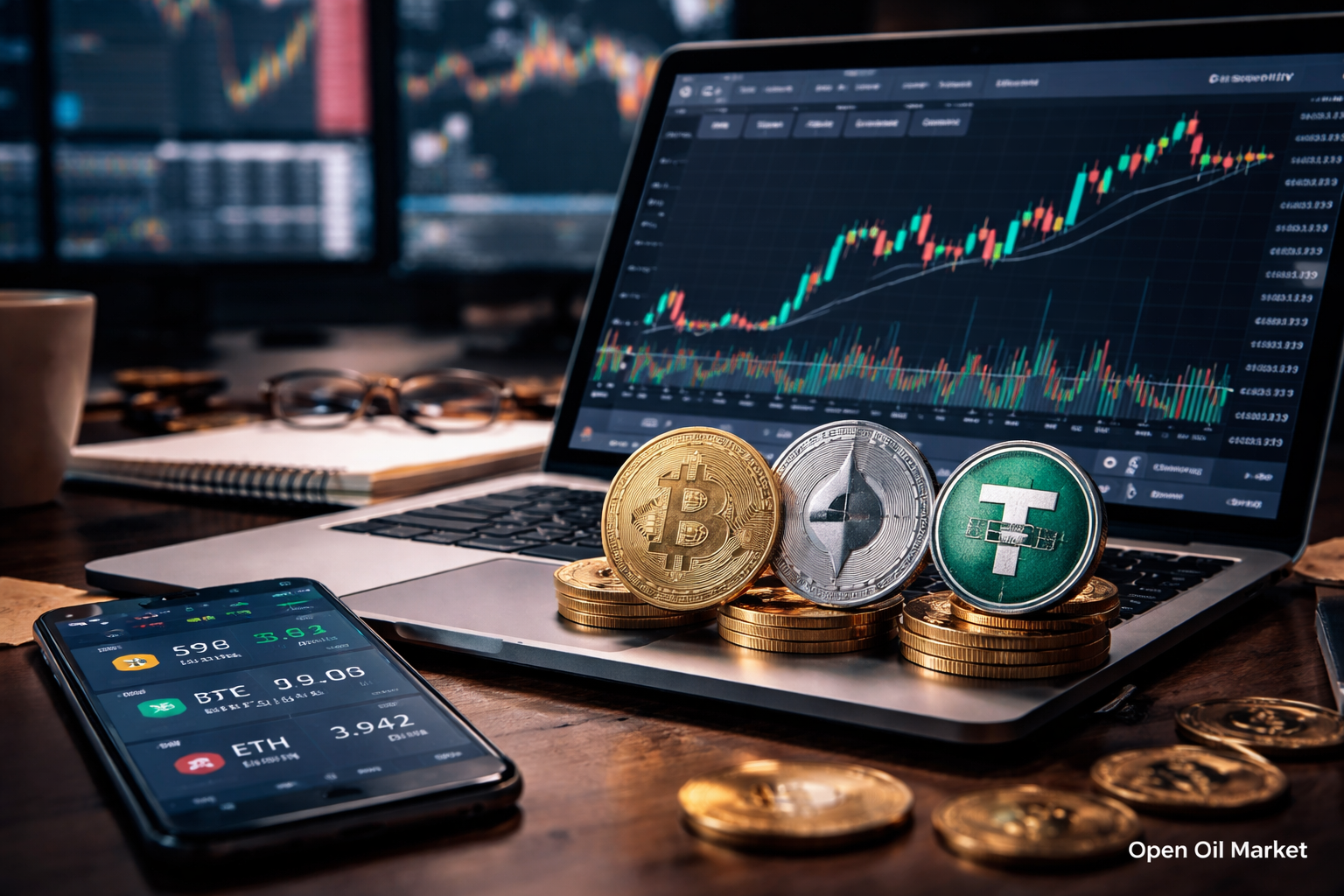
Current Cryptocurrency News as of March 1, 2026: The Impact of Geopolitics on the Cryptocurrency Market, ETF Dynamics, Digital Asset Regulation, DeFi Cybersecurity, and the Top 10 Most Popular Cryptocurrencies for Global Investors
The cryptocurrency market enters March in a state of "risk reassessment": a combination of geopolitical tension, a heterogeneous macroeconomic backdrop, and an increase in attention to infrastructure risks creates a nervous atmosphere for investors. On the demand side, there is noticeable activity in institutional interest through exchange products and derivatives, while regulatory frameworks continue to evolve, aligning rules among key jurisdictions. Below is a structured overview of what global digital asset market participants should focus on in the coming days and weeks.
Global Risk Appetite: Cryptocurrencies Trading Again as a "Risk Asset"
Market dynamics at the end of the week underscore an age-old pattern: during periods of sharp geopolitical events and spikes in uncertainty, cryptocurrencies often behave synchronously with high-risk segments—such as tech stocks, high-yield bonds, and certain commodity stories. Investors react by reducing leverage, tightening margin limits, and increasing demand for liquidity. In such conditions, short-term volatility rises, and intraday "liquidations" become frequent even without significant changes in fundamental factors.
- Key takeaway for investors: In the next sessions, it's more important to focus on "risk management" rather than "long-term ideas"—position sizing, margin, stop logic, and diversification between spot and hedging instruments.
- Practical guidance: Monitor correlation with global risk indicators (USD, yields, stock market volatility)—these often lead movements in digital assets.
Institutional Layer: ETF Flows and the "Quality" of Demand
It is critical for the digital asset market not only to note price direction but also the quality of demand. At the end of February, there was a marked increase in interest in Bitcoin exchange products—this is important for two reasons. First, ETF mechanics can create sustained daily demand for the underlying asset amid positive flows. Second, such demand is often less speculative than short-term futures positions, which can help mitigate downturns during local shocks.
However, amid a strained external backdrop, even positive flows do not guarantee a calm market: volatility may remain high, and price increases may be "choppy." To assess trend resilience, it is useful to distinguish between:
- Short-term flows (responses to news/macroeconomic events, rebalancing).
- Structural demand (long-term portfolios, strategic asset allocation).
- Speculative layer (futures, perpetuals, high leverage).
Regulation: 2026—From Discussions to Implementation
The global regulatory agenda remains one of the main drivers of cryptocurrency asset reassessment, especially for segments like stablecoins, exchange infrastructure, and custodial services. Europe is continuing to build a unified regime of oversight and requirements for market participants, while the UK and several Asian centers are intensifying their focus on licensing and operational risk control. In the US, discussions surrounding the delineation of powers and rules for stablecoins continue to influence expectations for the legalization of the business models of major players.
- What this means for the cryptocurrency market: The premium for "regulatory clarity" is increasing—projects and platforms with transparent structures, auditing, and compliance gain an advantage in access to capital.
- What this means for investors: The importance of choosing platforms, the quality of custody, and the legal structure of products is rising (especially when working with institutional mandates).
Cybersecurity and DeFi: Infrastructure Risks Back in the Spotlight
Events surrounding hacks and the halting of certain DeFi projects remind us that technological risk in cryptocurrencies is not an abstraction but a recurrent factor of loss. Even large ecosystems are vulnerable at the level of access keys, operational processes, counterparties, and integrations. In practice, this manifests as a "chain reaction": an incident involving one participant can quickly impact liquidity, trust limits, and risk assessments for the entire ecosystem (especially in networks with high application concentration).
For retail and institutional investors, a basic "risk hygiene" checklist includes:
- Diversifying storage: part on cold infrastructure, part on proven custodial solutions.
- Limiting exposure to smart contracts and protocols without a long track record and independent audits.
- Avoiding concentration in a single bridge, DEX, or liquidity provider.
- Assessing not only return but also the risk of capital loss due to vulnerabilities.
Derivatives and Market Structure: Moving Towards 24/7 Trading and Growing Role of Hedging
One of the structural trends remains the "institutionalization" of crypto derivatives: trading hours are expanding, the range of instruments is growing, and clearing and risk management are developing. For the market, this is a double-edged sword. On one hand, the availability of hedging instruments enhances the ecosystem's resilience and facilitates entry and exit for large participants. On the other hand, during moments of stress, derivatives can accelerate price movements through cascades of liquidations and rising financing costs.
In the coming weeks, investors should monitor:
- The level of leverage in perpetuals and futures;
- Changes in funding (overheating/oversold conditions);
- The balance of open interest and spot liquidity;
- The status of margin requirements on major platforms.
Altcoins: Where to Find Risk and What Drives the "Second Tier"
Amid an unstable macro backdrop, capital typically shifts towards more liquid assets; however, selective activity persists within altcoins. The primary thematic baskets at the beginning of 2026 are as follows:
- L1/L2 and scalability: Competition among ecosystems for developers and liquidity, efficiency in fees and UX.
- DeFi 2.0: Efforts to reduce smart contract risks and improve collateral management.
- Tokenization of Real-World Assets (RWA): Institutional interest in understandable structures and rights for claims.
- Data and Security Infrastructure: Demand for risk monitoring, proof of reserves, compliance analytics.
At the same time, "momentum" in altcoins remains sensitive to news about regulations and cybersecurity incidents: risk premiums can expand rapidly, and liquidity in certain pairs can vanish within hours.
Top 10 Most Popular Cryptocurrencies: A Guide for Global Investors
Below is a practical list of the "core" of the digital asset market, which supports the majority of global liquidity and derivatives. This list serves as a useful foundation for monitoring the cryptocurrency market, assessing market sentiment, and building a diversified asset display:
- Bitcoin (BTC) — the primary market benchmark and main institutional asset.
- Ethereum (ETH) — the infrastructural base for DeFi, tokenization, and applications.
- Tether (USDT) — the key stablecoin for trading liquidity.
- USD Coin (USDC) — stablecoin favored in institutional and compliance-oriented scenarios.
- BNB (BNB) — a large ecosystem and asset with high exchange involvement.
- Solana (SOL) — an ecosystem with high application activity and retail liquidity.
- XRP (XRP) — an asset sensitive to regulatory news and payment themes.
- Cardano (ADA) — an ecosystem focused on a research-based approach and smart contract development.
- Dogecoin (DOGE) — an indicator of retail risk and "meme sentiment."
- TRON (TRX) — significant infrastructure for transactions and stablecoin circulation in various regions.
Important: Popularity and market capitalization may change; therefore, for portfolio decisions, rely not only on the "top list" but also on liquidity, risk profile, storage infrastructure, and regulatory constraints in your jurisdiction.
What to Watch for Investors March 1-7: Risk and Opportunity Checklist
- Macro and Geopolitics: Any news affecting global risk appetite and funding costs.
- ETF Flows and Institutional Signals: Resilience of demand for Bitcoin through exchange products.
- Cryptocurrency Regulation: Initiatives regarding stablecoins, licensing of platforms, and custody requirements.
- Cybersecurity: News about exploits, halts in protocols, and issues with bridges and wallets.
- Derivatives: Rising leverage and the risk of cascading liquidations during sharp price movements.
Conclusion: Base Scenario as of Early March
The basic configuration of the cryptocurrency market as of March 1, 2026, appears as follows: heightened volatility amid external shocks, institutional support through exchange products, and a growing demand for "quality"—both in infrastructure and regulatory transparency. For the global investor, this means prioritizing risk management over attempts to "catch the bottom" and exercising discipline in choosing platforms, instruments, and levels of high-risk exposures. In the coming days, the market will be particularly sensitive to macro signals and security news—these will likely set the tone for the first week of March.