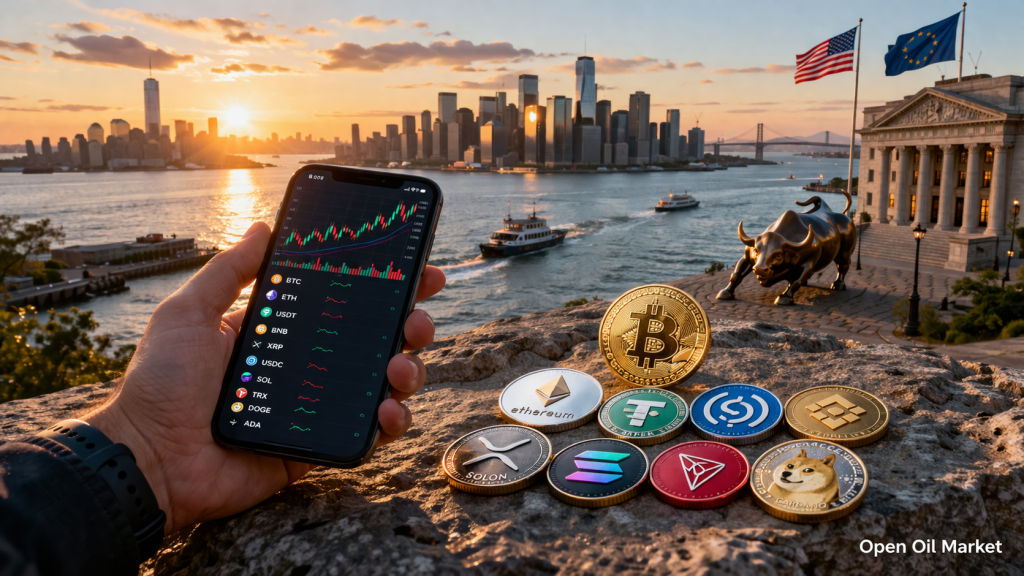
Current cryptocurrency news as of March 30, 2026: Analysis of Bitcoin, Ethereum, stablecoins, and the top 10 largest digital assets.
The key theme for Monday is not just price movements but rather the changing nature of demand. Previously, the cryptocurrency rally was supported by momentum and expectations of a rapid influx of capital; however, the market is now becoming much more selective. Investors are increasingly focusing not on the entire sector at once but on individual cryptocurrencies, infrastructural solutions, and projects with clear liquidity.
In such conditions, Bitcoin maintains its status as the fundamental benchmark for the cryptocurrency market, Ethereum remains the primary indicator of interest in blockchain infrastructure and the smart contract economy, while stablecoins are becoming a vital layer of the new digital financial system. For the market, this signals a shift from simple speculation to a more mature asset valuation model.
Bitcoin: The Primary Defensive Position within the Crypto Market
Bitcoin begins the week as the most resilient asset in the digital segment. Even during periods of increased volatility, Bitcoin continues to concentrate the primary interest of major market participants. This is due to several factors:
- High liquidity compared to most altcoins;
- Strong institutional perception as the fundamental digital asset;
- Ability to recover trust faster after sell-offs;
- Ongoing role of Bitcoin as the “core” of cryptocurrency portfolios.
For investors, this means that Bitcoin news remains a central part of the entire cryptocurrency agenda. When the market is nervous, capital often either shifts to stablecoins or returns specifically to Bitcoin. Therefore, the current dynamics of the first cryptocurrency are important not only in their own right but also as an indicator of the potential for broader movements within the entire market.
If at the start of the week Bitcoin maintains buyer interest and prevents negative external conditions from escalating into a significant sell-off, this could act as a stabilization signal for major altcoins. Conversely, if pressure persists, the market may revert to a defensive mode.
Ethereum: A Bet on Infrastructure, But No Room for Weakness
Ethereum remains the second most significant asset in the global crypto industry; however, the market is currently placing particularly stringent demands on it. Investors assess Ethereum not merely as an abstract technological idea but as a fully-fledged infrastructural platform that must prove its value through network activity, ecosystem development, demand for smart contracts, and long-term utility.
This week, Ethereum is important for several reasons:
- It is the primary infrastructural asset for DeFi, tokenization, and stablecoins.
- Its dynamics indicate whether the market is prepared to increase risk within the crypto sector.
- Weakness in Ethereum is typically perceived as a caution signal across the entire altcoin segment.
For global investors, this is especially crucial: if Bitcoin is an indicator of trust in cryptocurrencies as an asset class, then Ethereum serves as an indicator of trust in the blockchain economy as a technological platform. This is why news surrounding Ethereum, network development, and sentiments around the ecosystem will remain in focus at the start of the new week.
Top 10 Most Popular Cryptocurrencies: Where Market Attention is Concentrated
As of March 30, 2026, the core interest of investors remains centered around the largest assets by market capitalization and liquidity. The following cryptocurrencies are in focus for the global crypto market:
- Bitcoin (BTC) — the primary reserve asset of the crypto market and a key barometer of global risk demand.
- Ethereum (ETH) — the central platform for infrastructural crypto projects and smart contracts.
- Tether (USDT) — the largest stablecoin and a key liquidity parking instrument.
- BNB — a major exchange and ecosystem asset with sustained interest from traders.
- XRP — one of the most notable liquid assets for global cross-border settlements and speculative capital.
- USDC — one of the leading institutionally recognized stablecoins.
- Solana (SOL) — a leader among high-performance blockchains and assets with increased volatility.
- TRON (TRX) — a noticeable player in the remittances and stablecoin circulation segment.
- Dogecoin (DOGE) — an indicator of speculative interest and retail appetite for risk.
- Cardano (ADA) — a major infrastructural asset that investors continue to eye as a long-term bet on ecosystem development.
For investors, this group of assets forms the fundamental architecture of the cryptocurrency market. When capital returns to the sector, it typically flows through Bitcoin, Ethereum, and stablecoins before being redistributed into Solana, XRP, Dogecoin, Cardano, and other liquid coins.
Stablecoins: The Most Significant Hidden Narrative in the Crypto Market
One of the most significant themes of 2026 is the strengthening role of stablecoins. Whereas many investors previously regarded them solely as a technical tool for trading, stablecoins are now becoming a standalone strategic segment of digital finance. A significant portion of turnover, liquidity management, and cross-border settlements now pass through them.
For the market, this implies several important consequences:
- The increasing significance of USDT and USDC as the infrastructural foundation of crypto trading;
- Heightened regulatory interest in reserves, reporting, and the architecture of stablecoins;
- Expansion of use cases beyond speculative crypto trading;
- Strengthening ties between cryptocurrencies and the traditional financial system.
On Monday, this segment may remain one of the key areas for assessing future trends. When the market enters a phase of uncertainty, the volume of funds in stablecoins and their role in turnover become indicators of whether capital has exited the sector fully or merely adopted a wait-and-see position temporarily.
Altcoins: The Market Demands Proven Utility
The situation in altcoins at the start of the week appears more complex compared to Bitcoin. The market is becoming less tolerant of assets that cannot provide a clear economic rationale, stable liquidity, or a strong network effect. This is especially crucial for investors focused not on short-term noise but on the capital structure within the cryptocurrency market.
Currently, altcoins can be broadly categorized into three groups:
- Systematically Significant Assets — Solana, XRP, Cardano, TRON, and other large coins with widespread recognition and notable liquidity.
- Speculative Assets — coins whose movements are more heavily influenced by crowd sentiment than by fundamental factors.
- Infrastructure Niches — projects related to tokenization, payment infrastructure, DeFi, and specialized ecosystems.
For the cryptocurrency market, this indicates that broad growth across the sector indiscriminately is becoming less likely. A more probable scenario is that capital will return in a targeted manner — to liquid, recognizable, and functionally justified assets.
Macroeconomics and Geopolitics: Why Cryptocurrencies are Trading as Risk Assets Again
One of the most critical factors for the crypto market remains the external environment. Investor behavior in digital assets is increasingly dependent on general market sentiment. When nervousness in the stock market increases, energy prices rise, or interest rate expectations shift, cryptocurrencies also come under pressure.
As of March 30, 2026, the following external drivers are particularly important for cryptocurrencies:
- The dynamics of global risk appetite;
- The markets' reaction to geopolitical signals;
- The price of oil and its impact on inflation expectations;
- The trajectory of monetary policy from major central banks;
- The state of liquidity in global financial markets.
For investors, this indicates that cryptocurrency news this week should be assessed in close conjunction with global macroeconomic developments. The digital asset market is not isolated; on the contrary, it is increasingly embedded in the behavior of global capital.
What It Means for Investors at the Start of the Week
On Monday, March 30, 2026, participants in the market might draw several practical conclusions:
- Bitcoin remains the primary benchmark. As long as it maintains its status as a key asset within the crypto market, the likelihood of a complete capitulation across the sector remains limited.
- Ethereum and major altcoins require confirmation of strength. The market will closely observe where real demand emerges and where there is only inertia.
- Stablecoins are becoming a strategic theme. Their role extends far beyond simple capital “parking.”
- The market's selectivity is increasing. Investors are increasingly focused on differentiating liquid and systematically significant assets from peripheral stories.
- Macroeconomic factors cannot be ignored. Cryptocurrencies continue to respond to global financial and geopolitical signals.
Hence, global investors' focus this week will be not only on cryptocurrency prices but also on the quality of demand: who is buying, which segments capital is flowing into, and how sustainable this flow appears.
Conclusion: The Cryptocurrency Market Retains Potential but Requires Discipline
The cryptocurrency news as of Monday, March 30, 2026, paints an important picture for investors: the market has not lost its strategic significance but has become more demanding regarding the quality of narratives. Bitcoin maintains its leadership as the fundamental asset of the sector, Ethereum remains a key infrastructural indicator, and stablecoins are increasingly transforming into a separate strategic layer of digital finance.
For those tracking cryptocurrencies globally, the key takeaway of the day appears as follows: the market remains alive, liquid, and systematically important; however, the era of unconditional growth for all coins simultaneously is yielding to a phase of selection. In such an environment, not the loudest narratives prevail, but rather assets with strong liquidity, clear functionality, and sustained capital attention.
At the start of the new week, investors should closely monitor how Bitcoin, Ethereum, Solana, XRP, Dogecoin, Cardano, and the stablecoin segment perform. These will set the tone for the entire crypto market and indicate whether the sector is transitioning to a new wave of growth or remaining in a state of cautious consolidation.