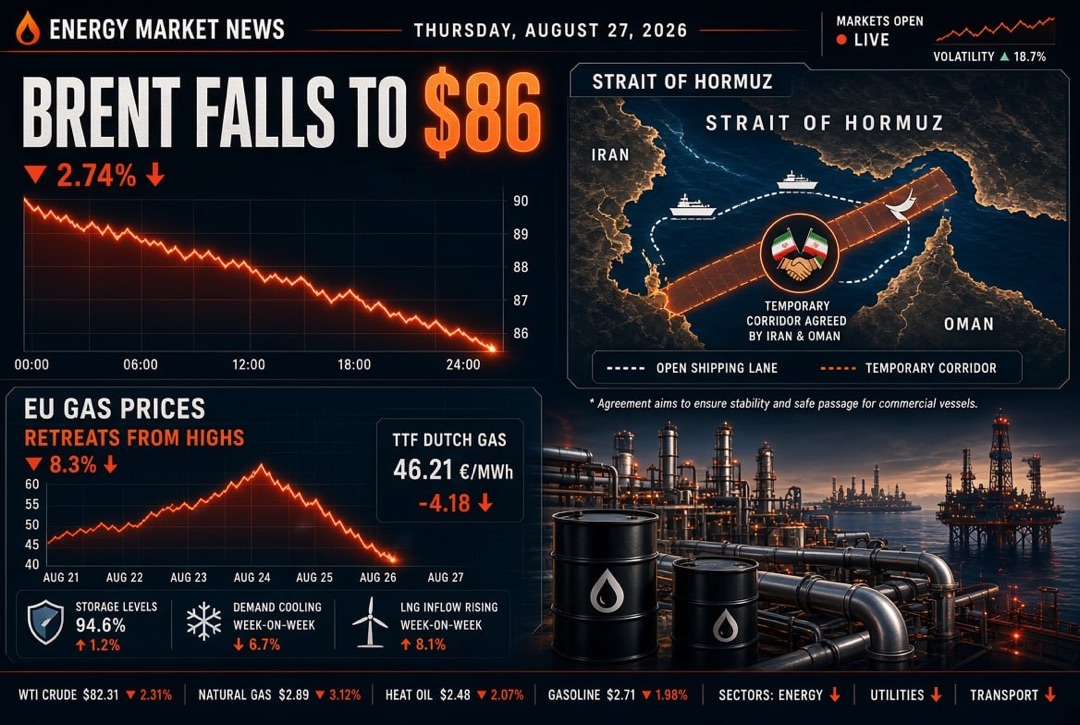
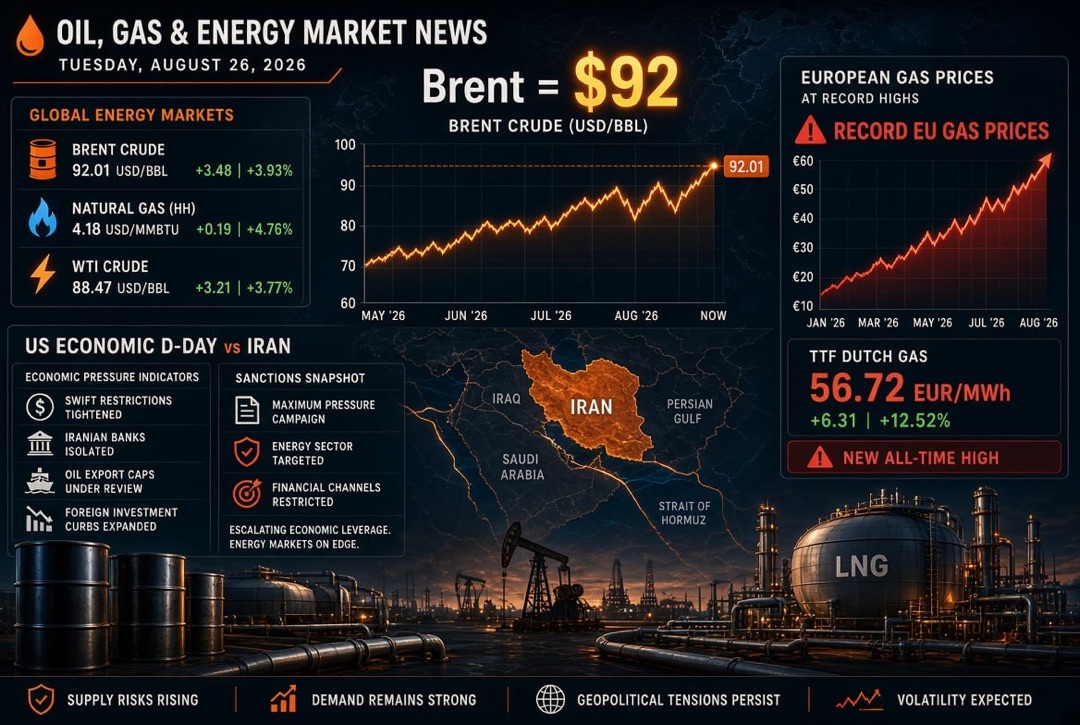
Oil Market: Brent Near $92, WTI Around $85 — A Pause After the Rally
Oil prices ended Monday down more than 2%: Brent closed near $92 per barrel, while WTI trades around $85. This marks the first significant correction after two weeks of growth, during which the market priced in stalled negotiations over the Strait of Hormuz and attacks on vessels in the Persian and Oman Gulfs. Relative to pre-war levels (around $71 for Brent in late February), the geopolitical risk premium remains at about 30%.
Key factors impacting price dynamics today:
- Sanctions factor: The market is awaiting specifics on new U.S. restrictions — tightening pressure on buyers of Iranian oil could reduce supply but simultaneously heightens the risk of escalation in the Strait.
- Physical flows: Transit through the Strait of Hormuz remains significantly below pre-war levels of approximately 110 vessels per day; tracking data shows daily passages ranging from one to several dozen, while hundreds of tankers wait offshore.
- EIA Forecast: The U.S. Energy Information Administration (EIA) anticipates an average Brent price of around $85 in Q3 and approximately $87 for the entirety of 2026; a return of Middle Eastern production to pre-war levels is not expected before early 2027, given a loss of around 0.6 million barrels per day until the end of next year.
- Inventories: An API report is due out on Tuesday evening, with EIA data following on Wednesday; commercial oil inventories in the U.S. remain below the five-year average, supporting the current market structure.
"Economic Outcast": U.S. Shifts Conflict with Iran to the Financial Realm
On August 24, U.S. Treasury Secretary Scott Bassett unveiled a campaign dubbed by the administration as "economic D-Day." Its goal is to "cut all economic lifelines" of the Iranian regime and achieve a resumption of shipping through the Strait of Hormuz without a new round of airstrikes. Key elements of the package include:
- Sector-specific sanctions targeting five areas deemed "vital" for Tehran: digital assets, technology, gold, aviation, and maritime transport.
- Over 60 legal and physical entities, as well as vessels, added to the OFAC lists — including a network of brokers and a "shadow fleet" operating through the UAE, Hong Kong, China, Singapore, and Switzerland for transporting Iranian oil.
- Expanded risk of secondary sanctions for any counterparties to Iran: countries will receive a specific time frame to unwind connections, after which unilateral measures will follow.
- A promise of a major sanction against an unnamed financial institution by the end of the week.
The most severe blow has been postponed for now: Bassett described the announcement as a "warning shot," while President Trump personally calls world leaders with "specific requests." According to experts, countries at risk include China, India, Turkey, Iraq, and the UAE. Tehran has responded with a promise of a "seismic" counter-response, and the Iranian finance minister has stated a full readiness for new restrictions. For the oil market, the critical issue is whether Washington will implement sanctions against Chinese banks: China remains the primary buyer of Iranian oil, although maritime blockades have already reduced its imports from Iran to about 340,000 barrels per day, down from 1.14 million in March.
Strait of Hormuz: Attack on Tanker and Negotiations via Oman
Early Tuesday morning, the British center UKMTO reported an attack on an oil tanker by an unidentified projectile approximately nine nautical miles off the coast of Oman: the engine room was damaged, the crew was unharmed, and environmental impacts are under evaluation. This incident confirms that despite U.S. claims of "complete control" over the Strait, shipping security has not been restored.
A diplomatic track remains in place. Iran and Oman continue discussions on managing maritime traffic, and indirect contacts between Tehran and Washington are happening through Pakistan. However, the positions of both sides are rigid: Iran insists on the lifting of the U.S. maritime blockade and recognition of its right to regulate (and charge for) vessel passage, while Washington demands freedom of navigation. A memorandum from June 17 already collapsed once in July, so the market assesses the likelihood of a quick breakthrough with caution.
OPEC+: Quotas Restored, Physical Production Not
September's quota increase of 188,000 barrels per day has ended the voluntary cuts of 2023, which totaled 1.65 million barrels per day. Seven countries of the alliance (Saudi Arabia, Russia, Iraq, Kuwait, Kazakhstan, Algeria, Oman; the UAE left OPEC in May) have indicated that quotas will likely remain unchanged until the end of the year. The next decision regarding October is expected on September 6.
A key nuance for investors: paper quotas and actual production have diverged. Due to the closure of the Strait, attacks on infrastructure, and forced shutdowns, actual OPEC+ production remains several million barrels per day below February levels. That is why analysts warn: once flows normalize, the alliance will have to manage not a deficit, but a potential surplus.
Gas and LNG: TTF Above €65/MWh Amid Delays in Injecting Gas into Storage
The European gas market remains the tightest segment of the energy sector. September futures at the TTF hub are trading near €65/MWh — a maximum since January 2023 and over 20% above levels two weeks ago. Reasons include:
- Shortage of Qatari LNG: shipments from the Persian Gulf through the Strait of Hormuz occur sporadically, and QatarEnergy is in no rush to return to a full schedule.
- Low inventories: EU gas storage was only 61.4% full as of August 17, compared to nearly 74% a year earlier; the target for November 1 has been lowered from 90% to 80%.
- Heat and Hydropower: abnormal temperatures have increased demand for gas for generation, while record-low hydropower production has intensified the load on gas plants.
- Competition with Asia: spot LNG prices (JKM) are around $21+/MMBtu; Japan, Korea, and Taiwan are partially hedging risks with coal.
Against this backdrop, the American Henry Hub remains below $3/MMBtu with record production in the U.S. at about 122.5 billion cubic feet per day — the spread between American and global gas continues to justify a wave of investments in export LNG terminals.
Electricity and Renewables: Record Solar Generation Saves Grids
The summer of 2026 has proven a stress test for Europe's energy systems. In June–July, hydropower generation in the EU fell to its lowest level in at least a decade, France reduced nuclear power output due to overheating rivers, and intra-day prices in France and Germany exceeded €300/MWh in the evening hours, reaching €700/MWh in Southeast Europe. However, the grid held up thanks to record solar generation: on peak hot days, solar output was 17% above normal levels. The main conclusion for regulators is that deficits occur during evening hours, prompting accelerated investments in storage solutions: the UK is subsidizing 7.6 GW of long-term battery projects, while Spain could triple storage capacity by year's end.
In the U.S., wind and solar energy in the first half of the year surpassed coal and nuclear combined for the first time, accounting for 20% of output; solar generation grew by 21%, hydropower by 9%, and wind by 6%. Demand from data centers remains a growth driver, although Texas has paused the approval of new sites.
Coal: Newcastle Around $130 per Ton as Asia Hedges LNG Risks
Newcastle energy coal has stabilized around $130/ton after averaging $144 in June. Pressure on prices stems from weakening demand in China due to a rainy summer and an increase in domestic production in India (+7.5% year-on-year in July, to 69.75 million tons). Support comes from energy security: Japan, South Korea, and Taiwan are ramping up coal purchases as a hedge against LNG supply disruptions. The consensus for Q3 is around $130/ton, with a gradual drop to $120 by 2027; coking coal remains near $240/ton amid restrictions in China.
Russia: Oil Exports to Asia at Records, Domestic Fuel Market in Manual Mode
Russian oil exports are being redirected to the East. In July, China purchased 50% of Russian crude oil, while India accounted for 37%; Indian refineries imported a record 2.8 million barrels per day — 55.5% of total country imports. The average price for Urals in July was around $60 per barrel — above the new G7 and EU cap of $44.10, effective since February. Chinese purchases of Russian maritime shipments rose by 28% in one month as refineries substitute lost Middle Eastern barrels.
The domestic oil products market is experiencing a second wave of crisis:
- The ban on gasoline exports has been extended until January 31, 2027, while restrictions on diesel fuel remain until September 1, with no decision made yet on an extension for producers;
- Deputy Prime Minister Alexander Novak reported that several refineries are returning to operation after repairs and confirmed that the federal headquarters convenes twice a week;
- The deficit is being covered by imports (Indian gasoline has entered the market) and production of fuel of environmental classifications K-2–K-4, which will not exceed 10%;
- In the south, including the Krasnodar region, oil companies are instituting fuel release limits during the peak resort season;
- A ban on the export of aromatic hydrocarbons — a raw material for high-octane components — is being discussed.
What to Watch on August 26: Calendar for Energy Market Participants
- Details on U.S. sanctions — the list of countries receiving deadlines and the announced decision regarding the financial institution.
- Investigation into the tanker attack off the coast of Oman and the response from insurers and vessel owners.
- Progress in negotiations between Iran and Oman on the maritime protocol in the Strait of Hormuz.
- Weekly API data on oil and oil product inventories in the U.S.
- Trends in injections into European gas storage and TTF quotations amid the remaining injection season.
- Preparation for the OPEC+ meeting on September 6: signals of a pause in quota increases.
In summary, the oil market is balancing between two scenarios — successful financial pressure leading to the opening of the strait and a drop in Brent to $80–85, and escalation that would push prices back to the triple digits seen in spring. The European gas market will enter the heating season with less buffer than a year ago, while the energy transition receives an additional boost from record solar generation and investments in storage. Daily analysis of the energy market can be found in the Telegram channel Open Oil Market.