Detailed Review of Economic Events and Corporate Reports for July 6, 2026: Industrial Inflation in the Eurozone, Business Activity in the US and Canada Services Sector, ISM Services PMI, ECB President Christine Lagarde's Speech, and Public Companies Earnings Calendar
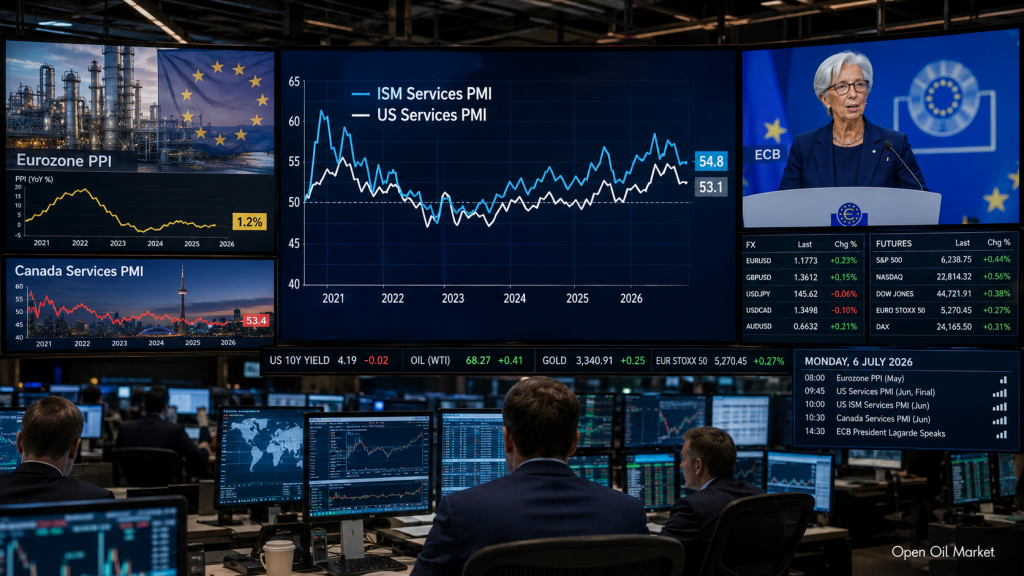
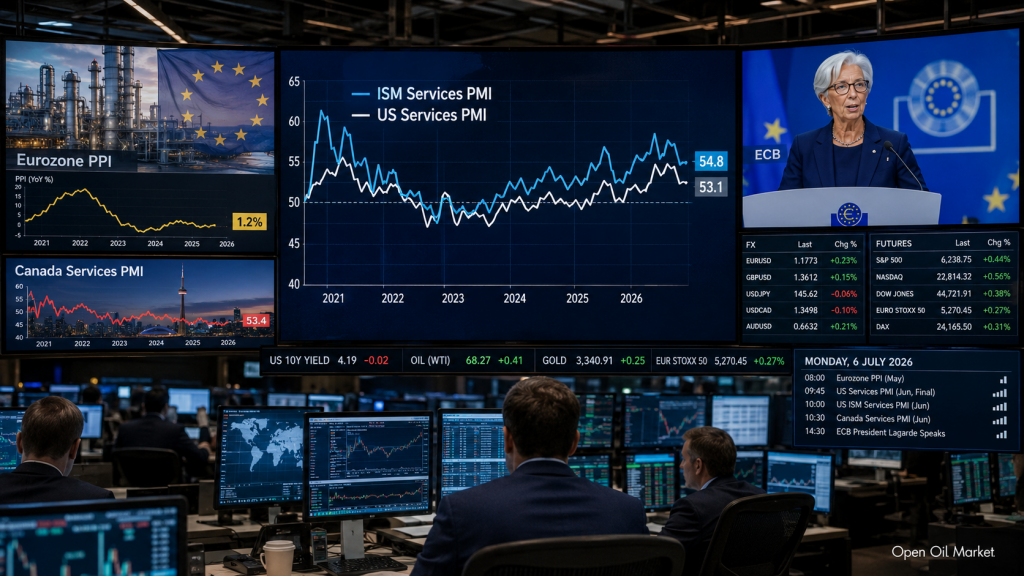
Monday, July 6, 2026, marks the beginning of a week where global markets will evaluate the resilience of business activity following a robust first half of the year and reassess expectations regarding interest rates in the US, Eurozone, and Canada. The day's key economic events are centered around the services sector: services remain a vital indicator of consumer demand, inflationary pressure, and employment dynamics.
For investors from the CIS region, this day is significant not only as a date on the economic calendar but also as the kickoff for a new week in global markets. Key focus areas include Eurozone PPI, Canada's Services PMI and Composite PMI, S&P Global Services PMI for the US, US ISM Services PMI, and the evening speech by ECB President Christine Lagarde. On the corporate side, the day is relatively quiet: major companies within the S&P 500, Euro Stoxx 50, Nikkei 225, and MOEX do not present a dense cluster of earnings reports, implying market momentum will primarily be influenced by macroeconomic factors, bond yields, currencies, and interest rate expectations.
Macroeconomic Calendar for Monday, July 6, 2026
Key economic events of the day (Moscow time):
- 12:00 Moscow time — Eurozone: Industrial inflation PPI.
- 16:30 Moscow time — Canada: Services PMI and Composite PMI for June.
- 16:30 Moscow time — US: S&P Global Services PMI and Composite PMI for June.
- 17:00 Moscow time — US: ISM Services PMI for June.
- 19:00 Moscow time — Eurozone: Speech by ECB President Christine Lagarde.
This array of data makes Monday a day for assessing global demand. If the PMI indices reveal an expansion in business activity above the 50-point threshold, it will bolster risk appetite, positively impacting cyclical sectors, banks, industrials, and consumer companies. Conversely, weak figures may amplify discussions about economic slowdown, declining corporate profits, and a more cautious stance from central banks.
Eurozone: PPI as an Indicator of Price Pressure and Company Margins
Industrial inflation PPI in the Eurozone serves as a crucial leading indicator for evaluating future consumer inflation, cost dynamics, and pressure on producer margins. For the Euro Stoxx 50, this metric is particularly significant in conjunction with the energy sector, industrial goods, chemicals, engineering, and consumer companies.
Investors need to observe not only the overall PPI figure but also its structure:
- Energy component — influences the oil and gas sector, utility companies, and producers with high energy cost shares;
- Intermediate goods — reflect pressure within supply chains;
- Durable goods — important for assessing demand for automobiles, technology, and equipment;
- Annual dynamics — indicates the resilience of the inflation backdrop in the Eurozone.
Should the PPI exceed expectations, the market may reassess the ECB's rate trajectory towards a more hawkish stance. This could potentially support the euro and yields on European bonds but place pressure on companies with high debt loads.
Canada: Services PMI and Composite PMI as Signals for Domestic Demand
Canada will release its Services PMI and Composite PMI for June at 16:30 Moscow time. For global investors, this data is significant for several reasons. First, the Canadian economy is sensitive to the commodity cycle, particularly oil, gas, metals, and exports. Secondly, business activity metrics provide insights into the resilience of domestic demand following a period of high interest rates. Thirdly, the Canadian dollar often responds to the link between "PMI — oil — Bank of Canada expectations."
A strong PMI in Canada may support the CAD, shares in the banking sector, energy companies, and consumer-related stocks. A weak PMI would indicate cooling demand, risks for employment, and potential declines in corporate revenue growth.
US: S&P Global Services PMI and Composite PMI
At 16:30 Moscow time, the US will publish its S&P Global Services PMI and Composite PMI for June. For the S&P 500 and Nasdaq indices, this data is essential as a preliminary indicator of the state of the largest segment of the American economy — the services sector. Unlike manufacturing indices, the services PMI better reflects consumer activity, demand for financial services, transport, IT, tourism, healthcare, and business services.
Key components for investors will be:
- New orders — a signal for future company revenues;
- Employment — an indicator of labor market resilience;
- Prices — a factor for assessing inflationary pressure and the Federal Reserve's policy.
If the PMI shows growth with moderate pricing components, it would signal positively for stocks: the economy maintains momentum, but inflation risks are not escalating. Conversely, if business activity rises alongside prices, the market may anticipate higher Treasury yields and increased pressure on growth stocks.
ISM Services PMI: The Day’s Key Indicator for the Dollar, Bonds, and Stocks
At 17:00 Moscow time, the ISM Services PMI for the US will be released — the central economic event of Monday. The ISM index traditionally has a stronger impact on markets than preliminary PMI estimates, as investors closely monitor its components: business activity, new orders, employment, prices, and deliveries.
For the global market, three scenarios may emerge:
- Strong ISM above expectations. Supports the dollar and cyclical stocks but poses risks of rising bond yields.
- Moderate ISM around expectations. The most comfortable scenario for markets: the economy is not overheating, but also not entering a sharp slowdown.
- Weak ISM below 50 points. Signals cooling in the services sector, potential pressure on banks, retail, transport, and small caps.
Investors should pay particular attention to the price component. Even with strong business activity, a decline in the price component could be perceived positively, as it reduces the risk of a hawkish stance from the Federal Reserve. In contrast, rising service prices could amplify volatility in the bond market and tech stocks.
Christine Lagarde's Speech: ECB Signals for the Euro and European Assets
At 19:00 Moscow time, ECB President Christine Lagarde is set to speak. For investors, this is a crucial political-monetary element of the day. Following the release of Eurozone PPI, the market will seek answers to three questions in Lagarde's comments:
- How concerned is the ECB about the persistence of inflation in services and industry;
- Is the regulator prepared to maintain a hawkish tone longer than the market anticipates;
- How does the ECB view the balance between weak economic growth in the Eurozone and price stability.
A hawkish tone from Lagarde could bolster the euro but simultaneously exert pressure on European stocks with high debt loads. Softer comments would be favorable for bonds and dividend stocks, although they might raise caution regarding the banking sector.
US Corporate Reports: A Day without Major S&P 500 Releases
The corporate earnings landscape for July 6, 2026, appears calm. Among major companies within the S&P 500, no significant reports are anticipated for Monday. This suggests that the American market will react more to macroeconomic data, yield dynamics, the dollar, and sector rotation than to isolated corporate results.
Among the public companies featured in the earnings calendar for this day, noteworthy mentions include:
- Park Aerospace — a supplier of materials and solutions for the aerospace industry; important factors include orders, margins, and comments on defense and aviation demand;
- ASOS plc — a British online fashion retailer; investors will focus on sales, inventory levels, margin dynamics, and consumer demand;
- America’s Car-Mart — an American automotive dealership business; key topics include the availability of auto financing, delinquencies, demand for used cars, and financial results.
These reports may not drive the S&P 500 significantly but could provide granular signals regarding consumer sectors, credit quality, and automotive demand.
Europe, Asia, and Russia: Euro Stoxx 50, Nikkei 225, and MOEX
In Europe on July 6, the primary focus shifts from corporate earnings to macroeconomics and ECB rhetoric. For Euro Stoxx 50, PPI figures from the Eurozone, euro dynamics, German bond yields, and rate expectations will be more crucial. Banks, industrials, utility companies, and the consumer sector remain particularly sensitive.
In Asia, the calendar for major releases from Nikkei 225 on this day is not packed. Investors will evaluate the external backdrop: the dollar, US Treasury yields, yen dynamics, demand for technological exports, and the state of the global semiconductor cycle.
In the Russian market, MOEX's focus on this day is more related to dividend events than major earnings reports. Specific dividend dates, including for X5 and Gazprom Neft, as well as several second-tier companies, may be in the spotlight. This is important for CIS investors concerning dividend gaps, liquidity, tax calendars, and resource redistribution within the Russian equity market.
Market Impact: Stocks, Bonds, Currencies, and Commodities
Economic events on July 6 affect several asset classes. For the stock market, the main question is whether growth in business activity will persist without accelerating inflation. For bonds, the key risk is strong ISM data and resilient price components. For the currency market, the focus is on the dollar, euro, and Canadian dollar. For commodities, it signals indirectly through demand, business activity, and global economic expectations.
The most sensitive assets of the day include:
- S&P 500 and Nasdaq: reaction to ISM Services PMI and US bond yields;
- Euro Stoxx 50: Eurozone PPI and Lagarde's comments;
- USD/CAD: Canadian PMIs, oil, and Bank of Canada expectations;
- EUR/USD: Eurozone industrial inflation and ECB rhetoric;
- MOEX: dividend events, oil, the ruble, and external risk appetite.
Day's Summary: What Investors Should Focus On
Monday, July 6, 2026, is not overloaded with significant public company earnings but is rich in critical macroeconomic signals. For investors, this day requires looking beyond individual indicators to see the overall picture: services, inflation, rates, currencies, and corporate margins.
- ISM Services PMI for the US — the main indicator of the day for the S&P 500, dollar, and bonds.
- Price components of PMI — key to understanding inflationary pressure in the services sector.
- PPI in the Eurozone — an important signal for industry, the euro, and ECB policy.
- Lagarde's speech — a potential driver for EUR/USD, European bonds, and Euro Stoxx 50.
- Canada PMI — an indicator for CAD, commodity markets, and the banking sector.
- Corporate earnings — a calm backdrop: few significant releases in the S&P 500, so macro data will dominate.
- MOEX — focus on dividend dates and potential gaps in individual stocks.
The fundamental takeaway for investors is that July 6 represents a day for assessing the resilience of the global services sector. Should the data confirm moderate growth without accelerating inflation, markets may maintain a constructive outlook. Conversely, if ISM and PMI indicate rising prices or sharp demand cooling, volatility may intensify across growth stocks, bonds, currency pairs, and commodity assets.