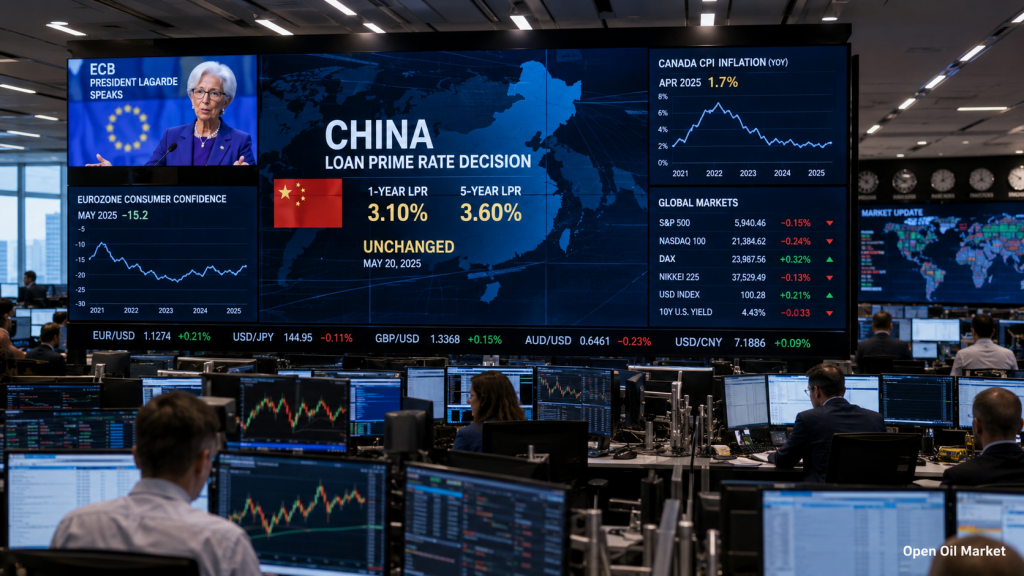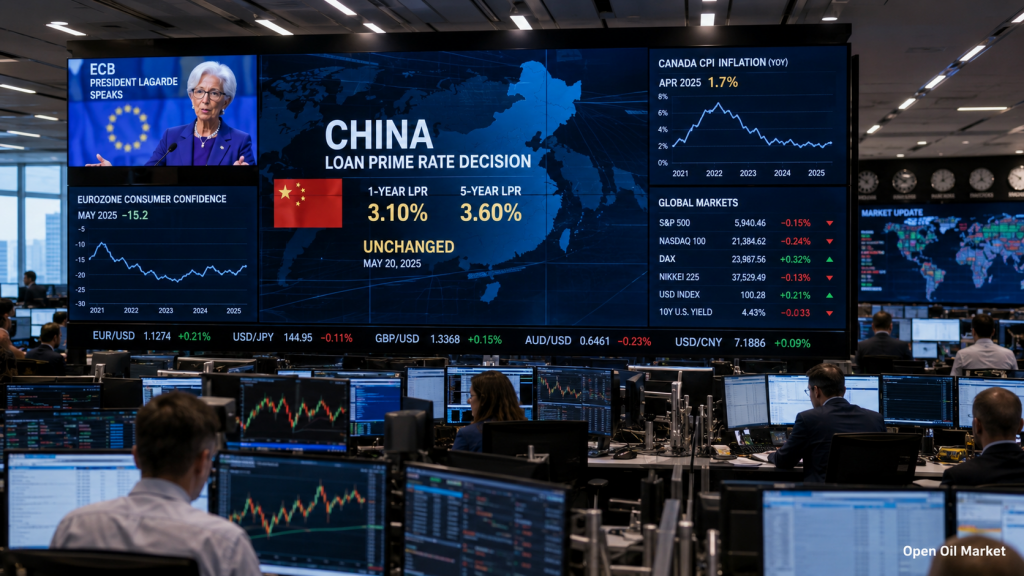
Global Financial Markets Respond to China's LPR Rate, ECB President Christine Lagarde's Speech, Canadian Inflation, and Eurozone Consumer Confidence Data on June 22, 2026
Monday, June 22, 2026, marks the start of a week in which global markets will closely evaluate the trajectory of interest rates, inflation, and consumer demand. Key economic events of the day are concentrated in China, the Eurozone, and Canada: the morning will see the release of the Chinese LPR rate decision, followed by ECB President Christine Lagarde’s speech in the afternoon, the release of Canada’s CPI for May later in the day, and finally, the preliminary Eurozone consumer confidence index for June will be announced in the evening.
For investors from the CIS, this calendar is significant not only as a collection of individual macroeconomic indicators. The Chinese LPR rate influences expectations regarding industrial demand and commodity markets, comments from the ECB set the tone for European bonds and the euro, inflation in Canada helps assess the resilience of price pressures in developed economies, and Eurozone consumer confidence reflects the state of domestic demand in one of the world's largest trading regions.
Key Macroeconomic Events Calendar for June 22, 2026
Major economic events of the day (Moscow time):
- 04:15 MSK — China: LPR, Loan Prime Rate. The market expects decisions on the one-year and five-year lending rates.
- 13:00 MSK — Eurozone: Speech by ECB President Christine Lagarde. Investors will be focusing on her tone regarding inflation, rates, and the role of the euro in the global financial system.
- 15:30 MSK — Canada: CPI for May. This is one of the main inflation releases of the day for the currency and bond markets.
- 17:00 MSK — Eurozone: Preliminary consumer confidence index for June. This indicator will show the resilience of household demand amidst high borrowing costs and energy risks.
In a broader context, Monday sets the stage for a week where market attention will gradually shift to PMI business activity data, the U.S. PCE inflation indicator, and further signals from central banks. Thus, even a relatively short calendar on June 22 can become an important benchmark for assessing global risk appetite.
China: LPR Rate and Signal for Commodity Markets
The first important event of the day is China's decision on the LPR. For global investors, the Loan Prime Rate is a key indicator of how willing the People's Bank of China is to support lending, the construction sector, industry, and domestic demand.
If the LPR rate remains unchanged, it will signal that Chinese authorities prefer targeted economic support rather than aggressive monetary stimulus for now. For commodity markets, including oil, metals, and industrial products, this scenario could be neutral: it does not provide a strong impetus for growth but also does not heighten fears of a sharp slowdown in lending activity.
Investors should pay attention to two components:
- One-year LPR — important for corporate lending and short-term business activity.
- Five-year LPR — particularly significant for the mortgage market, real estate, and long-term investment projects.
For Asian stock indices, including the Nikkei 225 and Chinese markets, the LPR decision may affect banks, developers, metallurgical companies, equipment manufacturers, and exporters.
Eurozone: Christine Lagarde's Speech and ECB Policy
ECB President Christine Lagarde's speech is the central event of the European trading day. Following a period of heightened sensitivity to inflation, investors will seek answers to three questions in her comments: How concerned is the ECB about price pressures, does the regulator foresee further policy tightening, and how does it assess growth prospects in the Eurozone?
Key signals for European markets include:
- Assessment of inflation and its link to energy prices;
- Comments on interest rates and a potential pause in ECB policy;
- Tone regarding the euro's exchange rate and the international role of the European currency;
- Evaluation of corporate lending and consumer demand.
For the Euro Stoxx 50 index, the reactions from the banking sector, exporters, automakers, and industrial companies will be particularly important. A more hawkish tone from the ECB could support the euro and bond yields, but simultaneously exert pressure on companies with high debt loads.
Canada: CPI for May and Its Importance for Currency Markets
The publication of Canada’s May CPI at 15:30 MSK will be the main inflation release of the day. The consumer price index is critical for assessing the Bank of Canada's future actions, the dynamics of the Canadian dollar, and expectations for the bond market.
For investors, three sets of data will be crucial:
- Overall CPI inflation. This will indicate how persistent pressure on consumer prices remains in light of changes in the energy and commodity sectors.
- Core inflation components. Particularly important for understanding the resilience of price pressures without volatile categories.
- Response of the Canadian dollar. A strong CPI may support CAD, while a weak one could heighten expectations for a softer Bank of Canada policy.
For commodity markets, Canada is crucial as a significant economy connected to oil, gas, metals, and the export of natural resources. Therefore, the CPI in Canada may indirectly influence assessments of inflationary pressures in commodity currencies and investor behavior in the oil and gas sector.
Eurozone: Consumer Confidence as an Indicator of Demand
The preliminary Eurozone consumer confidence index for June will be released at 17:00 MSK. This indicator does not always provoke sharp market movements, but it is essential for assessing domestic demand, retail trade, banking credit, and GDP expectations.
If consumer confidence improves, it could support stocks of retailers, banks, travel companies, and consumer goods manufacturers. Conversely, if the indicator is weak, the market may increase caution regarding cyclical sectors and companies dependent on household spending.
For investors from the CIS, the Eurozone consumer confidence indicator is also important as a signal for external demand. A weak European consumer means more cautious dynamics for imports, pressure on exporters' margins, and increased sensitivity to currency fluctuations.
Corporate Reports from the U.S., Europe, Asia, and Canada
The corporate reports calendar for Monday, June 22, 2026, appears moderately calm: there are no major reports from S&P 500 companies that could independently set the direction for the entire U.S. market. However, the global calendar includes several public companies that may provide important sectoral signals for investors.
| Region | Company | What Investors Should Watch |
|---|---|---|
| Canada / North America | Alimentation Couche-Tard | Consumer demand, fuel retail, margins of convenience stores, sales dynamics in North America and Europe. |
| Japan / Asia | Nidec | Demand for electric motors, industrial components, automotive, automation, and capital expenditures of manufacturers. |
| Europe | 3i Infrastructure | Yield of infrastructure assets, portfolio assessment, debt load, sensitivity to rates. |
| Europe | Finnair | Passenger flow, fuel costs, recovery of air travel, geopolitical impact on routes. |
| USA | Replimune, Anixa Biosciences, NeuroSense Therapeutics | Biotechnology, clinical programs, cash runway, regulatory risks. |
| USA | Ennis, Americas Car-Mart, OFS Credit | The state of small and medium businesses, auto financing, credit spreads, dividend sustainability. |
| UK / Europe | ASOS, NextEnergy Solar, Iomart | Online retail, renewable energy, IT infrastructure, and demand for digital services. |
Although these corporate reports are not from major tech giants, they provide insights into several important sectors: consumer demand, aviation, infrastructure, biotechnology, solar energy, IT services, and credit companies.
S&P 500, Euro Stoxx 50, Nikkei 225, and MOEX Indices
For the S&P 500, Monday looks like a day primarily of macroeconomic expectation: major reports from American blue chips are pushed to the later days of the week. Therefore, the dynamics of the U.S. market will depend on bond yields, inflation expectations from the PCE, and global risk appetite.
For the Euro Stoxx 50, the main driver will be the rhetoric from the ECB and the consumer confidence data. Banks may benefit from a higher rate, but cyclical companies and the real estate sector remain sensitive to capital costs.
For the Nikkei 225, two factors are important: Asia's reaction to China's LPR decision and the industry signal from Nidec. The Japanese market continues to evaluate the balance between export demand, the yen's exchange rate, and global demand for industrial components.
For the MOEX on Monday, the main agenda is related not so much to reports as to corporate events: the annual shareholders' meeting of the Moscow Exchange regarding dividends for 2025, the shareholders' meeting of Fix Price, and the closure of registries for certain dividend stories. For Russian investors, this is an important day in terms of the dividend calendar and corporate governance evaluation.
Market Context for Investors
The global environment remains sensitive to three themes: inflation, interest rates, and commodity prices. After a period of elevated volatility in the energy market, investors are once again closely watching how oil and gas prices are transmitted to consumer inflation in developed countries.
Key market connections of the day include:
- China's LPR → Commodities → Industrial Stocks. A soft signal from China may support expectations for demand for metals and energy resources.
- Lagarde → Euro → Euro Stoxx 50. A hawkish tone from the ECB may strengthen the euro but weaken the attractiveness of companies with high debt loads.
- Canada's CPI → CAD → Commodity Currencies. Strong inflation is likely to support expectations for a tighter Bank of Canada policy.
- Eurozone Confidence → Consumer Sector. Weak data will heighten caution regarding European retailers and banks.
What Investors Should Note
On Monday, June 22, 2026, it is vital for investors not to overestimate the significance of a single indicator, but rather to look at the overall picture of the day. The macroeconomic calendar is not overloaded, but each release is directly linked to interest rates, currencies, commodity markets, and equity valuations.
- Chinese LPR. The main morning benchmark for Asia, industrial goods, and commodity companies.
- Christine Lagarde's Speech. Important for the euro, European bonds, banks, and Euro Stoxx 50.
- Canada's CPI. May impact the Canadian dollar, bond market, and inflation expectations in commodity economies.
- Eurozone Consumer Confidence. Will indicate the resilience of internal demand amid high borrowing costs and household price sensitivity.
- Corporate Reports. Focus on Alimentation Couche-Tard, Nidec, 3i Infrastructure, Finnair, ASOS, and the biotech sector in the U.S.
- MOEX and Dividend Events. Russian investors should take into account shareholders' meetings and the closure of registries for specific securities.
The main takeaway of the day is that Monday, June 22, is not a day of major corporate earnings from the S&P 500, but rather a day for setting market expectations ahead of a busier week. Investors should monitor how data from China, Canada, and the Eurozone will shift expectations regarding rates, currencies, commodities, and global risk appetite.