Economic Events and Corporate Reports: Wednesday, July 29, 2026 — Fed Rate Decision, Reports from Microsoft, Meta, and Airbus
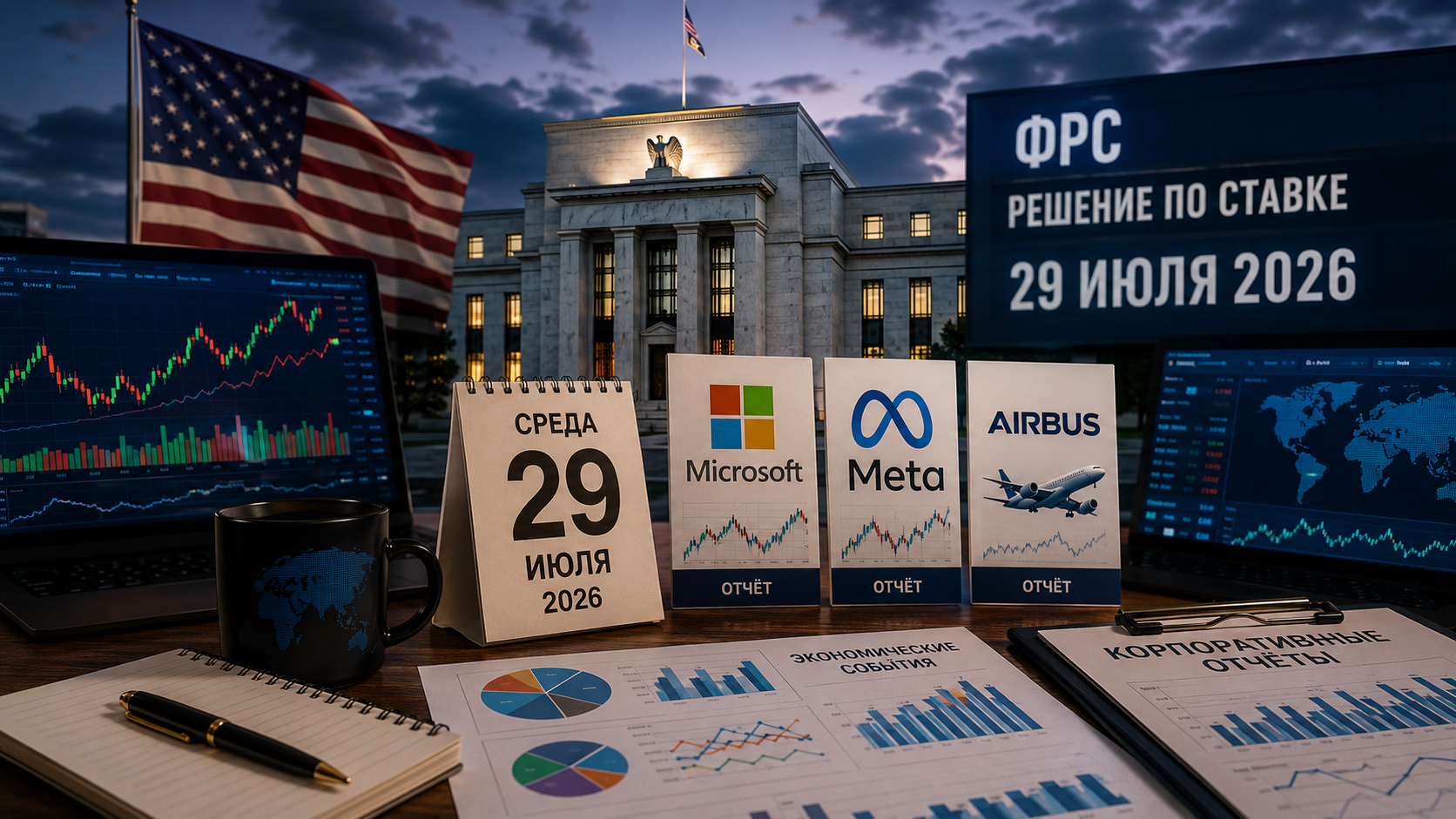
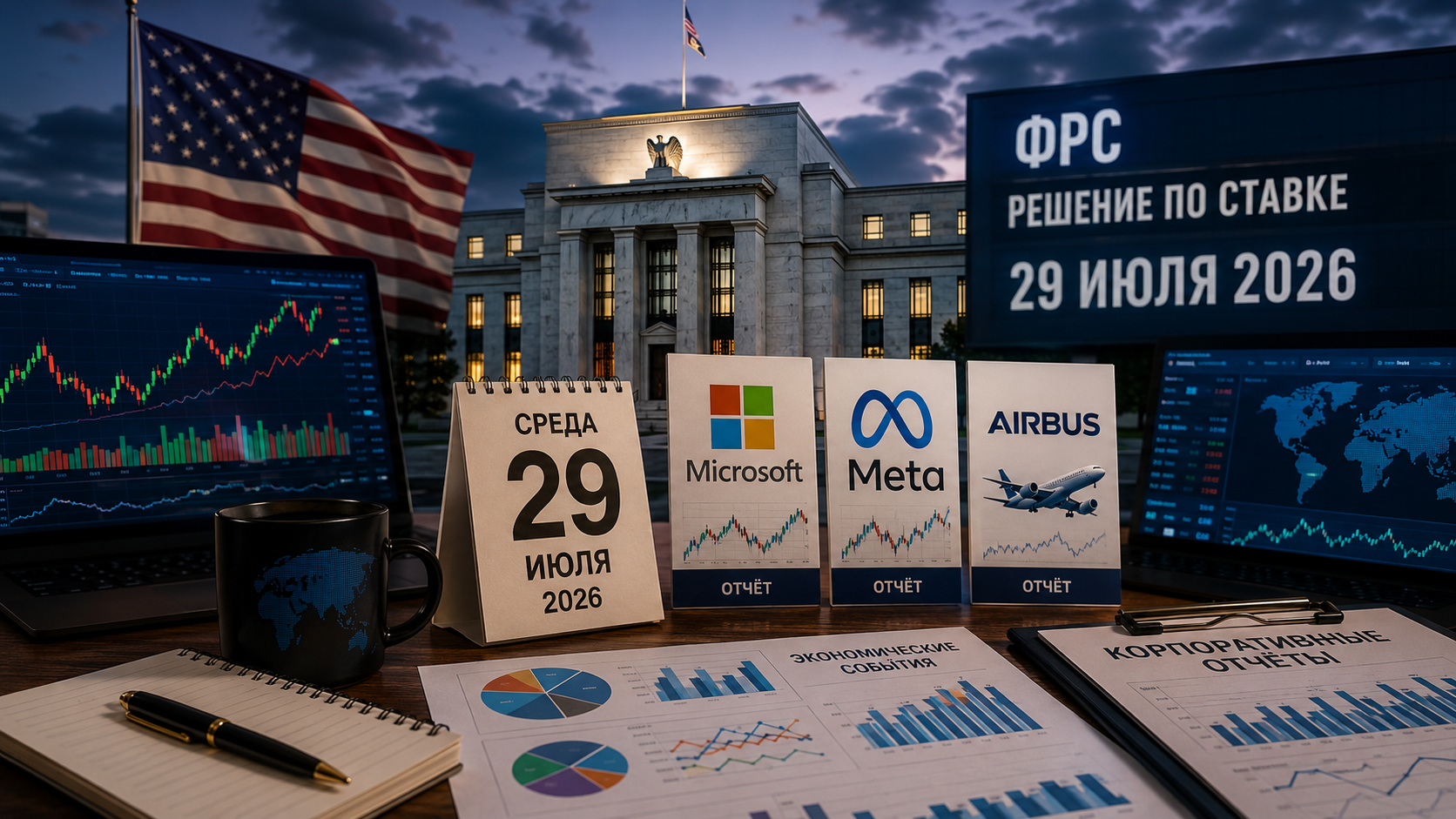
Wednesday, July 29, 2026, will be a pivotal day for global financial markets. The economic calendar for investors combines two factors of maximum volatility: the outcomes of the two-day FOMC meeting with Jerome Powell's press conference, and the busiest day of the quarterly earnings season. After the market closes in the U.S., Microsoft and Meta Platforms—two heavyweights of the S&P 500 index—will present their results, while in Europe, half-year reports from Airbus, AstraZeneca, and UBS will be released. The Asian session will be set by the SK Hynix report and inflation data from Australia, while the Russian market will continue to digest the half-year earnings season on MOEX. Below is a detailed overview of the economic events and corporate reports for July 29, 2026, for investors from the CIS and around the world.
Key Events of the Day: Brief Overview
- Federal Reserve's interest rate decision — 21:00 MSK, Jerome Powell's press conference — 21:30 MSK.
- Consumer Price Index (CPI) for Australia for Q2 2026.
- Pending home sales data in the U.S. and weekly oil inventories from EIA.
- Reports from Microsoft, Meta Platforms, Qualcomm, Lam Research, Arm, Starbucks — after U.S. market close.
- Procter & Gamble, GE HealthCare, General Dynamics, Humana — before the New York trading opens.
- Half-year results from Airbus, AstraZeneca, and UBS in Europe; SK Hynix in Asia.
Federal Reserve Interest Rate Decision — Central Event of the Day
The FOMC meeting on July 28–29 is the main macroeconomic benchmark of the week. The Federal Reserve's key rate has been maintained in the range of 3.50–3.75% since December 2025: the regulator has kept it unchanged at four consecutive meetings, citing inflation consistently exceeding the 2% target according to the PCE index. The market consensus anticipates that the rate will remain unchanged this time as well, so all eyes will be on the wording of the final statement, the vote distribution within the committee, and Powell's rhetoric.
It is important to note that the July meeting takes place without updated macroeconomic forecasts and the dot plot— the next forecast publication is scheduled for September. This increases the weight of each word from the Fed Chair. Some market participants do not rule out that the regulator may signal its readiness to raise the rate by 25 basis points in September if inflationary pressures do not ease. Any hint of tightening could trigger a rise in Treasury yields, strengthen the dollar, and exert pressure on growth stocks.
Macroeconomic Statistics: Inflation in Australia and Data from the U.S.
The Asian session will kick off with the release of the Consumer Price Index for Australia for Q2—a key indicator for the Reserve Bank of Australia and the value of the Australian dollar. Throughout the day in the U.S., data on pending home sales for June will be published, which will reflect the state of the real estate market amidst high mortgage rates, as well as the weekly EIA report on oil and petroleum products inventories—a significant factor for Brent and WTI prices. In Canada, a summary of the Bank of Canada's discussions from the last meeting will be released.
American Company Reports: Microsoft and Meta in the Spotlight
The earnings season for Q2 2026 is peaking: this week, more than 170 companies from the S&P 500 index will report results, with the combined earnings of the index expected to grow by approximately 24.7% year-over-year, according to FactSet. However, the backdrop for the "Magnificent Seven" is tense: following Alphabet's report, which increased its capital expenditure plan to $205 billion amidst negative free cash flow, investors are evaluating big tech companies' AI spending more rigorously.
Microsoft: Azure and Capex Under the Microscope
Microsoft will report its IV fiscal quarter results after the close of trading. Wall Street expects earnings of around $4.24 per share (+16% year-over-year) with revenue approximately $87.6 billion (+15%). Key metrics include growth rates for the Azure cloud segment (consensus 40–42%) and forecasts for capital expenditures for the 2027 fiscal year: in the last quarter, capex grew by 84% year-over-year, and any disappointment in this area has previously led to stock declines of nearly 10% in a single day.
Meta Platforms: Advertising versus AI Spending
Meta will present its Q2 results: the market anticipates earnings of around $7.14–$7.19 per share and revenue approximately $60.2 billion (+27% year-over-year). Investors will assess trends in ad pricing (expected growth of 9–12%), audience engagement, and, importantly, comments on AI spending. Both stocks approach their reports after significant corrections since April, raising the stakes on market reactions.
Other Reports in the U.S.: From Procter & Gamble to Starbucks
Besides the tech giants, dozens of issuers from the S&P 500 will report on July 29:
- Before the market opens: Procter & Gamble (expected EPS $1.41), GE HealthCare, General Dynamics, L3Harris, Humana, Biogen, Teva, Garmin, Johnson Controls, Vertiv, Old Dominion, Bunge.
- After the market closes: Qualcomm, Lam Research, Arm Holdings, Starbucks, Chipotle Mexican Grill, Robinhood, Equinix, Fortinet, O'Reilly Automotive, Public Storage, MGM Resorts, Canadian Pacific Kansas City.
Reports from Qualcomm, Lam Research, and Arm will provide insight into the state of the semiconductor cycle and demand for AI infrastructure, while results from Starbucks and Chipotle will serve as indicators of consumer spending resilience in the U.S.
European Reports: Airbus, AstraZeneca, and UBS
The European earnings season is also underway, and Wednesday will bring results from several constituents of the Euro Stoxx 50 and major indices in the region:
- Airbus will publish its report for the first half of 2026; a conference call for analysts is scheduled for the evening. The focus will be on aircraft delivery rates, the condition of engine supply chains, and confirmation of the annual forecast.
- AstraZeneca will present quarterly results (consensus around $2.49 per share): investors will assess the dynamics of the oncology portfolio and comments on U.S. pricing policy.
- UBS will report its Q2 results (expected around $0.88 per share)—a key report for the European banking sector amidst discussions on capital requirements in Switzerland.
Asian Markets: SK Hynix and the Bank of Japan's Expectations
In Asia, the main corporate event will be the report from South Korea’s SK Hynix—one of the key global manufacturers of HBM memory for AI accelerators. Strong numbers could support the entire semiconductor sector from Taiwan to Japan. Meanwhile, the Nikkei 225 index will trade in a wait-and-see mode: the Bank of Japan will hold its meeting on July 30–31, which raised its rate to 1% in June and is expected to take a pause according to consensus. Inflation data from Australia will set the tone for commodity currencies and Asian bonds.
Russian Market: Half-Year Reporting Season on MOEX
The Russian stock market continues to navigate the season of first-half 2026 earnings disclosure: in the last days of July, issuers on MOEX traditionally publish RAS reports for six months, while major banks and companies report interim results based on IFRS. The MOEX index is also reacting to the results of the Central Bank of Russia's July meeting regarding the key rate: the trajectory of monetary policy easing remains the main driver for bank stocks, developers, and domestic demand companies. Investors should monitor the publications from energy and financial sector issuers, as well as the dynamics of the ruble in the context of the Fed's decision.
Key Considerations for Investors on July 29, 2026
Wednesday creates a rare combination of monetary and corporate risks, thus the day demands discipline and readiness for sharp price movements. Key benchmarks include:
- The Fed's rhetoric is more important than the decision itself. The maintenance of the rate in the 3.50–3.75% range is priced in; the market will be influenced by the tone of the statement and Powell's responses regarding September's outlook.
- Big tech's capital expenditures. Following the reaction to Alphabet's report, Microsoft and Meta's forecasts regarding AI spending could determine the direction of the entire Nasdaq and S&P 500 for the rest of the week.
- Volatility after U.S. market close. Major reports will be released post-market and will coincide with the digestion of FOMC results—manage position sizes and avoid excessive leverage.
- The calendar for the rest of the week. On Thursday—first estimate of U.S. GDP for Q2, reports from Apple and Amazon, and a meeting of the Bank of England; on Friday—Bank of Japan and preliminary Eurozone inflation. Decisions made on Wednesday should be viewed in the context of the entire week.
- Diversification across regions. Strong reports from SK Hynix and Airbus could bolster Asian and European indices even amid cautious reactions from the U.S. market.
For the long-term investor, July 29 is a day for hypothesis testing: do market leaders demonstrate the ability to convert record investments in AI into profits and is the Fed ready to maintain a balance between fighting inflation and supporting the economy? Answers to both questions will set the direction for global markets throughout August.