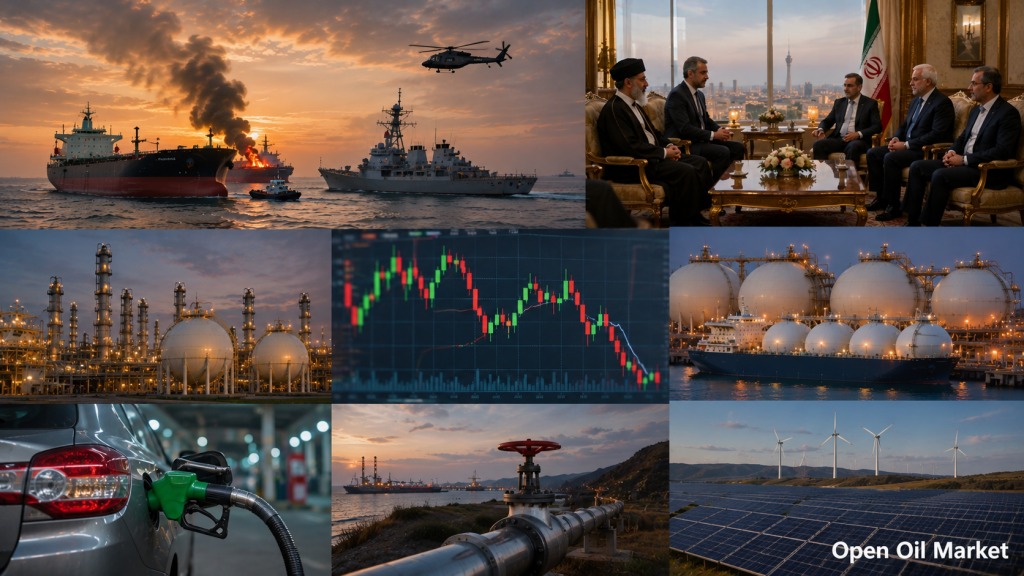
Top Oil, Gas, and Energy News for Saturday, June 6, 2026: Brent Crude, Strait of Hormuz Risk, LNG Market, Refineries, Refined Products, Coal, Electricity, and Renewables for Investors and Global Energy Sector Participants
The global energy sector enters Saturday, June 6, 2026, in a state of heightened nervousness. Brent crude remains below the psychological threshold of $100 per barrel, yet the market continues to price in a geopolitical premium due to the situation surrounding the Strait of Hormuz, limited visibility of maritime shipments, and declining commercial inventories. For investors, oil companies, fuel operators, refined product traders, and electricity market participants, this signals a shift from simple oil price assessment to a more complex analytical model: what matters is not only Brent and WTI quotes but also logistics, LNG availability, refinery margins, gas storage status, coal demand, and power system resilience.
The day's key theme is the divergence between the outward calm in prices and the internal tension within the energy market. Oil has not entered extreme growth territory, but inventories are declining, refined products are becoming more expensive relative to crude, gas remains sensitive to competition between Europe and Asia, and the power sector is increasingly dependent on the balance between gas, nuclear generation, hydroelectricity, and renewables.
Oil: Brent Below $100, But Risk Premium Persists
The oil market ends the week without panic-driven gains, yet also without signs of sustainable normalization. Brent is trading near $94 per barrel, while WTI is around $92. Pressure on prices was eased by reports that operations at Oman's Mina al Fahal port continue normally after rumours of possible disruptions. Nonetheless, the market's reaction itself demonstrates how sensitive oil quotations have become to any news about ports, tankers, straits, and shipping insurance.
For the global oil and gas sector, the key issue remains not only physical supply but also delivery routes. The Strait of Hormuz remains a critical chokepoint for oil, LNG, and refined products. Even a partial reduction in tanker movement transparency heightens uncertainty for buyers in Asia and Europe. This supports a premium in oil prices, even if current quotes have not yet breached the $100 mark.
OPEC+ and Oil Supply: Market Awaits July Decisions
The focus for energy sector participants is on expectations for further OPEC+ policy. The market is assessing the likelihood of another increase in target production levels for July, but the actual ability of several producers to boost exports remains constrained by logistics, geopolitics, and technical risks. Therefore, a formal decision to raise output does not necessarily translate into an immediate expansion of physical oil supply.
For investors, this creates an important analytical gap: official quotas may signal market easing, while actual oil flows indicate a persistent deficit. In such an environment, companies with stable access to production, their own fleet, diversified routes, and the ability to quickly redirect shipments between Europe, Asia, and domestic markets stand to benefit.
Oil Inventories: Safety Buffer Thinning
One of the week's key signals was the decline in US oil inventories. Commercial stocks, excluding the strategic reserve, fell by almost 8 million barrels and are now below the five-year average for the current season. Against the backdrop of summer fuel demand, this raises the importance of each new report on gasoline, diesel, jet fuel, and crude oil inventories.
Globally, the market is increasingly dependent on storage buffers and strategic reserves. If supply disruptions persist and demand for refined products remains high during the summer season, declining inventories could quickly shift from a statistical factor to a price shock. Diesel, jet fuel, and high-sulphur fuel oil markets remain particularly sensitive.
Gas and LNG: Europe and Asia Compete for Flexible Supplies
The gas market remains the second centre of tension after oil. European TTF is hovering near €49 per MWh, while the Asian LNG Japan Korea Marker is around $18.80 per million BTU. These levels do not repeat the extremes of 2022, but they are high enough to impact industry, power generation, chemicals, and heating season costs.
Europe is forced to accelerate gas injection into storage ahead of winter, while fill levels remain below comfortable seasonal benchmarks. Asia, in turn, is competing for LNG amid heatwaves, high electricity demand, and limited supply. As a result, flexible LNG cargoes have become a strategic resource rather than just a traded commodity.
Electricity: Gas, Hydro, and Nuclear Again Set the Price
In the power sector, price dependence on gas availability and base-load generation is growing. In Europe, winter electricity contracts are trading with an elevated premium, especially in countries where gas-fired generation plays a significant role in grid balancing. Additional pressure comes from low hydro resources in certain parts of Northern Europe and nuclear plant outages.
For industrial consumers, this signals a risk of higher electricity costs in the second half of 2026. For investors, it means increased interest in companies involved in grid infrastructure, energy storage, flexible generation, nuclear power, and long-term electricity supply contracts.
Refineries and Refined Products: Processing Margin Becomes Key Indicator
The refined products market currently appears more strained than the crude oil market. Refining margins remain high due to limited supply of diesel, jet fuel, and gasoline. This is particularly relevant for refineries, oil traders, and fuel companies supplying industry, transportation, construction, and agriculture.
Special attention is drawn to Africa. During tests, Nigeria's Dangote refinery processed around 700,000 barrels per day, exceeding the design capacity of 650,000 barrels. This is an important signal for the global market: Africa is gradually transforming from a fuel importer into a potential refining and refined product export centre.
In Russia, the situation is the opposite: attacks on refining infrastructure have increased pressure on the domestic fuel market. Reduced processing leads to higher crude oil exports but simultaneously creates risks for gasoline, diesel, and jet fuel. For the refined products market, this sustains elevated volatility and makes logistics as important as raw material prices.
Coal: Energy Security Again Boosts Demand
Coal remains a controversial asset in the global energy sector. On one hand, in the US and Europe, its long-term role is structurally declining due to competition from gas, renewables, and environmental regulations. On the other hand, in Asia, coal is again gaining support as an energy security tool amid expensive LNG.
Japan and South Korea are increasing coal-fired generation because gas has become more expensive and less predictable. For Asian countries, coal today serves as a backup fuel: it is less convenient from a climate policy standpoint but more straightforward in terms of logistics and availability. This supports thermal coal prices and interest in suppliers from Australia, Indonesia, and other export regions.
Renewables and Energy Transition: From Climate Agenda to Security Issue
In 2026, renewable energy is increasingly viewed not only as a climate tool but also as an element of energy independence. Growth in solar and wind generation reduces certain markets' dependence on imported gas and coal, but simultaneously requires investments in grids, storage, digital load management, and backup capacity.
China remains the key growth centre for renewables and nuclear generation. A significant portion of the country's additional electricity demand is expected to be covered by low-carbon sources. For global investors, this strengthens interest in supply chains for solar panels, inverters, batteries, copper, aluminium, grid equipment, and software solutions for energy system management.
What Investors Should Watch
For investors and energy market participants, Saturday, June 6, 2026, yields several practical conclusions:
- Brent crude below $100 does not rule out a new price spike if the situation around the Strait of Hormuz deteriorates.
- OPEC+ decisions should be assessed through actual export flows, not just announced quotas.
- Declining oil and refined product inventories increase the significance of summer demand for gasoline, diesel, and jet fuel.
- Gas and LNG remain key factors for European electricity and industry.
- High refinery margins may support shares of processing companies but simultaneously increase pressure on end fuel consumers.
- Coal temporarily benefits from expensive LNG, especially in Asia, but its long-term investment appeal remains limited.
- Renewables, grids, storage, and nuclear power are becoming part of energy security strategy, not just the energy transition.
The key takeaway for the global energy market: the world's energy sector is entering a period where the price per barrel no longer reflects the full picture. Investors must simultaneously track oil, gas, LNG, coal, electricity, refineries, refined products, and renewables. It is the intersection of these markets that will determine the returns on energy assets, fuel costs, inflation risks, and investment opportunities in the second half of 2026.