Global Startup and Venture Investment News for July 19, 2026: Venture Capital Concentrates Again Around Artificial Intelligence, Deep Tech, Defense Technologies, Space, Fintech, and Biotechnology
As of Sunday, July 19, 2026, the global startup and venture investment market remains in a phase of active capital redistribution. Following a record first half of the year, investors are increasingly selective regarding new deals, yet the largest funds continue to support companies poised to become the infrastructure for the next technological cycle. The main focal points for this week are AI infrastructure, semiconductors, defense technologies, space startups, fintech for mid-sized businesses, biotechnology, and climate solutions.
For venture investors and funds, the key takeaway is clear: the market is no longer merely financing "trendy" AI applications. Capital is shifting towards foundational infrastructure—computing, chips, models, data centers, energy, security, and autonomous systems. These segments are forming the core of new mega-rounds and creating noticeable competition for deal access.
The Venture Market of 2026: Record Capital, but Stricter Selection
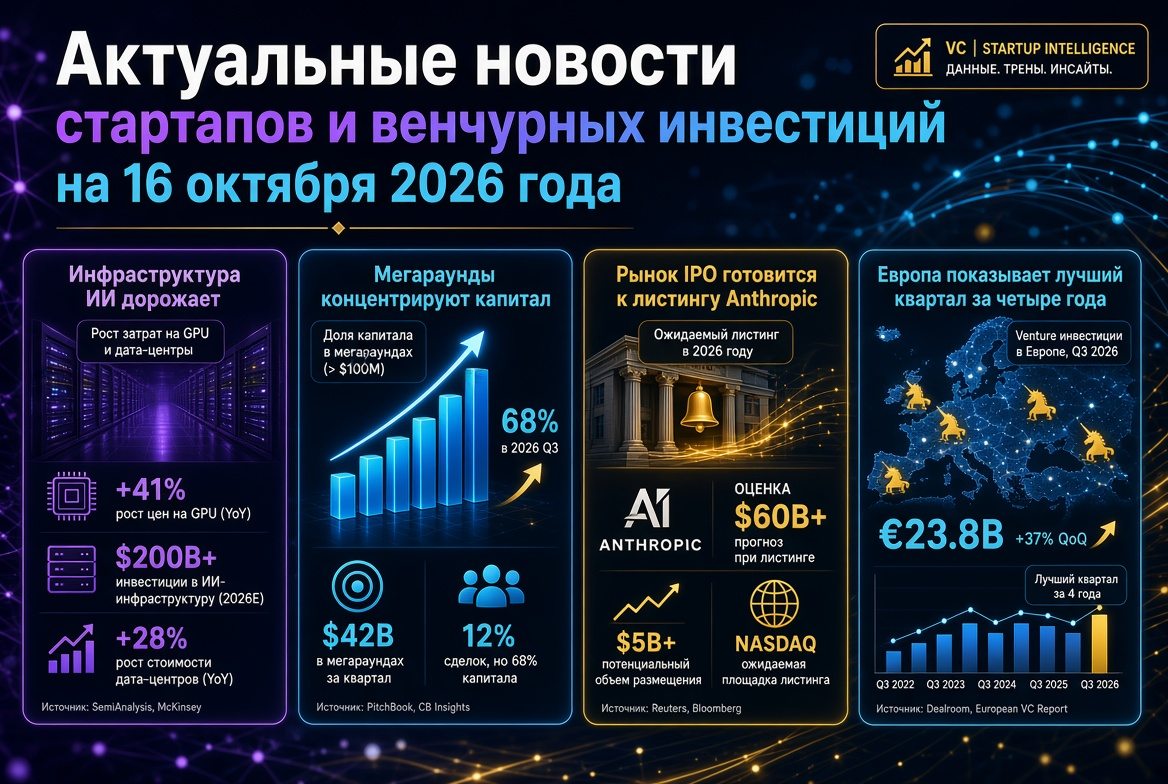
The first half of 2026 has become one of the strongest periods for global venture capital. Startups worldwide have attracted hundreds of billions of dollars, with total investment already exceeding that of the entire previous year. However, this growth does not signify a uniform market recovery. On the contrary, venture investments are becoming increasingly concentrated: top companies gain access to capital faster and at a higher cost, while startups without proven revenues, technological advantages, or clearly defined markets face a more challenging fundraising process.
The startup market is forming a "barbell structure": on one side are large mega-rounds for leaders in AI, deep tech, and defense tech; on the other, a cautious recovery in the seed and Series A segments. The middle stage remains most sensitive to valuations, growth rates, and the quality of unit economics.
- AI startups continue to receive an disproportionate share of venture capital.
- Investors are intensifying due diligence on infrastructure risks: chips, energy, data centers, regulations.
- Funds are increasingly demanding not only ARR growth but also evidence of sustainable profitability.
- IPOs and M&A are again becoming viable exit scenarios, particularly for mature tech companies.
AI Infrastructure: The Main Magnet for Mega-Rounds
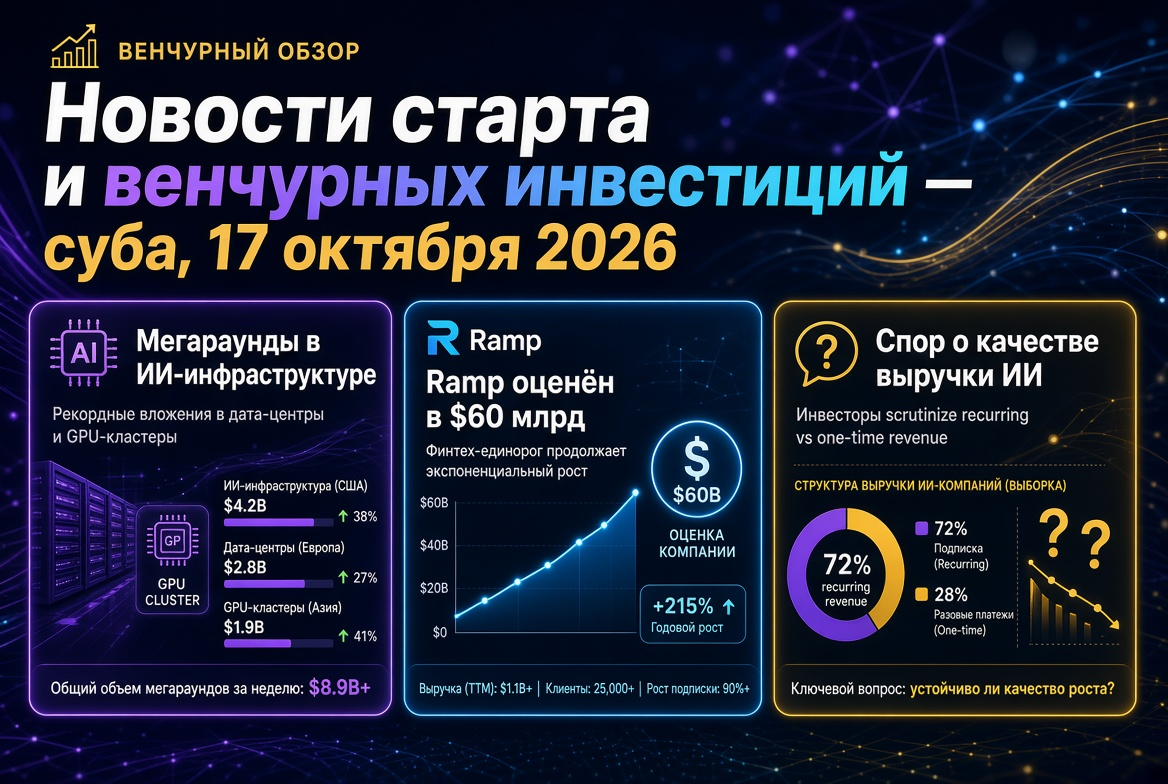
Artificial intelligence remains a central theme in the venture market, but investors' focus has notably shifted. While in 2023-2025, primary capital flowed into foundation models and generative AI applications, 2026 has seen a spotlight on infrastructure: AI chips, inference platforms, neocloud providers, tools for AI agents, and enterprise AI operating systems.
One of the most telling indicators is the interest in manufacturers of specialized AI chips. The startup Etched, which develops chips for AI inference, is discussing a new round with an estimated valuation of around $20 billion. This demonstrates that investors are willing to pay a premium for companies that can reduce market dependence on Nvidia and accelerate computations for large language models.
Another noteworthy example is SambaNova, which raised approximately $1 billion at a valuation of about $11 billion. Against the backdrop of an oversaturated GPU market and rising computing costs, such companies become strategic assets not only for venture funds but also for corporate investors, semiconductor manufacturers, and cloud platforms.
AI Agents and Corporate Software: A New Wave of 'Unicorns'
Venture investments in AI agents remain one of the fastest-growing segments of the startup market. Investors are betting on companies that not only create chatbots but also automate workflows in finance, law, programming, sales, customer support, and knowledge management.
Prime Intellect raised $130 million in Series A funding at a valuation of around $1 billion, underscoring the high demand for platforms creating corporate AI agents. In India, Emergent became a new AI "unicorn" after a $130 million round at a valuation of about $1.5 billion. Interest is growing in the U.S. and Europe for open-source AI projects, including initiatives like Nous Research, which is discussing funding at a valuation of around $1.5 billion.
For venture funds, this segment is attractive for three reasons:
- Corporate clients are already ready to pay for the automation of routine processes;
- AI agents can scale quickly through a SaaS model;
- The best startups gain access to strategic partnerships with cloud and chip companies.
Defense Technologies: Europe Becomes a New Center for Defense Tech
One of the major events of the week was Helsing's $1.8 billion round at a valuation of around $18 billion. This German defense tech company has become one of the most notable examples of how Europe is reshaping its venture agenda around security, autonomous systems, artificial intelligence, and technological sovereignty.
Defense startups are no longer perceived as a niche and difficult segment for funds. In 2026, defense tech has emerged as an institutional domain, attracting not only specialized funds but also large global investors. The reasons are clear: increasing military budgets, demand for autonomous systems, drones, cybersecurity, satellite analytics, and AI platforms for decision-making.
For venture investors, this area remains complex due to long sales cycles, export restrictions, and high dependency on government contracts. However, the potential market is becoming large enough to justify significant late-stage rounds.
Space Startups: Capital Follows Orbital Infrastructure
The space sector also maintains high interest from venture capital. In the second quarter of 2026, space tech companies raised approximately $7.5 billion across more than 140 deals. This nearly matches the record level of the previous quarter and indicates a robust demand for space infrastructure.
Investors are increasingly viewing space not as an experimental market but as a foundational infrastructure for communication, navigation, climate monitoring, defense, logistics, and data. The potential IPO of SpaceX heightens interest in the sector: a successful public exit by the market leader could establish a new benchmark for valuing private space companies.
The most promising areas in space tech include:
- Low-earth orbital satellite constellations;
- Satellite data analytics for businesses and governments;
- Propulsion systems and components for launches;
- Space communication and secure infrastructure;
- Services for servicing devices in orbit.
Fintech: A Return of Capital to B2B Models
Fintech in 2026 is recovering unevenly. Mass consumer applications are no longer capturing the same multiples, while B2B fintech, embedded finance, payment infrastructure, and AI services for businesses are again attracting the attention of funds.
A noteworthy example is Flex, an AI fintech for mid-sized businesses, which raised $70 million and reportedly increased its company's valuation to around $1.2 billion. This format reflects a broader trend: investors are looking for fintech startups that operate with real cash flows, serve solvent clients, and can expand their product offerings without excessive marketing costs.
For venture funds, fintech is becoming interesting again, but the selection criteria have changed. Priorities now include low credit risk, high retention, clear regulatory models, access to data, and scalability through partnerships with banks or corporate platforms.
Biotechnology and Climate Tech: Selective Interest Over a Broad Boom
Biotechnology startups continue to attract capital, but investors are increasingly favoring companies with clinical data, clear regulatory pathways, and a focus on specific diseases. In the first half of the year, venture financing for biotech companies has recovered; however, most capital has gone to projects with drugs either in development or in trials.
The situation is similar in climate technologies: the market has stabilized but lags behind AI in growth rates and investor attention. Capital is flowing into energy infrastructure, storage, grid tech, geothermal, nuclear and fusion technologies, industrial emissions reduction solutions, and data center efficiency.
For funds, this means climate tech and biotech remain promising, yet they require a longer investment horizon. Here, rapid user metrics are less important than technological validation, patents, partnerships with corporations, and access to government support programs.
Geography of Venture Investments: The U.S. Leads, Europe Accelerates, and Asia Restructures
The global venture capital landscape in 2026 is becoming more multipolar. The U.S. retains its lead in AI, chips, neocloud, enterprise software, and biotech. Europe is gaining strength in defense tech, industrial AI, climate tech, and deep tech. India is showing rapid growth in AI development, fintech, and SaaS. China remains an important player in AI models and manufacturing infrastructure; however, for global funds, the Chinese market is still associated with heightened geopolitical and regulatory risks.
Investors are paying special attention to the Middle East. The region's sovereign funds continue to create technology clusters by investing in AI, cloud infrastructure, semiconductors, robotics, and logistics. This opens an additional source of late-stage capital for startups, especially if the business has already demonstrated international demand.
What Matters for Venture Investors and Funds on July 19, 2026
The current venture agenda reveals that the market is again prepared to finance growth, but only in those segments where there is strategic significance, technological barriers, and potential for significant exits. Simply having an "AI label" no longer guarantees a high multiple. Funds are increasingly analyzing computing costs, access to data, energy consumption, regulatory risk, and demand resilience.
Key signals for investors in the coming weeks include:
- Monitoring new mega-rounds in AI chips, inference, and neocloud;
- Assessing the impact of technological corrections on late valuations of AI startups;
- Analyzing IPO candidates as indicators of exit market recovery;
- Comparing defense tech and space tech in terms of sales cycles and capital intensity;
- Searching for undervalued opportunities in B2B fintech, biotech, and climate infrastructure;
- Accounting for geographical diversification—U.S., Europe, India, the Middle East, and Asia offer different profiles of risk and returns.
The main trend for Sunday, July 19, 2026, is the shift of the venture market from euphoria over applications to a competition for the infrastructure of the future technological economy. AI, semiconductors, defense technologies, space, energy, and corporate software are becoming central areas where venture funds seek not short-term hype but long-term platform assets. For investors, this means a more complex yet potentially higher-quality market: fewer random deals, more capital in leaders, and a higher price for mistakes when entering overvalued rounds.