Cryptocurrency News for Sunday, June 21, 2026: Bitcoin Holds Key Range, ETF Flows Impact Market, Stablecoins and Regulation Top Global Investor Agenda
The cryptocurrency market is approaching Sunday, June 21, 2026, in a cautious yet more resilient state. After a volatile week, investors are reassessing Bitcoin, Ethereum, Solana, and other major digital assets through the lens of global liquidity, central bank policies, flows into cryptocurrency ETFs, and tightening stablecoin regulations. For the global cryptocurrency market, this is a pivotal moment as digital assets are increasingly seen not as an isolated speculative segment, but as deeply intertwined with macroeconomics, stock indices, the US dollar, and institutional capital.
The main topic of the day is Bitcoin's ability to maintain its position in the $63,000 to $64,000 range amidst mixed signals. On one hand, the market is witnessing support from major investors and ETF infrastructure. On the other hand, interest in risk assets remains unstable, with some capital continuing to flow into tech stocks, bonds, and money market funds. For investors, this means that cryptocurrency news on June 21, 2026, should be viewed not only through the lens of price dynamics but also through the structure of demand.
Overall Market Background: Cautious Recovery Without Euphoria
The global cryptocurrency market remains in a phase of consolidation. The total capitalization of the sector hovers around $2.3 trillion, with Bitcoin maintaining its dominant role within the digital asset structure. The market no longer appears homogeneous: Bitcoin remains the foundational safe-haven asset within the crypto sector, Ethereum is regarded as the backbone for smart contracts and tokenization, Solana is capturing attention due to its speed and user activity, while stablecoins USDT and USDC are evolving into critical components of the global settlement infrastructure.
Key factors currently shaping investor sentiment include:
- Bitcoin's dynamics around the psychologically significant range of $63,000 to $64,000;
- Inflows and outflows from spot Bitcoin ETFs and Ethereum ETFs;
- Expectations around interest rates in the US and the dollar's performance;
- Increased regulation of stablecoins and cryptocurrency exchanges;
- Rising interest in real asset tokenization and DeFi infrastructure.
Bitcoin: The Market's Main Barometer Keeps Institutional Investors Engaged
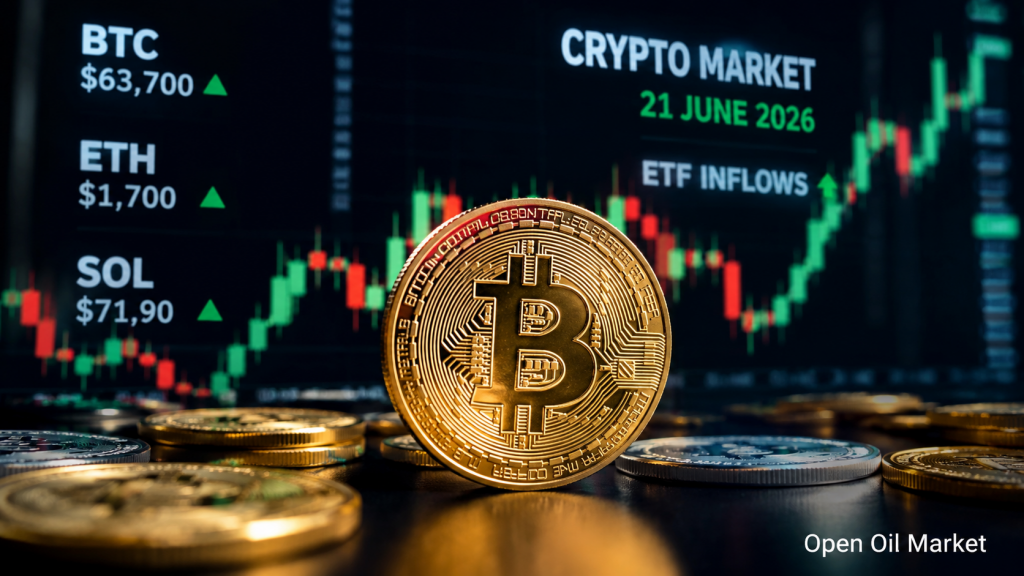
Bitcoin remains the primary indicator of the cryptocurrency market’s health. As of the time of this review, BTC is trading around $63,700, making the $63,000 to $64,000 range a key zone for short-term analysis. Holding this area is crucial for investor sentiment: if Bitcoin can maintain levels above the current price, the market may see a resurgence in demand for Ethereum, Solana, XRP, BNB, and other major altcoins.
However, Bitcoin's upward movement can't yet be labeled as a confident bullish reversal. The market remembers recent outflows from spot Bitcoin ETFs, macroeconomic pressures, and declining risk appetite. In 2026, Bitcoin is competing for capital not only against gold and stocks but also against rapidly growing AI companies, tech ETFs, and major IPOs. Therefore, it’s essential for investors to look beyond the price of BTC and gauge the quality of demand: Are long-term holders, ETF funds, corporations, or short-term traders purchasing the asset?
Ethereum and Solana: Infrastructure Cryptocurrencies Remain in the Spotlight
Ethereum is trading around $1,700 and retains its position as the second-largest cryptocurrency. The primary investment thesis for ETH is not only tied to its price but also to its role in the development of smart contracts, DeFi, NFTs, asset tokenization, and corporate blockchain solutions. For global investors, Ethereum remains an infrastructure bet on the expansion of the digital economy.
Solana stands out as one of the most notable assets among large cryptocurrencies. SOL is trading in the range of $71 to $72 and demonstrates more dynamic short-term movement compared to many other altcoins. Investors are closely monitoring the Solana ecosystem given its high throughput, activity in DeFi, meme coins, consumer applications, and tokenized assets. However, risks remain elevated: Solana reacts more sensitively to shifts in sentiment than Bitcoin, potentially experiencing sharper movements both upward and downward.
Top 10 Most Popular Cryptocurrencies for June 21, 2026
Investors are focusing on the largest cryptocurrencies by capitalization and liquidity. These assets primarily account for the bulk of trading volume, are utilized by institutional participants, and frequently serve as the basis for ETFs, derivatives, custodial services, and settlements.
- Bitcoin (BTC) — the main digital asset and benchmark for the entire cryptocurrency market.
- Ethereum (ETH) — the largest smart contract platform and foundation for DeFi and tokenization.
- Tether (USDT) — the largest dollar stablecoin and key liquidity tool.
- BNB (BNB) — the Binance ecosystem token and one of the largest exchange infrastructure assets.
- USDC (USDC) — a regulated dollar stablecoin popular for institutional settlements.
- XRP (XRP) — an asset related to cross-border payments and settlement infrastructure.
- Solana (SOL) — a high-speed network for DeFi, applications, and tokenized assets.
- TRON (TRX) — a blockchain with high activity in stablecoin transfers and digital payments.
- Hyperliquid (HYPE) — a rapidly growing DeFi asset reflecting demand for decentralized derivatives.
- Dogecoin (DOGE) — the largest meme coin that maintains high recognition and liquidity.
It is noteworthy that the composition of the top 10 is changing. The emergence of Hyperliquid among the largest assets signals that in 2026 the cryptocurrency market is reevaluating not only established blockchain projects but also new financial protocols, particularly in the decentralized derivatives segment.
Stablecoins: USDT and USDC Become Systemic Components of the Crypto Market
Stablecoins remain one of the key elements of the cryptocurrency infrastructure. USDT and USDC are utilized for trading, transfers, settlements, DeFi operations, and storing dollar liquidity within blockchain ecosystems. For investors, this serves as an important signal: demand for cryptocurrencies is increasingly expressed not only through purchasing Bitcoin or Ethereum but also through the growing turnover of dollar tokens.
Meanwhile, stablecoins are becoming targets for stricter regulation. In the US, there is increasing scrutiny on anti-money laundering compliance, sanction compliance, and reserve transparency. For large issuers, this may raise costs but simultaneously enhance trust among institutional clients. For the market as a whole, the regulation of stablecoins could become as significant a milestone as the launch of spot Bitcoin ETFs.
Regulation: US and Europe Shape New Rules of the Game
Cryptocurrency regulation remains a central theme for global investors. In the US, the legal framework for digital assets, stablecoins, exchanges, and derivatives continues to evolve. Regulators aim to clarify which tokens fall under the category of digital commodities, which may be classified as securities, and which should be regulated as payment instruments.
In Europe, the focus is on MiCA. The European Commission is evaluating whether the existing regulatory framework is suitable for the rapidly changing market of crypto assets, stablecoins, DeFi, and real asset tokenization. For global exchanges and issuers, this means that access to European investors will increasingly depend on licenses, transparency, compliance, and the ability to operate under unified rules.
An additional risk is posed by the status of major cryptocurrency exchanges in the EU. If regulators tighten licensing requirements, some players may face restrictions on servicing European clients. This could temporarily reduce liquidity, but in the long term, the market may become more institutional and transparent.
ETF Flows: The Main Channel of Institutional Demand
Spot Bitcoin ETFs and Ethereum ETFs remain crucial indicators of institutional interest. Following a period of significant outflows, the market is closely monitoring whether funds are returning. Even modest inflows hold significance, given that ETFs have become one of the primary channels for traditional capital to enter digital assets.
For investors, it's essential to assess not only daily inflow or outflow figures, but also the overall trend. Stabilization of ETF funds could support Bitcoin and alleviate pressure on major altcoins. Conversely, if outflows continue, the cryptocurrency market will remain sensitive to any negative macroeconomic signals.
What Matters for Investors on June 21, 2026
The cryptocurrency market enters Sunday without overt euphoria, but also without signs of capitulation. Bitcoin is holding its key range, Ethereum maintains its infrastructural importance, Solana showcases activity, and stablecoins are central to the global crypto economy. The main intrigue for the coming days is whether the market can shift from a technical recovery to a sustainable influx of capital.
Investors should pay attention to several factors:
- Bitcoin maintaining its position above the $63,000 zone and the reaction of buyers during declines;
- The dynamics of spot Bitcoin ETFs and Ethereum ETFs;
- Ethereum and Solana's behavior as indicators of demand for infrastructure blockchains;
- News on stablecoin regulations in the US and MiCA in Europe;
- Liquidity of the top 10 cryptocurrencies, particularly BTC, ETH, USDT, BNB, USDC, XRP, SOL, TRX, HYPE, and DOGE;
- Shifts in global risk appetite in the context of central bank policies and the stock market.
The primary takeaway for investors: cryptocurrencies in June 2026 remain a high-risk but now mature segment of the global financial market. Bitcoin is no longer driven solely by retail interest, Ethereum competes as a technological infrastructure, Solana and Hyperliquid reflect the demand for new blockchain models, and stablecoins serve as a bridge between traditional finance and digital assets. Therefore, an investor's strategy should be built not on expecting a rapid rally but on analyzing liquidity, regulation, ETF flows, and the resilience of the largest cryptocurrency ecosystems.