Startup and Venture Investment News Update: July 14, 2026 - Helsing Mega-Round, Growth in Defense AI, Major Investments in Artificial Intelligence, European Startups, IPOs, and Key Trends in the Global Venture Market
On Tuesday, July 14, 2026, the global startup and venture investment market remains in a phase of strong but highly uneven growth. The key headline of the day is the new mega-round for the European defense AI company Helsing, which effectively establishes defense tech as a standalone investment class, alongside artificial intelligence, infrastructure software, space technology, and energy deep tech.
For venture investors and funds, this serves as an important signal: capital continues to flow into startups, but not evenly across all segments. Money is concentrated around companies capable of addressing national security issues, AI infrastructure, regulatory automation, computing power, digital healthcare, and the energy transition. Startups without a technological barrier, large corporate clients, or a clear exit trajectory are facing more rigorous selection processes.
Helsing Takes Center Stage: Defense AI Becomes a Venture Priority
The key news for the startup and venture capital landscape is Helsing's $1.8 billion round at an estimated valuation of around $18 billion. The Munich-based company develops AI software, autonomous systems, and platforms for defense and national security. For Europe, this is not just a major deal but also an indicator of a structural shift: defense technologies have ceased to be a niche and have become a primary focus for late-stage venture rounds.
The Helsing round indicates three significant changes in investor behavior:
- Defense tech has become an acceptable focus for large global funds;
- AI in defense is viewed not as an experiment but as an infrastructure technology;
- European startups are now positioned to attract capital at the level of American late-stage companies.
For funds, this necessitates a reassessment of their priority map. While venture capital was heavily pursuing SaaS and fintech in 2021-2022, by 2026, there is a noticeable shift towards critical infrastructure: defense, energy, computing, satellites, robotics, data security, and autonomous systems.
Global Venture Market: Record Investment Volumes, but High Concentration
The first half of 2026 has been record-breaking for the global venture market: investments in startups reached approximately $510 billion. This exceeds the total for all of 2025 and reflects the scale of a new investment cycle primarily related to artificial intelligence.
However, beneath the strong aggregated figures lies a concentration of capital. A significant portion of investments is directed towards a small number of leading AI companies and infrastructure players. For venture funds, this creates a dual effect. On one hand, the market demonstrates liquidity and substantial valuations once again. On the other hand, access to the best deals is becoming increasingly restricted, leading to heightened competition for stakes in industry leaders.
Investors must consider that the growth of the venture market in 2026 is not a uniform rise for all startups. This is a market where the winners receive an disproportionately large volume of capital, while average companies must prove their efficiency, profitability, and ability to reach IPO or M&A.
AI Infrastructure Remains a Major Capital Magnet
Artificial intelligence remains a central theme for venture investments. In recent weeks, major rounds have attracted companies involved with computing infrastructure, open-source AI, video analytics, agent systems, and corporate automation.
Among the most notable deals:
- Together AI raised $800 million at an estimated valuation of approximately $8.3 billion;
- TwelveLabs secured $100 million in Series B to advance video intelligence;
- Norm Ai raised $120 million, reaching a valuation of around $1.2 billion;
- Bespoke Labs acquired $40 million to develop an environment for training reliable AI agents.
The overall takeaway for venture investors is that the market is moving away from the simple idea of “AI applications” towards a more complex model. The highest premiums are awarded to startups that build infrastructure, control data, reduce computing costs, automate professional processes, or create tools for the secure integration of AI in corporate environments.
Europe Strengthens Its Position: Capital Flows into Defense Tech, Cloud, Fintech, and Energy
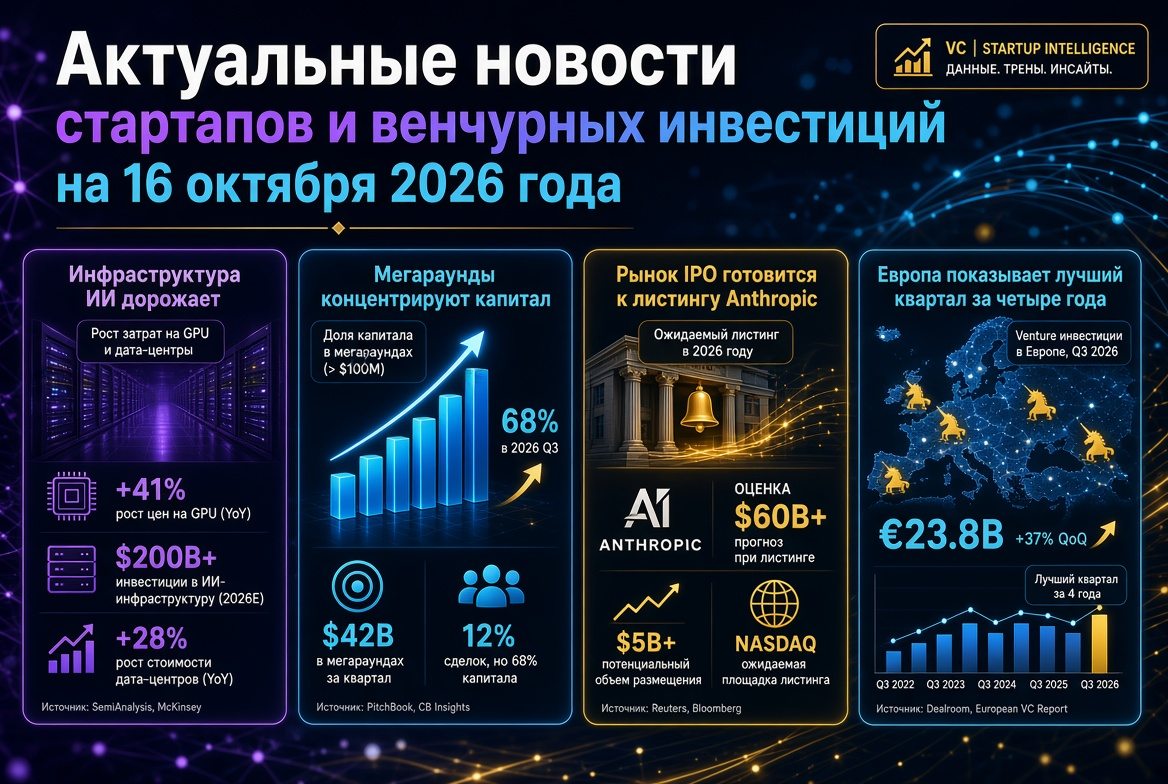
The European startup market is demonstrating notable activity. In the past reporting week, more than 70 tech deals were recorded, amounting to over €2.8 billion. Leading the capital raised were cloud infrastructure, fintech, and energy. At the country level, the United Kingdom took first place, followed by Germany and France.
For global funds, this is an important signal: Europe is no longer just a market for early scientific and engineering teams. The region is developing late-stage rounds in defense technologies, climate deep tech, energy, fintech, and industrial AI. Deals involving Helsing, Proxima Fusion, Kraken Technology, Skello, and others indicate that the European ecosystem is gradually bridging the gap between scientific research and scalable venture capital.
However, Europe still faces a shortage of growth capital. Hence, late-stage deals become particularly crucial as they allow technology companies to remain in the region and reduce dependence on American public markets.
Secondary Market Becomes a Distinct Strategy for VCs
The launch of the Acurio Secondaries I fund, with a volume of around €115 million, underscores another trend: the venture industry is searching for new liquidity mechanisms. The fund focuses on secondary transactions involving stakes in European venture funds, particularly in the segment of smaller transactions below €20 million.
This is especially relevant for venture fund managers. After several years of a weak IPO market, many limited partners demand a return of capital, while portfolios remain illiquid. Secondary transactions are becoming an interim solution between waiting for an IPO and selling to a strategic buyer.
For investors, this opens up three opportunities:
- Acquisition of stakes in mature funds with an already formed portfolio;
- Access to late-stage startups with lower technological risk;
- Potential returns due to discounts from the last valuation.
IPO Window Reopens, But Not for Everyone
The IPO market in the U.S. has approached a historical maximum in terms of capital raised. This supports the venture industry as public offerings create liquidity, return capital to limited partners, and provide funds with strong arguments for new fundraising.
However, the IPO window remains selective. The strongest demand is for companies with scale, recognizable brands, AI components, infrastructural roles, or sustainable revenue. For mid-tier startups, the public market remains challenging: investors require transparent economics, predictable growth, and proven profitability.
As of July 14, 2026, venture funds must evaluate not only the latest private valuation of a startup but also the likelihood of an exit. High valuations without a clear IPO, M&A, or secondary scenario become increasingly risky.
Early Stages: Capital Exists, But Quality Demands Have Increased
Despite the dominance of mega-rounds, early-stage investments have not vanished. Seed and Series A rounds remain active, especially in niches such as AI tools, healthtech, construction tech, climate software, cybersecurity, and vertical SaaS. However, investors have tightened their evaluation processes regarding teams.
Key criteria for early-stage startups now include:
- A clear customer pain point and short implementation cycle;
- Access to unique data or a technological core;
- Rapid verification of unit economics;
- Potential for international scalability;
- Founders with industry expertise and B2B sales experience.
A telling deal was made by Sodex Innovations, which raised €4 million for an AI platform for construction sites. Such projects demonstrate investors' interest in technologies that do not simply leverage artificial intelligence as a marketing gimmick but tackle specific industrial challenges.
Healthtech and Travel Tech: Niche Deals Remain Alive
Amid the surge of mega-rounds, it is crucial not to overlook smaller deals in healthtech and travel tech. Doctorsa raised €1 million to develop a telemedicine platform for travelers. The company operates at the intersection of international tourism, digital healthcare, and agent AI interfaces.
For venture investors, this exemplifies how small startups can occupy narrow but global niches. Not every successful project needs to be a foundation model or a defense platform. More critical is having a repeatable model, growing international demand, and a clear monetization channel.
What is Important for Venture Investors and Funds
As of July 14, 2026, the venture market appears strong but less democratic than in previous cycles. Capital is available; however, it is increasingly concentrated around companies with strategic importance, a technological barrier, and access to large corporate or governmental clients.
In the coming weeks, investors will focus on:
- New deals in defense tech and autonomous systems;
- Rounds for AI infrastructure and companies focused on reducing computing costs;
- Liquidity through IPOs, M&A, and secondary transactions;
- European scale-up funds and late rounds for deep tech companies;
- Revenue quality among Series B and Series C startups;
- Growing demand for legal AI, healthtech, and industrial automation.
The main takeaway of the day: venture investments in 2026 are again in a growth phase, but this growth is of a new type. The winners are not the trendiest startups; rather, they are companies becoming part of critical infrastructure in artificial intelligence, defense, energy, healthcare, finance, and global industry. For funds, this necessitates more rigorous selection, deep industry expertise, and a readiness to participate in significant rounds where future technological monopolies will form.