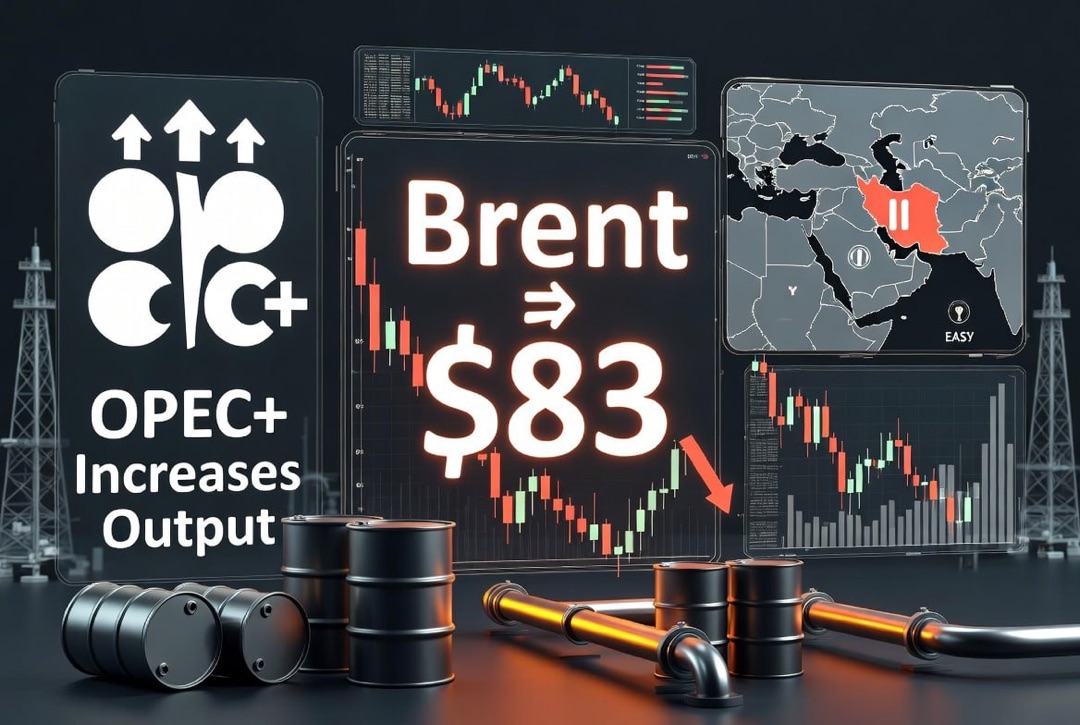
Oil Market: Brent Loses Over 5% on De-escalation Hopes
Global oil prices experienced their sharpest daily drop in several weeks on Monday, August 3. Brent futures fell approximately $4.65, or 5.3%, retreating to $83 per barrel; similarly, U.S. WTI prices declined at comparable rates. The sell-off was triggered by reports that the U.S. President postponed a planned strike against Iran in favor of pursuing a new peace agreement. According to the U.S. side, the contours of a potential deal suggest the "immediate and complete" opening of the Strait of Hormuz and the removal of the nuclear threat from Tehran.
The market is pricing in a scenario of gradual normalization of supplies from the Persian Gulf, however, volatility remains extreme. Key pricing factors as of August 4:
- Geopolitical Premium: The Strait of Hormuz has been closed to free navigation since spring 2026 — this route previously accounted for approximately 20 million barrels of oil and oil products entering the global market daily. Any news regarding negotiations is immediately reflected in the quotes.
- Export Disruptions: Supply constraints are affecting not only Gulf countries — disruptions from Russia and Kazakhstan have also supported prices throughout the year, offsetting the effect of increased OPEC+ quotas.
- Risk of Reversal: Should diplomatic processes fail and hostilities resume, prices could quickly revert to the $88–95 per barrel range.
Analysts warn that a full opening of the Strait of Hormuz could "flood" the market with oil and provoke further price corrections as deferred volumes from Saudi Arabia, Iraq, Kuwait, and the UAE begin to re-enter the global market.
Strait of Hormuz: Iran and Oman Negotiations Reach Final Stage
The diplomatic track remains the main intrigue of the week. Iran's foreign ministry has confirmed that discussions regarding safe navigation are being conducted solely with Oman — there is no direct dialogue with Washington, according to Tehran. The aim of the consultations is to establish a temporary route as soon as possible to ensure safe passage for vessels through the strait. Furthermore, the Iranian side emphasizes that an agreement on the corridor does not imply the immediate resumption of full-fledged navigation.
Among the scenarios being discussed is the opening of the so-called "Middle Corridor," a route that vessels have avoided since the conflict began due to mine threats. An additional topic has been the potential transit fees for Western commercial vessels navigating through the strait. For the energy market, the resolution of this situation will determine price trajectories for oil, LNG, and freight through the end of the year.
OPEC+: Production Increase of 188,000 Barrels per Day Starting September
In a virtual meeting on August 2, a group of eight key participants in the agreement — Saudi Arabia, Russia, Iraq, Kuwait, Kazakhstan, Algeria, and Oman — agreed to increase oil production by 188,000 barrels per day in September 2026 compared to the August level. This decision continues the gradual unwinding of voluntary restrictions that have been in place since April 2023. Key parameters of the deal include:
- The largest contributions to the increase will come from Saudi Arabia and Russia; Kazakhstan's quota has been raised by 10,000 b/d to 1.628 million barrels per day.
- Participants confirmed their commitment to fully compensate for overproduction accumulated since January 2024.
- The next ministerial meeting of the "eight" is scheduled for September 6, with a full-format meeting of all alliance countries planned for November 29, 2026.
The paradox of the current situation is that since March, producers in the Persian Gulf have been physically unable to realize rising quotas due to the closure of the Strait of Hormuz. Therefore, the actual effect of the decision on market balance will depend on progress in negotiations over the maritime corridor.
Gas Market: Europe Enters August with Minimal Reserves
The European gas market remains under tension. Spot prices at the TTF hub closed last week at around $696 per thousand cubic meters, up from $626 days earlier — reflecting the aftermath of the March shock, when escalating tensions in the Middle East and a sharp reduction in LNG production in Qatar pushed prices to $850. The fundamental outlook does not inspire optimism:
- Storage Levels: According to Gas Infrastructure Europe, as of early August, European storage facilities are only 57% full — the lowest relative level for this date in history.
- LNG Imports: Liquefied natural gas imports to Europe are expected to decline by approximately 7% year-on-year in August, down to around 6.9 million tons, reflecting a supply shortage in the global market and competition with Asia.
- Injection Rates: The injection season is lagging behind schedule, raising the risk of price spikes in the heating period of 2026/27.
The potential opening of the Strait of Hormuz and the restoration of Qatari LNG exports could radically alter the balance; however, time is running out before winter, and the risk premium in gas prices remains.
Russia: Fuel Market Faces Peak Crisis
Russia's domestic oil products market is showing the first signs of stabilization following an acute summer crisis. In July, the situation peaked: exchange prices for gasoline hit record highs, fuel limits were implemented at independent gas stations in dozens of regions, and retail prices at certain stations exceeded 100 rubles per liter. The government utilized an extensive regulatory arsenal — a ban on gasoline exports, adjustments to the damper mechanism, and restrictions on exchange trading.
As of early August, experts agree that the peak of the fuel crisis has passed: stabilization is evident in major regions, with complete market normalization expected by the end of August to early September as oil refining volumes recover and seasonal demand diminishes. However, a significant decrease in retail prices is not anticipated; rather, the market is likely to settle at the levels reached. On the export front, an increase in Russian oil supplies to India was observed in July — Asian markets remain the key sales channel amid sanctions.
Electricity and Renewable Energy: Renewables Outpace Coal
The year 2026 is set to be a watershed for the global electricity sector. The International Energy Agency estimates that this year, renewable energy sources will finally surpass coal in terms of global electricity generation. Key trends include:
- Electricity generation from renewables is expected to grow by more than 8% in 2026, with the share of renewable generation in the global energy balance increasing from 33% in 2025 to 37% by 2027.
- Solar energy remains the driving force: solar power plants are projected to contribute around 600 TWh of additional generation in the current year.
- A record installation of new capacities — 582 GW per year — has primarily come from solar generation; investments in grids and energy storage systems are also rising alongside generation.
Nonetheless, high gas prices in Europe and Asia continue to support the utilization of coal-fired power stations as backup generation, while summer peaks in energy consumption due to heat further drive demand for all types of capacity — from nuclear to gas.
Coal: Asian Demand Holds Market Steady
Despite a symbolic leadership change in global generation, the coal market remains resilient. The Asia-Pacific region — China, India, Indonesia, Vietnam — continues to rely on coal-fired power plants to meet rising energy demand, and expensive LNG makes coal an economically attractive alternative for developing economies. Energy coal exporters maintain stable sales, and in the short term, coal generation remains a safeguard for the energy system against disruptions — especially during peak loads and high gas prices.
What This Means for Investors: Key Indicators on August 4
On Tuesday, August 4, 2026, the energy market finds itself in a state of fragile equilibrium between geopolitics and fundamental factors. Investors and participants in the commodity market should closely monitor:
- Progress in negotiations regarding the Strait of Hormuz — any confirmation of the opening of the corridor will increase pressure on oil prices; a breakdown in dialogue will push Brent quotes back to $90 and above.
- Statements from Washington and Tehran — the rhetoric from both sides defines the level of geopolitical premium in oil, gas, and freight rates.
- The dynamics of gas injection into European storage facilities — lagging behind schedule raises the likelihood of price spikes on the TTF in the fall.
- The actual implementation of OPEC+ quotas — the gap between permitted and physically possible production from Gulf states remains a key intrigue in market balance.
- The stabilization of the Russian fuel market — recovery in oil refining and exchange price dynamics for gasoline will set the tone for the domestic oil products market in August–September.
The energy sector remains at the forefront of global investor attention: the combination of Middle Eastern conflict, accelerating energy transition, and the strained gas balance in Europe shapes a unique market environment where short-term price fluctuations for oil, gas, coal, and electricity will be primarily driven by diplomatic news, while medium-term trends will be determined by fundamental shifts in global energy balance.