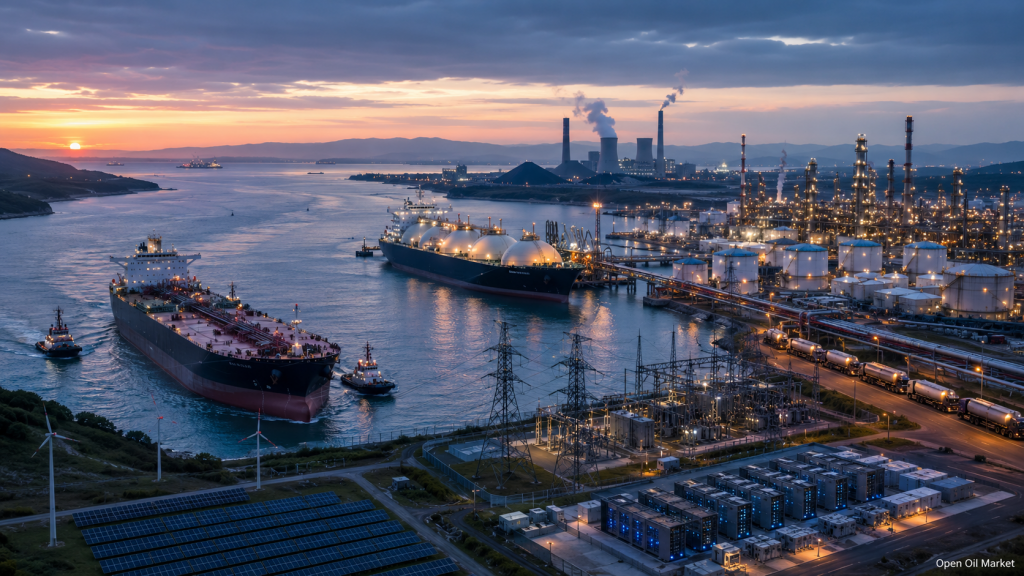
Global Fuel and Energy Complex: June 2, 2026 – Oil Tanker with Escort, Refineries, LNG Infrastructure, Petroleum Products, Power Grids, Data Centres, Solar Panels, Wind Parks, and Coal Generation
The global fuel and energy complex enters Tuesday, June 2, 2026, in a state of heightened geopolitical and price tension. For investors, energy market participants, fuel companies, oil companies, refineries, and power generators, the key theme remains the risk surrounding the Strait of Hormuz, which continues to affect oil, gas, LNG, petroleum products, coal, renewables, and the cost of electricity across different regions of the world.
A new energy configuration is taking shape on the global market: oil is trading with a significant risk premium, gas and LNG are becoming instruments of energy security, petroleum products are rising due to inventory shortages, and the power sector is increasingly dependent on heat, data centres, grids, and backup generation. Renewables continue to grow, but coal and gas retain their role as insurance fuel for power systems in Asia, Europe, and the United States.
Oil: Brent and WTI Remain Under the Influence of the Middle East
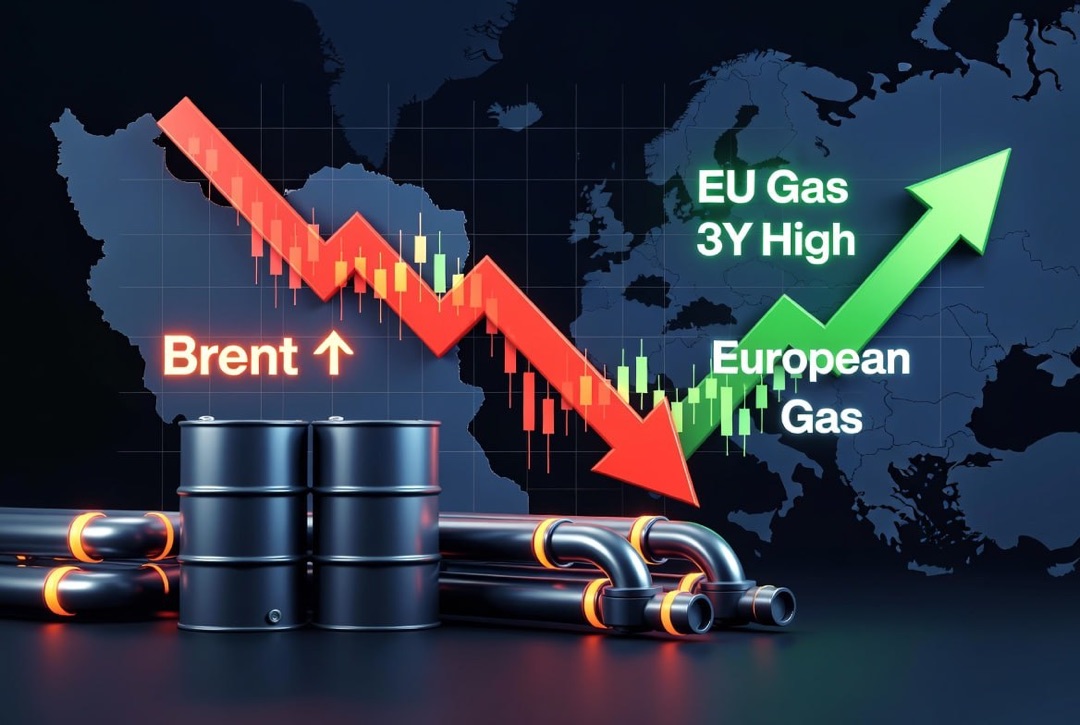
The oil market remains highly sensitive to news about US-Iran negotiations, attacks in the region, and the prospects for restoring normal shipping through the Strait of Hormuz. At the start of June, Brent holds near elevated levels, while WTI trades around a psychologically important zone, reflecting investor concerns about physical oil supply.
For the oil market today, it is not only futures quotes that matter, but also the real ability to deliver barrels to buyers. Even if production can be formally increased, constraints in logistics, freight, insurance, and shipping routes create an additional premium in prices. This is particularly important for countries in Asia and Europe that depend on imported oil and petroleum products.
- Brent remains the key indicator of global risk in the oil and gas sector.
- WTI reflects the balance between the strong US domestic market and global supply deficits.
- Physical logistics is becoming more important than formal production announcements.
- High oil supports the upstream segment but pressures fuel consumers.
OPEC+: The Market Awaits Signals on July Production
OPEC+ remains one of the central factors for the oil market. Energy market participants are awaiting signals on July quotas, but the significance of the alliance’s upcoming decision no longer appears straightforward. Under normal circumstances, an increase in production targets could cool prices, but now the main question is whether countries can physically bring additional volumes to the global market.
For investors, it is important to distinguish between two concepts: the production quota and export availability. If oil cannot be shipped quickly and safely through key sea routes, then a quota increase becomes more of a political and psychological signal than a real supply factor. Consequently, the market will assess not only OPEC+ press releases but also tanker flow dynamics, insurance premiums, and inventories at major consumers.
Gas and LNG: Investment Shifts Toward Reliable Routes
The gas market in June 2026 is becoming one of the main areas of investment focus. Rising investment in natural gas and LNG reflects a global shift toward supply security. Countries in Asia, Europe, and the Middle East are seeking to diversify contracts, routes, and suppliers to reduce dependence on individual bottlenecks in global energy trade.
LNG is gaining additional significance as a flexible supply tool. The United States, Canada, Australia, Qatar, and other exporters are strengthening their roles in the global gas balance. At the same time, high terminal utilization, tanker fleet costs, and competition between Europe and Asia limit any rapid increase in available supply.
- Europe continues to seek a stable replacement for unreliable gas flows.
- Asia competes for LNG amid heat and rising electricity demand.
- The US benefits from its role as a major supplier, but its domestic gas market remains uneven.
- New LNG projects require substantial investment and long-term contracts.
Petroleum Products and Refineries: Gasoline, Diesel, and Jet Fuel Become a Separate Risk
The petroleum products market remains one of the most sensitive segments of the global energy complex. In the United States, gasoline inventories have declined for several consecutive weeks and are approaching low seasonal levels, putting additional pressure on prices during the summer driving season. For refineries, this creates a favourable margin environment but simultaneously increases responsibility for supply stability.
Diesel, gasoline, and aviation fuel are becoming strategic commodities. Expensive oil matters in itself, but for the broader economy, the cost of petroleum products is even more critical: they directly affect transportation, logistics, aviation, agriculture, and industry. Refineries with high conversion capacity and access to stable feedstock can gain an advantage in such a market environment.
Electric Power: Heat, AI, and Grids Increase Load
The electric power sector remains key for investors in 2026. Demand growth is driven not only by seasonal heat but also by the expansion of data centres, artificial intelligence, transport electrification, and industrial automation. As a result, power systems in the United States, Europe, and Asia face the need to simultaneously increase generation, modernize grids, and build energy storage.
For energy companies, this means a shift in investment logic. Previously, the central issue was generation cost; now, grid reliability, reserve capacity, demand flexibility, and fuel availability are gaining importance. Gas-fired plants, coal capacity, nuclear power, renewables, and batteries are becoming parts of one system rather than separate competing directions.
- Data centres are boosting base electricity demand.
- Heat increases peak consumption due to air conditioning.
- Grids are becoming a bottleneck for adding renewables and new industrial loads.
- Gas and coal retain their role as backup generation.
Coal: Asia Returns to Insurance Fuel
Despite the long-term energy transition, coal retains an important role in global energy. In Asia, imports of thermal coal are increasing amid heat, LNG constraints, and the need to ensure stable generation. China, India, Japan, South Korea, and Southeast Asian countries still view coal as a resource for energy security.
For investors, the coal market remains contradictory. On one hand, climate policy and ESG requirements limit long-term investment appeal. On the other, the physical need for electricity and gas market instability support demand. Therefore, in 2026, coal cannot be excluded from analysis of the global energy complex, especially when assessing Asian power systems.
Renewables and Storage: Growth Continues, but the Market Requires Infrastructure
Renewables remain one of the largest areas of global energy investment. Solar and wind generation continue to expand, but the key challenge is increasingly not about building plants, but about grid connection, energy storage, and load balancing. Without grids and batteries, even rapid renewable growth does not fully solve the energy security problem.
In 2026, investors are paying closer attention to projects that combine generation, storage, digital management, and long-term power purchase agreements. Markets where renewables help reduce dependence on imported oil, gas, and coal look particularly promising.
Investment in the Energy Complex: Capital Flows to Both Traditional and Low-Carbon Energy
Global energy investment shows that the world is not abandoning oil, gas, and coal, while simultaneously accelerating spending on grids, renewables, storage, nuclear power, energy efficiency, and electrification. This capital structure reflects a dual objective: ensuring current energy security and preparing infrastructure for future demand.
For oil and gas companies, this means the need to diversify. The most resilient appear to be companies with production, refining, trading, gas assets, LNG access, petrochemicals, and participation in the power sector. A simple bet solely on higher oil prices can be profitable in the short term but is strategically risky.
What Matters for Investors and Energy Market Participants on June 2, 2026
On Tuesday, June 2, 2026, the global oil and gas sector and the broader energy industry remain in a phase of risk reassessment. The central theme is not only the price of oil but also the resilience of the entire supply chain: from production and marine logistics to refineries, petroleum products, power grids, and end consumers.
For investors, oil companies, fuel companies, and energy market participants, the key benchmarks are:
- Brent and WTI price dynamics amid Middle East negotiations;
- OPEC+ decisions and signals on July production;
- Inventories of gasoline, diesel, and jet fuel;
- LNG demand in Europe and Asia;
- Electric power system load due to heat and data centres;
- The growing role of coal as insurance fuel;
- Investment in renewables, storage, and grid infrastructure.
The main takeaway for the global market is that energy is once again becoming a central macroeconomic factor. Oil, gas, petroleum products, refineries, electricity, renewables, and coal directly influence inflation, industry, transportation, the cost of capital, and investment strategies. In such an environment, companies and countries that can do more than simply extract resources—those able to manage the entire energy chain, from feedstock to final electricity and fuel—gain the advantage.