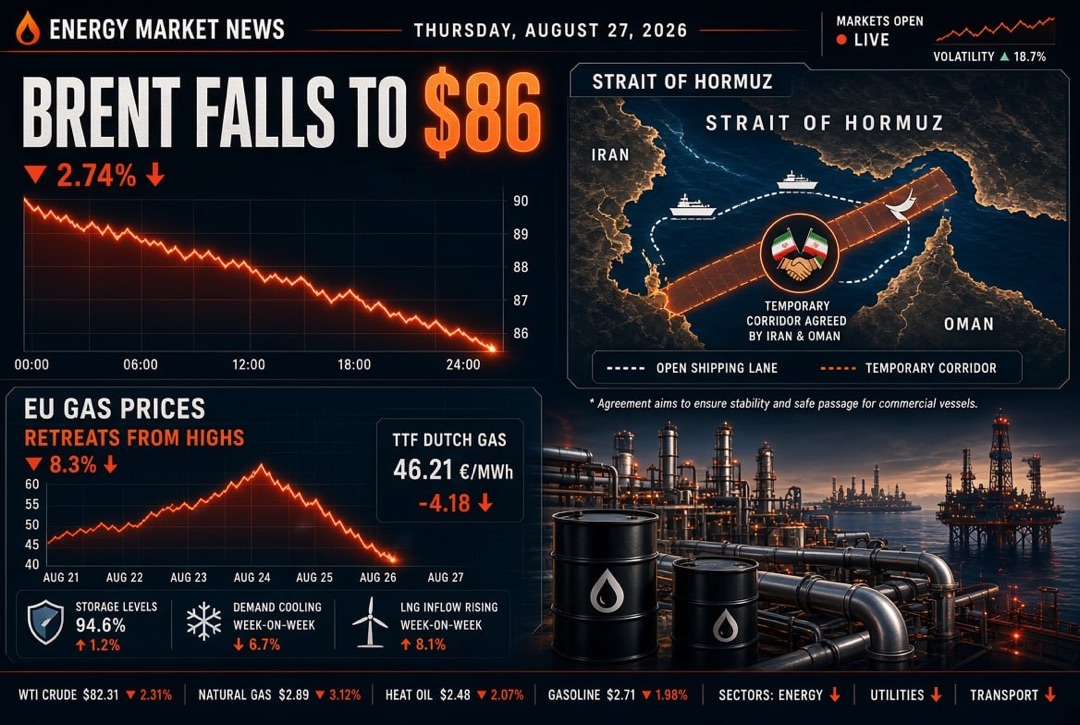
Oil Market: Third Session of Declines, Brent at $86, WTI at $80
Oil prices continued to decline on Wednesday for the third consecutive day: Brent fell by about 3% to $86 per barrel, while WTI dropped to $80. On Tuesday, Brent closed below $89, and since the start of the week, both benchmarks have lost 8-9%. This is the deepest weekly correction since mid-June when the market was reacting to the first U.S.-Iranian memorandum. However, compared to pre-war levels (around $71 in late February), Brent is still trading at a premium of about 20%.
Key Price Drivers for August 27
- Diplomacy in the Strait of Hormuz: The joint statement from Tehran and Muscat regarding a temporary corridor is perceived as the first practical step towards increasing transit after the June memorandum’s failure.
- U.S. Sanctions Proving Softer: Washington has not imposed secondary sanctions against Iran's trading partners, opting for a "correction period" with targeted inclusions in the OFAC lists.
- Signs of De-escalation: The visit of Pakistan's Chief of Army Staff to Tehran, continued Qatari mediation, and reports of the potential return of evacuated U.S. diplomats to the region reduce the likelihood of a new round of strikes.
- U.S. Inventories: According to the API, commercial oil inventories increased by 4.2 million barrels in the week ending August 21, against expectations of an increase between 0.6-1.9 million, which added pressure to prices.
The forecast backdrop remains mixed. The U.S. Energy Information Administration (EIA) expects an average Brent price of about $85 in the third quarter and a continued decline in Middle Eastern production of around 600,000 barrels per day until the end of 2027. The IEA in its August report estimates a reduction in global oil demand in 2026 of 1.6 million barrels per day, followed by a recovery of 2.4 million in 2027; reported global inventories in July decreased by 69 million barrels, and refinery utilization remains nearly 5 million barrels per day below last year’s levels. Crack spreads for diesel and jet fuel in the Atlantic Basin remain at record levels, thus keeping the physical products market significantly tighter than Brent prices might suggest.
Strait of Hormuz: Temporary Corridor Iran - Oman and Demining Project
The main news of the week has come from Tehran. Following the visit of Oman’s Foreign Minister Badr al-Busaidi to Iranian counterpart Abbas Araghchi, the parties announced an agreement on a "phased framework," which could serve as a practical basis for restoring safe navigation. The document includes:
- Establishment of a temporary joint navigation corridor through the Strait of Hormuz;
- A joint project for the clearance of mines from the Strait;
- Continuing technical discussions regarding a permanent corridor, future Strait administration, information sharing, traffic management, and providing navigation and security services;
- Inclusion of other Gulf Coast states in the dialogue.
Iran's Deputy Foreign Minister Kazem Garibabadi clarified that the inbound route to the Persian Gulf will pass entirely through Iranian waters, while the outbound will traverse Iranian and Omani waters; additional negotiations will take 30-60 days. Al-Busaidi expressed hope of announcing the launch of the corridor "soon." Two crucial caveats for the market are worth noting. First, the U.S. still insists on freedom of navigation along the southern route near Oman under naval protection, rather than under Iranian control. Secondly, the mention of demining contradicts recent U.S. statements claiming that mines have already been removed, although the American side reported the demining of a central part of the Strait. Risks remain: on Tuesday, the British center UKMTO reported an attack on a tanker by an unidentified projectile near the Omani coast close to the entrance to the Strait. Before the war, about 20 million barrels per day of oil and oil products passed through Hormuz; industry analysts estimate that the market is still missing around 8 million barrels per day.
U.S. Sanctions: "Economic Outcast" Without Secondary Measures for Now
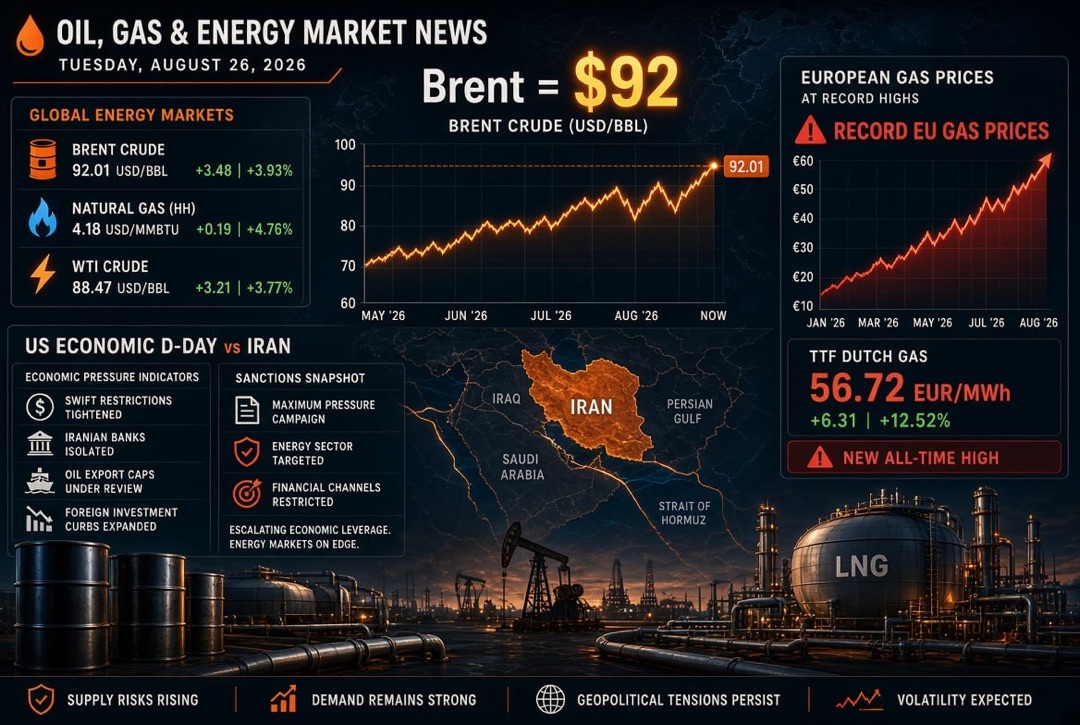
The campaign “Economic Outcast Operation” announced by the U.S. Treasury on August 24 was presented as "economic D-Day," but its first phase has turned out to be more of a warning. The sectoral definitions touched on digital assets, technology, gold, aviation, and maritime transport, with around 60 entities, individuals, and vessels related to the export of Iranian oil listed under OFAC. However, secondary sanctions against partnering countries have not been introduced: Minister Scott Besant talks about a "correction period" and individual timelines for specific countries, refusing to name them or set deadlines. A decision regarding an unnamed financial institution has been promised by the end of the week.
The reactions from counterparties have been telling. The UAE announced the cessation of all trade with Iran; Beijing urged Washington to "act rationally"; the head of Iran's Central Bank stated that the new measures do not add pressure, as the country had already accumulated currency reserves in advance. A key issue for the oil market is whether the administration will opt for sanctions against Chinese banks ahead of the anticipated visit of Xi Jinping. For now, the market is pricing in that it will not.
U.S. Inventories: SPR Approaching Operational Minimum
The API report for the week ending August 21 served as a cold shower for bulls. Against the backdrop of an increase in oil inventories by 4.2 million barrels, gasoline stocks decreased by 3.2 million, and distillates by 0.5 million, while stocks in Cushing rose by 1 million. The strategic reserve saw a drawdown of another 3.7 million barrels in a week, bringing levels to 289.7 million, close to the widely accepted operational minimum of 250-300 million. According to the latest official EIA data, commercial oil stocks were at the five-year average, while gasoline stocks were 5% lower and distillates 13% below normal. The official EIA statistics for the reporting week were released on Wednesday evening, and this will determine whether such a significant increase can be confirmed.
OPEC+: Quota Increase Suspension to Be Reviewed on September 6
The September quota increase of 188,000 barrels per day marked the end of the voluntary cuts of 1.65 million barrels per day implemented in 2023. Seven alliance countries (Saudi Arabia, Russia, Iraq, Kuwait, Kazakhstan, Algeria, Oman; the UAE exited OPEC in May) will meet on September 6, and the base market scenario is a pause into the fourth quarter as preparations are made for the negotiations on quotas for 2027, where Iraq is seeking a "fair share." Due to export restrictions in the Gulf, Russia, and Kazakhstan, paper increases in quotas this year have not reached the physical market effectively, so with the real opening of Hormuz, the alliance will have to manage a potential surplus.
Gas and LNG: TTF Retreats from €68, EU Storage at 63%
The European gas market remains the most vulnerable segment of the energy sector; however, a respite has emerged here as well. TTF futures fell below €67/MWh after peaking at €68.46 on Monday, the highest level since January 2023. This decline reflects hopes for de-escalation and the absence of a physical impact on supplies due to new U.S. sanctions. Nevertheless, the fundamental picture has not changed:
- Inventories: EU storage is filled to approximately 63% against a seasonal norm of about 80%; the target level for November 1 has been lowered from 90% to 80%, and the current injection rate allows only for a rise to around 80-81%.
- Qatari LNG: The return to a full shipping schedule to Europe is unlikely before the beginning of the fourth quarter, considering demining timelines.
- Norway: Equinor launched the second phase of Troll Phase 3 on August 22, several months ahead of schedule, accelerating the extraction of 55 billion cubic meters; this supports export from the field covering approximately 10% of European demand but does not add new resources.
- Asia: Spot LNG JKM is holding around $21-22/MMBtu, with the spread to the American Henry Hub (below $3/MMBtu at record U.S. production levels) continuing to justify a wave of investments in export terminals.
Electricity and Renewables: Heat, Storage, and Growing Solar Share
The summer of 2026 confirms that the energy transition is accelerating, yet networks remain under stress. In Japan, wholesale electricity prices reached their highest level since 2023 amid heat and increasing cooling demand. In the U.S., according to the EIA, solar generation grew by 21% in the first half of the year, hydro by 9%, wind by 6%, while coal production fell by 11%; in the second half of the year, hydro generation is expected to decrease by 3% due to drought conditions in the West. Ember notes that in 2025, renewable sources surpassed coal for the first time in the global balance (33.8% compared to 33.0%), while battery costs fell by 45% with a 46% increase in storage capacity to 250 GWh. The IEA, however, reminds that coal will remain the largest single source of electricity at least until 2030, and the war in the Gulf has temporarily restored its competitiveness in Europe and Asia due to expensive gas.
Coal: Newcastle Above $131 - Three-Week High
Energy coal in Newcastle surged to $131-132 per tonne, up by 18% from a year ago, amid heat in Japan, signals of stimulus in China, and the continued switch from gas to coal. European ARA is trading around $122/t, while Australian coking coal is approximately $236/t. The EIA has raised its coal export forecast from the U.S. for 2026 to 102 million short tons. China is betting on consolidation and "intellectualization" of mines in its new five-year plan while aggressively closing outdated facilities, which limits supply elasticity.
Russia: Diesel Export Ban Extended at Least Until the End of September
According to industry sources, the Russian government intends to extend the full ban on diesel fuel exports, which has been in place since early July and is set to expire on August 31, at least until the end of September, with discussions on prolongation until the end of the year. The ban on gasoline exports remains until January 31, 2027, and on jet fuel until the end of November. Fuel shortages have returned to certain regions in August after a brief respite; to saturate the market, Russia is importing petroleum products from Asia and Belarus, while Deputy Prime Minister Alexander Novak reports several refineries are exiting unscheduled repairs. Meanwhile, crude oil exports remain high: in July, India imported a record 2.8 million barrels per day of Russian oil, while the average Urals price of around $60 remained significantly above the G7 price cap of $44.10.
What to Watch on August 27: Calendar for Energy Market Participants
- Official announcement of the Iran-Oman temporary corridor and U.S. response to the Iranian-controlled entry route scheme.
- Promised decision from the U.S. Treasury on the financial institution and the first “deadlines” for Iran's partner countries.
- Results of the EIA report on oil and petroleum products inventories in the U.S. and SPR dynamics.
- Investigation into the attack on the tanker off the Omani coast, insurers' and shipowners' positions.
- Injection into EU storage and keeping TTF below €67/MWh.
- Signals from OPEC+ delegations ahead of the September 6 meeting.
- Russian government decision on the timing of the diesel export ban.
In conclusion: The oil market has received a documentary basis for reducing the geopolitical premium for the first time in a month; however, between the statement regarding the corridor and the actual increase in transit through the Strait of Hormuz lie demining, route agreements with the U.S., and 30-60 days of technical negotiations. The European gas market is entering the heating season with storage deficits, while coal and renewables are simultaneously increasing their positions in the global energy sector. Daily analytics on the energy market can be found in the Open Oil Market Telegram channel.