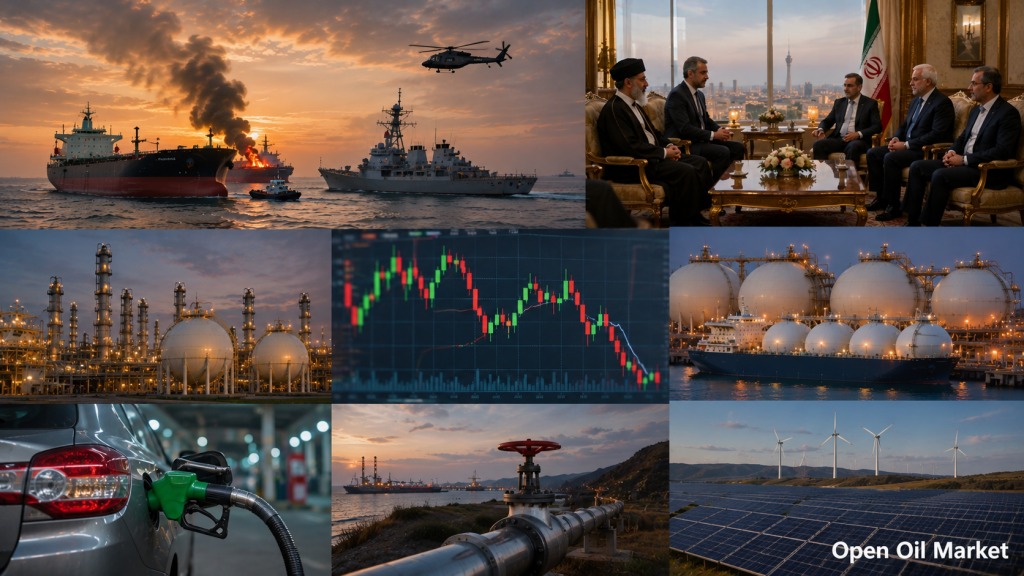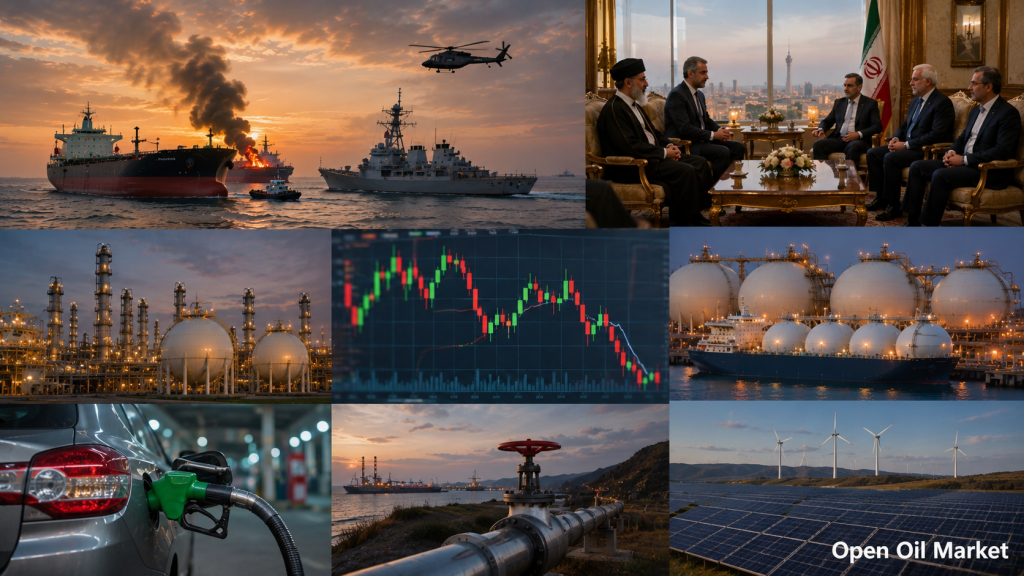
Energy Sector Overview July 27, 2026: Diplomacy in the Strait of Hormuz Moves the Oil Market, TTF Gas Holds Near Multi-Year Highs, OPEC+ Prepares to Decide on September Quotas
The global fuel and energy sector begins the week at a juncture where pricing is dictated not by the balance of supply and demand, but by the outcomes of diplomatic discussions. The weekend brought the market its first pronounced signal of de-escalation in a month: following two rounds of consultations in Tehran, Iran and Oman announced progress in developing a framework for safe navigation through the Strait of Hormuz, while U.S. media reported that the United States has suspended a series of strikes to avoid derailing the dialogue. Brent crude oil retreated from the $100 per barrel mark by Friday, and Monday promises high volatility across the oil and gas sectors. Below is a detailed overview of key energy sector news for investors, fuel distributors, and oil companies.
Key Developments for Monday Morning, July 27, 2026
- Oil: Brent ended Friday near $96.8 per barrel after Thursday's closing at $100.69; WTI was around $89. Weekly gains were at ~8%, while monthly gains exceeded 30%.
- Geopolitics: Negotiation rounds between Iran and Oman regarding the Strait of Hormuz were held on July 24-25; no agreement has been reached yet, but both sides agreed to continue the dialogue.
- Gas: TTF prices remain close to highs last seen in January 2023; EU storage levels are around 54%, the lowest since 2021.
- Logistics: Loadings at the Caspian Pipeline Consortium terminal near Novorossiysk remain suspended.
- Russia: The ban on gasoline exports has been extended until the end of 2026; restrictions on diesel will be lifted as the market recovers.
- Week’s Calendar: FOMC meeting on July 28-29, OPEC+ meeting on August 2, major companies' reports starting July 30.
Oil Market: Risk Premium vs. Diplomacy
The oil market enters the week with an unprecedentedly broad range of scenarios. Over the month, Brent crude fluctuated from $70 to $102 per barrel and back, with an average price in July exceeding $81. Friday's correction of 4-5% was a direct reaction to signals indicating the resumption of negotiations, including mediation efforts supported by China, for whom disruptions in the Persian Gulf represent a direct threat to the economic interests of the world's largest raw material importer.
Factors Supporting Prices
- The absence of a final agreement regarding the Strait of Hormuz, through which approximately one-fifth of global oil trade historically occurs.
- Global production in June recovered to 98.8 million barrels per day, but remains about 9.4 million barrels per day below pre-war levels.
- Crack spreads and refinery margins are at four-year highs amid shortages of light oil products.
- Suspension of Kazakh exports is removing over 1% of global supply from the market.
Price Pressures
- EIA forecast: global oil consumption in 2026 is expected to decline by an average of 1.2 million barrels per day, mainly from Asian countries.
- Anticipated return of significant volumes of crude oil to the market as transit normalizes.
- Risk of tightening monetary policy: futures contracts indicate nearly a 40% probability of the Fed raising interest rates during the July 28-29 meeting.
OPEC+: On August 2, the Alliance Approaches Quota Restoration Limit
The monitoring committee meeting and the gathering of countries with voluntary restrictions are scheduled for August 2. August quotas have been increased by 188,000 barrels per day—to 9.887 million for Russia, 10.416 million for Saudi Arabia, 4.405 million for Iraq, 2.660 million for Kuwait, 1.618 million for Kazakhstan, 1.001 million for Algeria, and 836,000 barrels per day for Oman. A similar step is expected for September, which would effectively complete the market's return of the previously lifted 1.65 million barrels per day, accounting for the UAE's share, which exited the alliance on May 1.
The key intrigue shifts to October: once the current quota schedule expires, the alliance will need to establish a new policy configuration, especially when paper quotas deviate from physical realities. Kazakhstan consistently produces well above the permitted level, and a significant portion of OPEC+'s spare capacity is geographically linked to the Persian Gulf.
Gas Market: Europe Loses Competition for LNG
European gas remains the second epicenter of the energy crisis. TTF prices are holding close to highs from January 2023, roughly equivalent to $700 per thousand cubic meters. EU underground storage levels are around 54%, the worst figure since 2021, and the injection rates are slowing down: from 308 million cubic meters per day in June to approximately 270 million in July, compared to 338 million a year ago.
The root causes are structural: reduction in Qatari LNG supplies, redirection of U.S. shipments to premium Asian markets, abnormal heat increasing demand for electricity for air conditioning, and rising freight and insurance rates. Asian imports in July reached a six-month high, while European imports dropped to a two-year low. The risk of storage facilities not being adequately filled before the heating season remains the primary medium-term threat to the EU's industry and a driving force for inflation.
CPC and Logistics: Kazakhstan's Exports Under Pressure
Loading operations at the Caspian Pipeline Consortium's marine terminal have been suspended following drone attacks on tankers. Kazakhstan has been forced to reduce daily production to avoid overflowing its storage tanks. CPC accounts for approximately 80-90% of the Republic's oil exports; in 2025, about 63 million tons of crude passed through the system. Partial rerouting of volumes via the Baku-Tbilisi-Ceyhan route does not compensate for the loss, and European refineries, geared towards the light low-sulfur CPC Blend, are compelled to seek substitute shipments.
Russia: Fuel Market and Extension of Gasoline Export Ban
The domestic petroleum products market is experiencing its most challenging season in recent years. Shortages caused by unplanned refinery shutdowns, seasonal peak demand, and logistical constraints are being addressed through administrative measures. A key decision over the weekend was the extension of the gasoline export ban, initially imposed on July 8 and originally set to expire on July 31, now extended until the end of 2026, applying to both producers and non-producers. Restrictions on diesel fuel are expected to be lifted gradually as the market stabilizes.
The active package of measures includes:
- Reduction of mandatory exchange sale quotas for gasoline from 15% to 10% and limits on daily price changes;
- Zeroing import duties and increasing imports of petroleum products, primarily from Belarus;
- Maximum utilization of capacity, postponement of planned repairs, and engagement of medium and small refinery capacities;
- Priority supply for agricultural producers during the harvest campaign and northern deliveries;
- Antitrust investigations against wholesale participants.
Retail prices are currently rising at a slower pace than wholesale prices: the average price for AI-92 is around 67.9 rubles per liter, while AI-95 is approximately 72.1 rubles. Support for the refining economy is provided by a damping mechanism, with payments exceeding 200 billion rubles in May.
Oil Exports and Discounts on Urals
Sanction infrastructure continues to keep realized prices below exchange indicators. The Urals discount on FOB Primorsk delivery to Dated Brent averaged about $25 per barrel in June, up from $21 in May, with a five-year average of less than $20, and nearly widened to $28 at the beginning of July. Discounts on shipments to India have again exceeded $10 per barrel amid the return of Middle Eastern volumes and decreased activity from Chinese independent refiners. At the same time, marine crude oil exports in June reached 4.4 million barrels per day, significantly higher than a year ago. For oil companies, this means that rising benchmark prices improve revenue, but the effect is partially offset by widening discounts and freight costs.
Coal: Fuel of Last Resort
The coal market remains a beneficiary of the gas deficit. Australian thermal coal Newcastle is trading around $130 per ton, while the South African index 6000 ranges between $116 and $119. Additional demand in the Asia-Pacific region to replace lost LNG is estimated at 70-90 million tons in 2026, with Japan, South Korea, and Taiwan leading in coal generation growth. Simultaneously, there is a correction towards the Chinese market: prices for Russian coal in China have decreased to about $105 per ton due to high stockpiles and reduced electricity consumption. Major mining companies interpret the surge in demand as cyclical and are hesitant to approve new projects.
Electricity and Renewables: A Record Year Despite the Crisis
The energy shock has not stalled but accelerated the energy transition. According to the updated forecast from the International Energy Agency, global electricity demand is expected to rise by 3.6% in 2026 and by 3.8% in 2027—approximately from 28,600 TWh to 30,700 TWh. The driving forces behind this growth are industry, air conditioning, electric transport, and data processing centers.
- Renewable generation in 2026 is set to surpass coal for the first time globally.
- Solar energy is expected to add around 600 TWh and surpass wind, becoming the second source of renewable energy after hydropower.
- The share of renewables in global generation is projected to grow from 33% to 37% by 2027; in Germany, this figure reached 58% in the first half of 2026.
- Total investments in the global energy sector are estimated at $3.4 trillion, with approximately $2.2 trillion dedicated to low-carbon technologies and networks.
- Investments in energy storage systems are anticipated to exceed $100 billion for the first time—response to the increasing number of periods with negative electricity prices.
Week’s Calendar: What Will Determine the Energy Sector Dynamics
- July 28-29: Meeting of the U.S. Federal Reserve. The current interest rate range is 3.50-3.75%, with the market perceiving an increase as a likely but not base scenario.
- July 29-31: U.S. GDP data for the second quarter and weekly statistics on oil and petroleum product inventories.
- July 30: Shell's Q2 report. The company has pre-oriented the market towards a refining margin of around $20 per barrel versus $17 the previous quarter, amidst a reduction in integrated gas segment output due to the situation in Qatar.
- July 31: Results from ExxonMobil and Chevron—indicators of the impact of the price rally on major companies' profits.
- August 2: OPEC+ meeting regarding September quotas.
Conclusions for Investors and Energy Sector Participants
The market remains in a mode where a single piece of news can shift prices by $5-10 per barrel within a session. Practical guidelines for the upcoming week include:
- Hedging is essential. Price fluctuations of 5-7% during sessions pose unacceptable risks for fuel companies and traders with open positions in oil, gas, and petroleum products.
- Logistics are more critical than geology. The Strait of Hormuz, Bab el-Mandeb, and Novorossiysk have shown that the cost of a barrel is determined by the throughput of chokepoints, rather than the volume of reserves underground.
- Refining margins are a key variable. High crack spreads support refineries where selling prices are not administratively restricted.
- Winter risks in Europe have not been eliminated. Delays in storage filling create potential for a new price impulse in the gas market in the fourth quarter.
- Assets with predictable cash flow are being revaluated upwards. Coal, nuclear generation, and renewables with long contract horizons receive a premium for independence from geopolitical supply chains.
The base scenario for the week is sustained heightened volatility with attempts for Brent crude to stabilize in the range of $88-98 per barrel. A downward breakthrough is possible if a deal on the Strait of Hormuz is signed, while an upward breakthrough could occur if negotiations collapse and strikes resume. Economic participants in the energy sector should anticipate that the phase of heightened uncertainty in the oil, gas, and energy sectors will continue at least until the end of the third quarter of 2026.