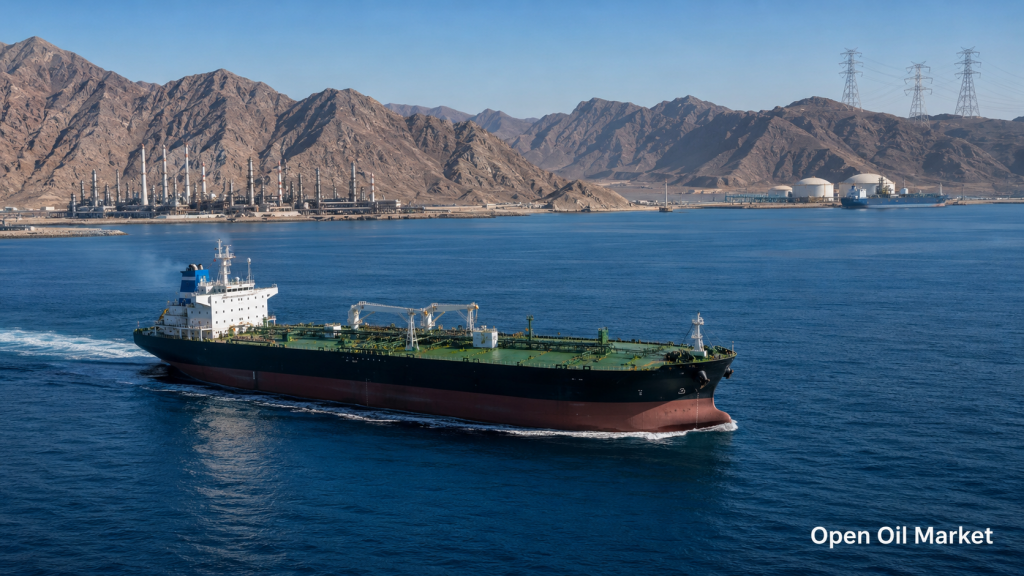
Global Energy Market: Oil Tanker Navigates the Strait of Hormuz Amid Refineries, LNG Infrastructure, and Power Lines
The global fuel and energy sector enters a state of fragile stabilization on Sunday, June 28, 2026. Following a partial recovery in shipping through the Strait of Hormuz, the oil market has begun to ease geopolitical premiums: Brent and WTI have retreated from peaks as traders reassess not only supply risks but also the weakness of demand. However, for investors, energy market participants, oil companies, refineries, and fuel suppliers, the main takeaway is not merely the lower cost of oil. Tensions persist in refining, diesel, LNG, power generation, coal, grid infrastructure, and renewable energy sources (RES).
The global energy landscape is increasingly bifurcating into two contours. The first is the raw commodity market, where oil responds to logistical recovery and expectations of supply growth. The second is the energy reliability market, where a shortage of oil products, expensive flexibility in energy systems, the need for LNG, and rising demand from data centers maintain high investment spending. For the global market, this indicates a transition from short-term panic to a more complex phase: oil prices may decline, but the cost of sustainable energy supply remains high.
Oil: Geopolitical Premium Eases, Yet Market Remains Nervous
A key event for the oil market has been the recovery of tanker movements through the Strait of Hormuz. After several weeks of military and political uncertainty, market participants began to reassess the risk of supply disruptions from the Persian Gulf. Against this backdrop, Brent returned to levels close to pre-war values, with WTI also declining alongside improved logistics.
For investors, it is crucial to note that the decline in oil prices is now tied to multiple factors beyond just geopolitics:
- Expectations of a recovery in supplies from Persian Gulf countries;
- Increased exports from alternative regions, including the Atlantic basin;
- Weak fuel demand in several Asian economies;
- Forecasts for declining global oil consumption in 2026;
- Concerns regarding inventory accumulation as supply routes normalize.
Oil remains a central asset for the global energy sector, but the short-term market structure is changing. While investors were buying oil as a hedge against shortages in May and early June, by the end of June, the focus has shifted to questions of how quickly the physical market can restore volumes without a new surplus of supply.
OPEC+ and Production: Balancing Quota Recovery and Concerns Over Surpluses
OPEC+ continues to cautiously return some production to the market. July's quota increase is viewed as a signal that the alliance aims to regain control over the supply balance following the shock around Hormuz. However, internal disagreements persist within the group: some producers are keen to revise quotas as the current system of restrictions no longer fully reflects their production capabilities and budgetary needs.
For oil companies and investors, this creates a mixed picture. On one hand, increased quotas limit the potential for a new rally in Brent and WTI. On the other hand, not all participants are capable of swiftly ramping up production due to infrastructural, political, and logistical constraints. Hence, actual supply may grow slower than formal quotas suggest.
In the U.S., however, oil and gas activity is on the rise: the increase in drilling rigs indicates that producers are responding to high volatility and sustained demand for energy resources. American oil and gas production remains a crucial stabilizer for the global market, particularly against the backdrop of rising LNG exports and the necessity for supplies beyond the Middle East.
Gas and LNG: Market Stabilizes, Yet Cheap Gas Remains Elusive
By the end of June, the gas market appears calmer than the oil market, but this tranquility is relative. The reduction of the geopolitical premium following the recovery in Hormuz has diminished the risk of panic-driven price spikes; however, LNG remains a strategically scarce resource. Europe continues to prepare for the winter season, Asia maintains high import demand, and repairs and restoration of some Middle Eastern infrastructure may take considerable time.
Key factors in the gas and LNG market include:
- Europe accelerates the filling of gas storage facilities and increasingly depends on LNG.
- Asia competes for flexible cargoes, especially during heat waves and rising electricity demand.
- The U.S. solidifies its position as the largest LNG exporter and key supplier for Europe.
- Qatar and other producers from the Persian Gulf remain critically important for long-term balance.
- Long-term contracts are regaining favor over spot purchases.
For energy sector investors, this means that gas infrastructure—LNG plants, regasification terminals, gas transportation systems, and storage facilities—remains one of the most resilient investment avenues. Even with declining short-term prices, demand for energy security supports the investment cycle.
Refineries and Oil Products: Diesel Remains the Most Pressured Segment
The most significant divergence within the market is observed between crude oil and oil products. Oil prices are falling, yet diesel margins remain elevated. This reflects a structural deficit in refining capacities, low stocks of distillates, and supply disruptions of oil products from certain regions.
For refineries, the current scenario presents both opportunities and risks. High crack spreads sustain refining profitability, especially for diesel, jet fuel, and certain types of middle distillates. However, operational risks are mounting: maintenance campaigns, attacks on infrastructure, export restrictions, logistical failures, and alterations in feedstock quality are increasing the cost of stable operations.
In the oil products market, three indicators warrant attention:
- Stock levels of diesel and distillates in the U.S., Europe, and Asia;
- Refining margins for complex refineries;
- Export restrictions and internal fuel shortages in major producing countries.
For fuel companies, this means that the price of oil is no longer the sole benchmark; the availability of specific products—diesel, gasoline, fuel oil, bitumen, jet fuel, and marine fuel—becomes increasingly significant.
Power Generation: Demand Growing Faster Than Networks
The global power sector is evolving into the main battlefield for investment. Increased consumption from industries, air conditioning, electric vehicles, and data centers is intensifying pressure on energy systems. Particularly rapid is the growth of needs from AI infrastructure: data centers require not only substantial electricity volumes but also high reliability, backup, and connectivity to grids.
The challenge lies in the fact that generation capacity is being built faster than networks can accommodate. In many countries, projects for solar and wind generation, energy storage, and large industrial consumers are in queues for connection. This transforms power grids into a bottleneck for the energy transition and creates a new investment logic: not only electricity producers benefit but also network owners, equipment suppliers, storage developers, and companies capable of providing balancing services.
For the global energy sector, this represents a strategic shift. Power generation is no longer a secondary segment relative to oil and gas; it is becoming a standalone center of capital investment, where network constraints can determine the cost of energy as much as fuel prices do.
Renewables and Storage: Energy Transition Accelerates, but Reserves Are Needed
Renewable energy sources continue to attract record investments. Solar power, wind farms, energy storage systems, hydrogen projects, networks, and digital energy management remain a priority for governments and institutional investors. The geopolitical crisis has only enhanced this trend: countries are striving to reduce dependence on imported hydrocarbons and increase energy sovereignty.
However, renewables do not eliminate the need for gas, coal, nuclear generation, and backup capacities. The higher the share of solar and wind, the more critical become:
- Energy storage systems;
- Flexible gas power plants;
- Inter-network connections;
- Demand management;
- Long-term electricity contracts.
For investors, it is essential to differentiate between the growth of installed capacity and the growth of available capacity. Under conditions of heat, windlessness, or network limitations, flexibility becomes a premium asset.
Coal: Demand Persists Due to Energy Security
Coal remains a controversial yet vital element of the global energy balance. Its role is gradually declining in Europe; however, in Asia, coal generation still provides essential baseload power for China, India, Indonesia, Vietnam, and other rapidly growing economies. High gas prices and the need for stable generation underpin demand for thermal coal.
For the coal market, the current situation appears balanced: prices are below the extreme levels of the 2022 energy crisis but remain sufficiently high to sustain production and exports. Coal also serves as a backup fuel during gas disruptions or insufficient renewable energy output.
From an investment standpoint, the coal sector remains constrained by ESG factors, but it cannot be entirely disregarded. For developing markets, coal continues to be a matter of not only economic viability but also energy security.
What Investors Should Watch in the Global Energy Sector
On Sunday, June 28, 2026, investors and participants in the energy sector should evaluate not only the direction of oil prices but also the structure of the energy balance. The primary risk is that declining Brent may create an illusion of normalization when physical markets for diesel, LNG, electricity, and grid capacity remain tense.
Key focal points for the upcoming days include:
- The dynamics of Brent and WTI following the recovery of shipping routes through Hormuz;
- The actual adherence to July quotas by OPEC+;
- Stock levels of diesel, gasoline, and distillates in the largest economies;
- The pace of filling gas storage across Europe;
- The demand for LNG from Asia during the summer heat;
- Refining margins and the availability of oil products;
- Investments in power grids, storage, renewables, and backup generation;
- The dynamics of coal as a backup fuel for energy systems.
The main theme in the global energy sector right now is not merely oil after Hormuz, but the new cost of energy reliability. The market demonstrates that cheap oil does not guarantee cheap energy. For oil and gas companies, fuel operators, refiners, electricity producers, and investors, the key advantage becomes the ability to manage logistics, refining, inventories, generation flexibility, and long-term contracts. These factors will determine business resilience in oil, gas, and energy throughout the latter half of 2026.