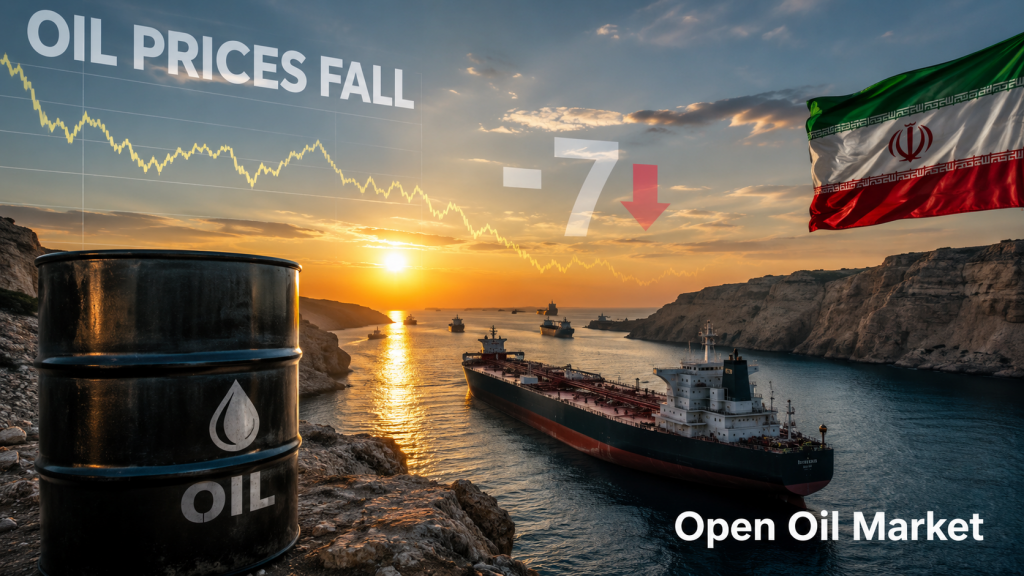
Global Oil and Energy Market as of June 19, 2026: Tankers, Declining Oil Prices Following the Hormuz Deal, Natural Gas and LNG Market, Oil Products, Refineries, Electricity, Renewable Energy, and Coal
The global energy sector enters Friday, June 19, 2026, with a significant shift in the balance of expectations: the geopolitical premium in oil prices is decreasing, the gas market remains sensitive to LNG logistics, oil products and refineries continue to operate with heightened margins, while electricity generation increasingly depends on heat, data centers, renewable energy, and network infrastructure. For investors, participants in the energy market, oil and fuel companies, and oil product suppliers, the key question of the day is not only the level of Brent and WTI quotes but also the speed of physical flow recovery through the Middle East.
Oil: Market Reassesses Risks Following the Hormuz Deal
The primary focus in the global oil and gas sector is the decline in oil prices following news of an interim agreement between the US and Iran, which involves extending the ceasefire, restoring shipping through the Hormuz Strait, and a gradual return of some supplies to the global market. For oil companies, this indicates that, in the short term, the military risk premium may decrease; however, it cannot fully vanish until the market sees stable shipments, insurance coverage for tankers, and normalization of logistics.
Brent prices have dipped to around $78 per barrel, with WTI falling below $75 per barrel. This does not signal a return to a calm market: traders are evaluating not only political statements but also the actual movements of tankers, port loading schedules, freight availability, and the willingness of Asian refineries to resume purchasing Middle Eastern oil.
- Base scenario: gradual recovery of supplies through the Hormuz Strait.
- Optimistic scenario: accelerated return of export flows and pressure on oil prices.
- Risk scenario: breakdown of negotiations, new attacks on infrastructure, and a return of the geopolitical premium.
OPEC and Long-term Demand: The Cartel Bets on Oil Again
Against the backdrop of short-term price declines, OPEC has presented a longer-term outlook in which oil remains a key raw material for the global economy. The organization maintains its assessment of sustainable demand growth and does not anticipate a peak in oil consumption on the horizon. This is an important signal for investors: even with accelerated renewable energy development and electrification, the oil and gas sector continues to be viewed as a foundational system for transportation, petrochemicals, aviation, and industrial activity.
For the global market, this creates a dualistic picture. On one hand, short-term oil prices are influenced by geopolitics, stocks, and supplies. On the other hand, long-term investment decisions in exploration, production, pipelines, refineries, and petrochemicals will be made based on the expectation that demand for oil and gas will remain in Asia, the Middle East, Africa, and Latin America.
Gas and LNG: Declining Oil Premium Does Not Eliminate Flexibility Shortages
The global gas market remains more tense than the oil market. Even if some risks around the Hormuz Strait diminish, LNG remains vulnerable to weather conditions, supply routes, competition between Europe and Asia, and underground storage filling schedules. For energy companies and industrial consumers, gas today is not only a commodity but also a tool for balancing energy supply.
In Europe, the focus has shifted to summer gas storage filling and TTF prices. In Asia, key factors include heat, electricity demand, and the willingness of buyers to pay a premium for spot shipments of LNG. For gas and LNG suppliers, the main takeaway is straightforward: the market may get a brief respite after a decrease in geopolitical tension, but the structural need for flexible supplies persists.
Oil Products and Refineries: Margin Remains High, but the Balance is Shifting
The oil products market remains one of the most sensitive segments of the energy sector. Diesel, jet fuel, gasoline, fuel oil, and bitumen are not only influenced by crude oil prices but also by the state of refineries, seasonal demand, logistics, and sanctions. Following a period of concerns about jet fuel shortages, the market has begun to stabilize due to an increase in processing and exports from the US, Europe, and select African countries.
Meanwhile, margins for middle distillates remain elevated. For refineries, this supports cash flow, but for airlines, transport operators, and industrial consumers, it results in continued high costs. The most important monitoring directions include:
- Dynamics of crack spreads for diesel and jet fuel;
- Loading rates at European, American, and Asian refineries;
- Presence of maintenance shutdowns in processing;
- Freight and insurance costs for oil product shipments;
- Impact of attacks on Russian refining infrastructure.
Russian Refining: Attacks on Refineries Heighten Risks for Domestic Fuel Market
Market attention is drawn to reports of another attack on the Moscow refinery. While this is not as significant a factor for the global oil market as the Hormuz Strait, it holds importance for the regional oil products market. Any damage to primary processing facilities, diesel hydrotreater, storage tanks, and auxiliary infrastructure can affect the production of gasoline, diesel fuel, and bitumen.
For fuel companies, this underscores the growing importance of logistics, inventories, and alternative supply channels. For investors, it serves as a reminder that the refining sector is increasingly subject to both commercial and geopolitical risks. Nonetheless, refining remains a crucial link between oil production and end demand for fuel.
Electricity: Data Centers Become a New Demand Driver
The electricity sector is becoming increasingly central to the global energy agenda. The growth of data centers, artificial intelligence, industrial electrification, and cooling during hot periods is fostering a new structural demand for electricity. In the US, regulators already require a review of connection rules for large consumers to the power grids, as data centers create loads that the existing infrastructure is not always able to accommodate quickly.
For energy investors, this opens several avenues: generation, networks, energy storage, gas stations, nuclear energy, and hybrid solutions with renewables. The electricity market is becoming as strategic as the oil and gas market, as the network ultimately determines how swiftly the economy can develop digital infrastructure and industry.
Renewable Energy: Solar and Wind Generation Strengthen Their Positions, Yet Require Grids and Storage
Renewable energy continues to expand its share in the global energy balance. Solar energy, wind generation, and energy storage benefit from declining technology costs, energy security, and countries' aims to reduce dependence on imported fuel. However, the main constraint is no longer just the cost of panels or turbines, but access to grids, balancing, and the energy system's ability to integrate variable generation.
In the US, summer generation from solar and wind is expected to rise, in India renewable generation is already significantly reducing the need for imported thermal coal, and in Europe, renewables remain a key component of strategies aimed at reducing gas dependence. For oil and gas companies, this presents not just a threat but also an opportunity: major energy players can develop hybrid portfolios that encompass gas, renewables, hydrogen, storage, and electricity trading.
Coal: Demand in Asia Persists, But the Import Model Weakens
The coal market displays mixed dynamics. In India, imports of thermal coal have fallen to their lowest levels in years due to increased domestic production and renewable energy generation. However, electricity demand remains high due to heat, population growth, and industrialization. This indicates that coal is not disappearing from the energy balance, but its role is gradually evolving: countries aim to reduce dependence on imported raw materials while increasing reliance on domestic production, renewables, and flexible generation.
For coal companies, the global risk is that the long-term investment attractiveness of the sector becomes increasingly regional. In some countries, coal retains its significance as a tool for energy security, while in others, it yields to gas, solar, wind, and storage.
What Matters for Investors and Energy Companies on June 19, 2026
Friday, June 19, marks a day of reassessing energy risks. Oil responds to expectations of supply recovery through the Hormuz Strait, gas and LNG remain sensitive to weather and logistics, oil products benefit from high margins, while electricity generation receives a new impulse from data centers and renewables.
Key focal points for investors, oil companies, fuel operators, participants in the gas, electricity, renewable energy, coal, oil products, and refineries markets include:
- Monitor the actual recovery of shipping through the Hormuz Strait;
- Assess whether Brent will remain above the $75–80 per barrel range;
- Analyze refinery margins for diesel, jet fuel, and gasoline;
- Control the situation with gas storage in Europe and demand for LNG in Asia;
- Consider the rising electricity demand from data centers;
- Compare investment opportunities in oil, gas, renewables, networks, and energy storage.
The main takeaway for the market: the global energy landscape is not moving in a single direction. Oil and gas remain critically important to the economy, renewables are becoming ever cheaper and more widespread, coal retains significance in certain regions, and electricity is transforming into a central asset of the new industrial and digital infrastructure. For investors in the energy sector, this indicates that the most resilient companies will be those with diversified portfolios, strong logistics, access to infrastructure, and the capability to operate amidst geopolitical volatility.