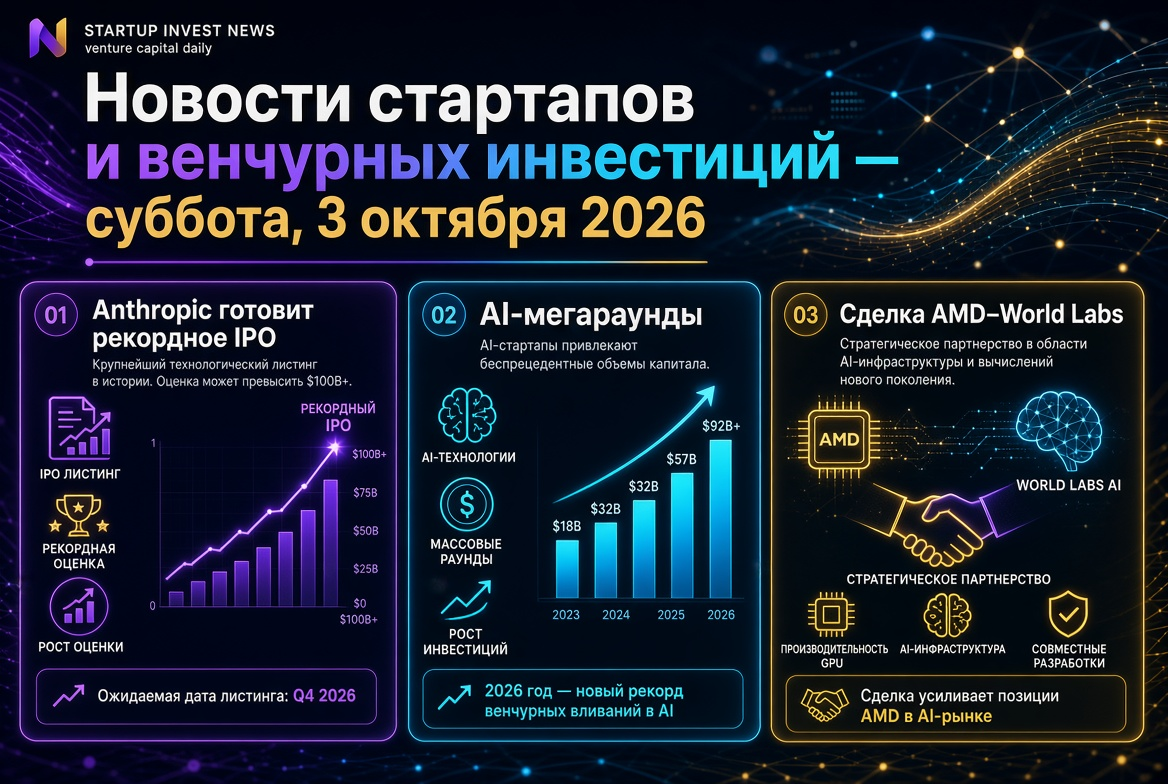
Startup and Venture Capital News for March 18, 2026: Analysis of AI Infrastructure, Robotics, Cybersecurity, Fintech, and Healthtech - Key Deals and Market Trends for Investors
By mid-March 2026, the startup and venture capital market increasingly reveals a new hierarchy of capital. Venture funds, growth investors, and major strategic partners are not just returning to active deals — they are concentrating their investments in specific segments where rapid commercialization of artificial intelligence, industrial automation, enterprise software, and cybersecurity is evident. For global venture capitalists, this signifies one clear message: the market is ready to pay for growth again, but only where there is infrastructural value, clear monetization, and potential for scaling in international markets.
The main topic of the day is not an abstract "AI boom" but rather the acceleration of the selection of winners. In prior cycles, the market funded a broad pool of companies, but now venture investments are increasingly flowing toward category leaders: AI startups with access to computational resources, platforms for enterprise implementation, robotics companies with industrial applications, and startups that are becoming critical layers for enterprise client operations.
AI Infrastructure Becomes the Central Focus of Venture Capital
The strongest signal for the startup market has come from the AI infrastructure segment. Investors are continuing to place bets not only on applied AI startups but also on those companies that control computing, deployment, and corporate implementation of models. This is no longer just a technological trend, but rather a distinct investment class within venture capital.
For funds, three criteria are essential here:
- access to computing capabilities and strategic chip suppliers;
- the ability to integrate into enterprise processes of clients;
- moving beyond experimentation towards repeatable revenue.
This is precisely why the market is closely monitoring major deals in the AI segment. In this context, startups operating at the intersection of models, orchestration, inference, and corporate automation are experiencing significant upside in valuations. For venture funds, this also signifies a shift in strategy: it is not only those who entered AI early that benefit but also those who managed to secure the infrastructural layer surrounding it.
Major Rounds Confirm: Capital is Flowing to Leaders, Not Just a Broad Sample
In recent days, the market has witnessed several indicative funding rounds. Legal AI startup Legora secured substantial funding at a significantly higher valuation, betting on rapid growth in the U.S. This is an important signal for the entire enterprise AI market: corporate clients are moving from testing to implementation, meaning that companies with products for professional users are entitled to premium multiples.
Another strong case is Mind Robotics, which is developing industrial robotics and a full-stack platform for automating production tasks. For venture investors, this represents one of the most interesting shifts of 2026: robotics is becoming an investment-worthy sector again, but not as a "visionary story," rather as a response to labor shortages, margin pressures, and the need for production modernization.
In practice, this means:
- rounds are consolidating faster than the number of real market leaders is growing;
- company valuations are increasingly tied to category rather than just current revenue;
- venture investments are becoming more concentrated and less democratic.
For founders, this news is only partially positive. There is a lot of money in the market, but access to it is primarily granted to companies with strong execution speed and a convincing go-to-market strategy in the U.S. or global markets.
Robotics and Industrial Automation Step Out of the Shadows as Distinct Investment Themes
Another significant shift is the growing interest in robotics and physical AI. The launch of new projects in this niche and substantial early rounds indicate that the market has grown weary of purely software stories and is increasingly looking for startups that enhance productivity in the real sector. This is why industrial automation, warehouse technology, autonomous operations, and specialized robots are receiving more attention.
Notably, new companies in robotics are increasingly being built around narrow applied tasks, rather than universal humanoid robots. This logic resonates more with funds: less futurism, more unit economics, a quicker path to revenue, and a clearer corporate customer.
In the upcoming quarters, this may lead to two investment forks:
- an increase in late rounds in robotics involving crossover investors;
- heightened interest from corporate strategists in M&A in automation and industrial AI.
Cybersecurity Strengthens Against the Backdrop of AI Agent Expansion
Cybersecurity remains one of the most resilient categories for venture capital investment, but in 2026, a new focal point has emerged — the security of AI agents and agentic workflows. Startups that assist companies in managing the actions of autonomous systems are attracting increased investor attention, as this represents a new operational risk for enterprise clients.
The launch of Onyx Security and recent rounds in the cyber segment confirm that the market sees this niche as the next layer of infrastructure. Essentially, this involves creating a new security stack for the AI era. For venture funds, this story is attractive for several reasons:
- the issue is critical for large companies already;
- budgets for security are better shielded from cyclical pressures;
- the category scales well in the global B2B market.
In this context, cybersecurity remains one of the few themes where venture investments combine high demand, international expansion, and strategic interest from major tech players.
Healthtech and the Care Economy Regain Interest from Growth Investors
The healthcare startup market is once again attracting capital, but not under the old "growth for growth's sake" model. Investors are supporting companies that address systemic issues: personnel shortages, access to therapy, reduction of care costs, and the use of AI to enhance the efficiency of care processes.
New rounds at Grow Therapy and Sage demonstrate that healthtech is once again capable of attracting substantial checks when a company has a clear scaling logic and sustainable demand. For funds, this represents a critical countertrend against the dominance of AI: capital is flowing not only into foundational models but also into applied markets where AI serves as a tool for productivity enhancement.
From an investment perspective, healthtech is currently appealing as a sector where:
- there is a long-term structural demand;
- there are high barriers to entry for new players;
- significant outcomes are possible through IPOs, private equity, or strategic deals.
Europe Strengthens its Position: Fintech and Deeptech Appear More Confident
For global investors, a crucial takeaway from March 2026 is that Europe can no longer be considered a secondary market in relation to the U.S. This is particularly evident in the fintech, semiconductor, legal AI, and industrial deeptech arenas. The strengthening of London as a global fintech hub, new European unicorn cases, and growing interest in local infrastructure indicate that the European startup market is becoming more mature and less reliant on external capital compared to several years ago.
It is also important to highlight deeptech and AI hardware. Startups focused on creating chips, computing infrastructure, and specialized solutions for inference are beginning to play a more significant role in the European venture landscape. For funds, this opens up windows of opportunity in segments where Europe was previously considered too slow to scale.
The Venture Model is Expanding: Private Equity and Retail Investors Closing In
The line between traditional venture capital, private equity, and public markets continues to blur. The discussed alliances around enterprise AI and new products that grant a broader range of investors access to private markets illustrate that the capital market is searching for new channels to participate in the growth of technology companies.
For venture funds, this is an important signal. On one hand, additional liquidity and new sources of capital are emerging. On the other hand, competition for the best deals is intensifying, particularly in late rounds. As a result, the startup market is increasingly operating under a model where:
- the best companies gain access to multiple types of capital;
- intermediate players face a stricter selection process;
- valuations are increasingly influenced by strategic relevance to the corporate world.
What This Means for Venture Investors and Funds
As of March 18, 2026, the key takeaway for investors is straightforward: the startup market is once again open to significant growth stories, but premiums are directed toward a limited set of themes. The best-performing sectors currently include AI infrastructure, legal AI, cybersecurity, industrial robotics, autonomous systems, and applied healthtech. At the same time, the overall picture of the startup and venture investment market does not resemble a broad recovery but rather a selective bull market.
For venture funds, this indicates the need for more precise actions:
- to seek categories where AI becomes a critical function rather than just a marketing label;
- to evaluate not only the product but also the startup's access to data, chips, clients, and implementation channels;
- to prepare for more expensive deals in top assets and weaker liquidity in the second echelon.
This is why the upcoming months will likely be defined not by the number of deals but by the quality of capital and the ability of funds to identify companies that will serve as the infrastructure for the next technological cycle. For a global audience of investors, this becomes one of the primary market indicators: winners will not just be rapidly growing startups but those that become an essential layer of the new corporate economy.