Startup and Venture Capital News, Thursday, April 30, 2026: AI Rounds, Defense Technologies, and a New Capital Cycle
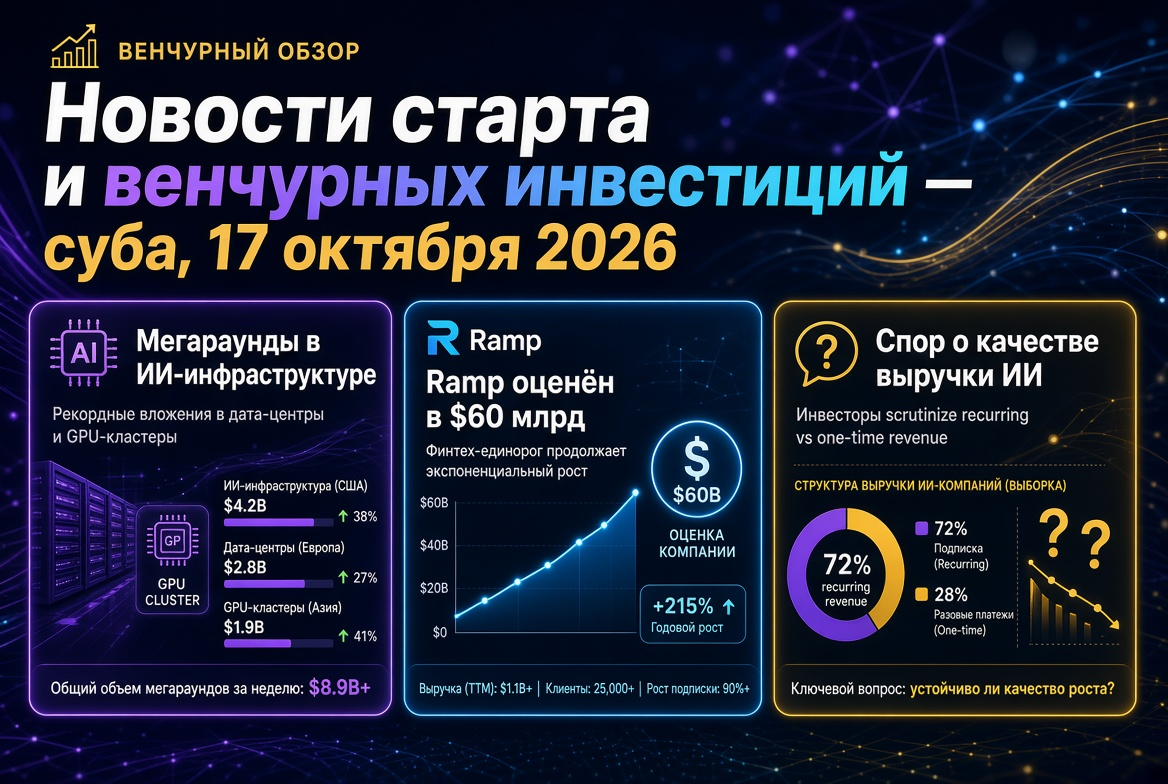
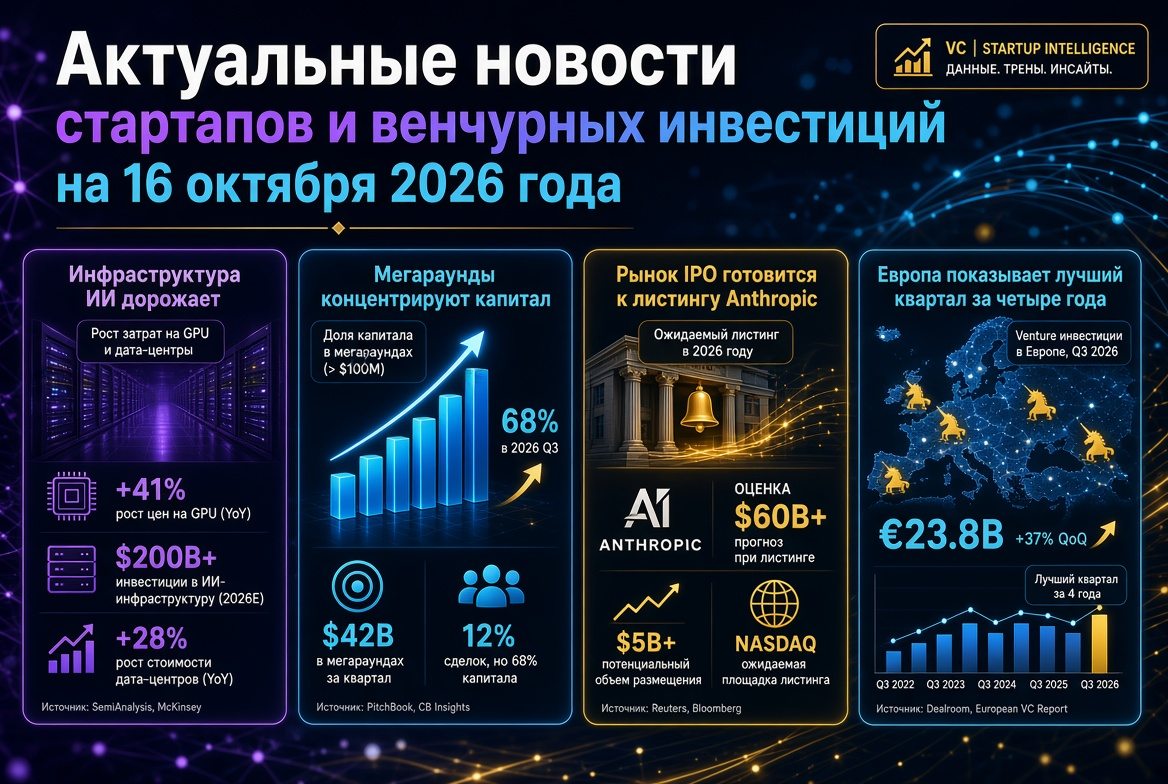
The venture market enters Thursday, April 30, 2026, with a pronounced concentration of capital around artificial intelligence, defense technologies, medical AI, industrial automation, and infrastructure for autonomous agents. For venture investors and funds, the key theme of the day is not merely the rising valuations of AI startups, but the market's shift towards a more rigorous selection process: funding now favors companies capable of demonstrating a technological edge, access to corporate demand, and a roadmap to scalable revenues.
Following a record first quarter of 2026, startup and venture capital news increasingly resembles a two-speed market. On one hand, major funds continue to finance frontier AI, agentic AI, defense tech, and vertical AI. On the other hand, early-stage startups find it more challenging to attract capital without strong product differentiation, commercial demand, and a clear monetization strategy.
Key Trend of the Day: Artificial Intelligence Has Become the Centerpiece of the Venture Market
The prevailing backdrop for investors is the dominance of AI startups within global venture capital. In 2026, artificial intelligence has definitively ceased to be a standalone sector and has evolved into a fundamental investment theme across most industries: software, healthcare, defense, industrial, marketing, autonomous systems, and corporate analytics.
For venture funds, this signifies a change in the deal-selection logic. Investors are now assessing not only the presence of AI in products but also the depth of the technological core, data access, cost of computation, team quality, and the startup's ability to integrate into the actual business processes of large clients.
- Most active sectors: AI infrastructure, AI agents, medical AI, defense tech, industrial AI, and development automation.
- Primary risk: inflated valuations of companies without sustainable revenues and technological barriers.
- Main opportunity: vertical AI startups addressing specific problems in high-budget industries.
Parallel Web Systems: Infrastructure for AI Agents and a $2 Billion Valuation
One of the most notable developments has been the recent funding round of Parallel Web Systems, a company founded by former Twitter CEO Parag Agrawal. The startup raised $100 million in a Series B round, achieving a valuation of approximately $2 billion. The round was led by Sequoia Capital, with participation from Kleiner Perkins, Index Ventures, and Khosla Ventures.
Parallel Web Systems is developing infrastructure for AI agents that require fast and reliable access to the open internet, corporate data, and complex research tasks. For venture investors, this deal is significant as the market gradually shifts from consumer AI applications to the infrastructure level: search, data extraction, multi-step analysis, and automation of digital operations.
Investment takeaway: If AI agents are to become the new interface for interacting with the internet, then access infrastructure for data might emerge as one of the crucial layers of the future digital economy.
Aidoc: Medical AI Back in the Spotlight for Major Funds
Clinical AI startup Aidoc has secured $150 million in a Series E round. Investors included Goldman Sachs Alternatives, General Catalyst, SoftBank Investment Advisers, and NVentures, the venture arm of NVIDIA. The company operates in the medical imaging segment, assisting in the analysis of CT scans, X-rays, and other diagnostic data.
For the venture investment market, this serves as an important signal: healthcare remains one of the most mature applications of artificial intelligence. Unlike many AI products still in search of a sustainable business model, medical AI can rely on a clear economic rationale: reducing the burden on doctors, speeding up diagnoses, increasing clinic throughput, and potentially lowering errors.
- Strength of the segment: high demand from hospitals and medical systems.
- Main barrier: regulation, certification, and long sales cycles.
- Key investment criterion: clinical proof and scalability of deployment.
Hightouch: $150 Million for AI Marketing and New Valuation of $2.75 Billion
Another significant funding round of the day came from Hightouch, a data and AI platform for marketing. The company raised $150 million in Series D, achieving a valuation of around $2.75 billion. The round was led by Goldman Sachs Alternatives and Bain Capital Ventures.
Hightouch is of interest to venture funds as a case study of the transition from classic SaaS to AI-native platforms. The company initially started as a tool for managing client data and is now developing AI solutions for marketing personalization, content generation, and campaign automation. For investors, this signals that mature SaaS companies can achieve reevaluation if they successfully integrate AI into core client workflows.
The main question for funds is whether AI marketing can become a sustainable source of high margins, or whether the market will quickly face commoditization as similar functionalities emerge among larger platforms.
Defense Tech: Scout AI and Firestorm Labs Illustrate New Demand for Autonomous Systems
Defense technology continues to be one of the fastest-growing segments of the venture market. Scout AI raised $100 million in Series A to develop AI models that manage autonomous military systems. The company is building a software layer for robotic platforms and autonomous operations.
Simultaneously, Firestorm Labs raised $82 million in Series B. The startup is enhancing containerized manufacturing systems that enable the production of unmanned platforms closer to the area of application. For investors, this reflects the growing demand for distributed manufacturing, autonomous systems, drones, robotics, and sustainable supply chain technologies.
Defense tech is becoming a distinct venture asset class characterized by large government contracts, complex sales cycles, high regulatory risk, and potentially large-scale contracts. For funds, this is a sector with significant asymmetry: successful companies can swiftly transition from pilots to multimillion-dollar contracts.
BMW i Ventures: Corporate Funds Increase Focus on Industrial AI
BMW i Ventures has announced a new $300 million fund that will invest in startups focused on physical AI, agentic AI, industrial software, manufacturing, supply chains, and advanced materials. The fund will primarily target companies from seed to Series B in North America and Europe.
This news is crucial for the entire venture market, as corporate funds are becoming active participants in early and mid-stage investments again. For industrial firms, AI is no longer an experimental technology but a tool for enhancing the efficiency of design, logistics, manufacturing, and materials management.
For startups, participation from a strategic investor may provide access to manufacturing facilities, engineering expertise, and initial corporate clients. For venture funds, such deals add an additional layer of validation: if an industrial strategic player enters the sector, it implies that demand may not only be financial but also operational.
Europe Strengthens Its Position in AI and Deep Tech
The European startup market in 2026 presents a dual picture. On one hand, the volume of capital in AI and deep tech is growing. On the other hand, the number of deals is declining and competition for funds is intensifying. This is rendering the market more selective: larger rounds are directed towards companies with fundamental technologies, strong research teams, and global ambitions.
Particular attention is being drawn to AI startups based in London, Paris, Berlin, and other European tech hubs. For global venture capital investors, Europe is becoming not just a talent market but also a platform for building frontier AI, quantum technologies, industrial AI, and climate tech.
- London is reinforcing its role as a center for AI research and significant seed rounds.
- France is solidifying its position in frontier AI and deep tech.
- Germany and the Netherlands remain important markets for industrial AI, quantum technologies, and manufacturing automation.
Early Stages: Large Seed Rounds Do Not Indicate an Easy Market
Despite the headlines surrounding startups, the early-stage landscape remains challenging. Venture investments are concentrating on a smaller number of companies, and funds are demanding higher proof from founders even at the seed and Series A stages. For startups, simply showcasing a presentation filled with AI terminology is no longer sufficient; investors expect a working product, data access, initial customers, a clear economic model, and a strong team.
A good example of the early market is Dreambase, an AI platform for data analytics that raised $3.7 million. The company is building AI agents for interacting with databases and analytical dashboards. Although the size of the round is small compared to megadeals in AI, such companies can become attractive to funds seeking practical products with a clear customer pain point.
What Matters to Venture Investors and Funds
Venture investors should view the current market not as an all-encompassing AI boom, but as a phase of capital reallocation in favor of companies with tangible barriers. The most appealing startups are those that integrate artificial intelligence with critical sectors: healthcare, defense, industry, corporate data, software development, and public process automation.
As of April 30, 2026, the key criteria for deal selection are as follows:
- Technological moat: proprietary models, unique data, infrastructure advantages, or industry access.
- Commercial validation: paying customers, repeat sales, large pilots, or strategic partnerships.
- Capital efficiency: the ability to grow without excessive reliance on expensive computation and continuous funding rounds.
- Regulatory resilience: particularly for health tech, defense tech, fintech, and govtech.
- Global market: the potential to scale beyond one country or a single corporate client.
The Venture Market Enters a Phase of Mature AI Selection
Startup and venture capital news for Thursday, April 30, 2026, shows that capital is still available but is being distributed increasingly selectively. AI startups remain a primary focus for venture funds; however, the market is becoming less tolerant of weak business models and inflated expectations.
For venture investors and funds, the main challenge is to distinguish between infrastructure and vertical AI companies from projects that merely use artificial intelligence as a marketing veneer. The most promising startups appear to be those operating at the intersection of AI, industry, defense, medicine, corporate data, and the automation of complex processes.
Therefore, as of April 30, 2026, the venture market is not witnessing a decline in interest in startups, but rather a shift towards a more mature investment model. Funds continue to flow into innovations, but they increasingly demand evidence: technology, revenue, market potential, and the ability to transform AI from a trendy concept into tangible economic results.