Startup and Venture Investment News — Thursday, April 23, 2026: AI Super Rounds, New Unicorn Cycle, and the IPO Window Battle
The global startup market is entering Thursday, April 23, 2026, in a state of rare capital concentration. Venture investments remain high, but are increasingly unevenly distributed: the largest checks are going to AI startups, infrastructure, robotics, and companies capable of becoming public stories or strategic acquisition targets. For venture investors and funds, this indicates not only an increase in activity but a transition to stricter selection criteria, where scale, speed of monetization, and a company's ability to capture a dominant market position hold significant weight.
AI Remains the Center of the Global Venture Capital Market
The main theme of the day is the ongoing flow of capital into artificial intelligence and related infrastructure. The venture capital market is no longer merely supporting technological growth but is effectively building a new investment cycle around several asset classes: foundational models, computational infrastructure, corporate AI, robotics, and autonomous systems.
For investors, this changes the very structure of decision-making. Previously, a startup could compete for capital based on a strong team and a compelling hypothesis; now funds are increasingly focusing on three parameters:
- a technological advantage or data that is difficult to replicate;
- the ability to quickly achieve substantial revenue or secure strategic contracts;
- a willingness to become part of a larger platform, ecosystem, or M&A deal.
This is why startup and venture investment news in April 2026 increasingly revolves not around the number of deals, but around their size, quality, and strategic significance. Money is available in the market, but it is concentrating among a smaller number of winners.
Recent Deals Set the Tone for the Entire VC Market
The agenda of the last few days confirms that large capital flows to where platform potential is perceived. The most notable signals are as follows:
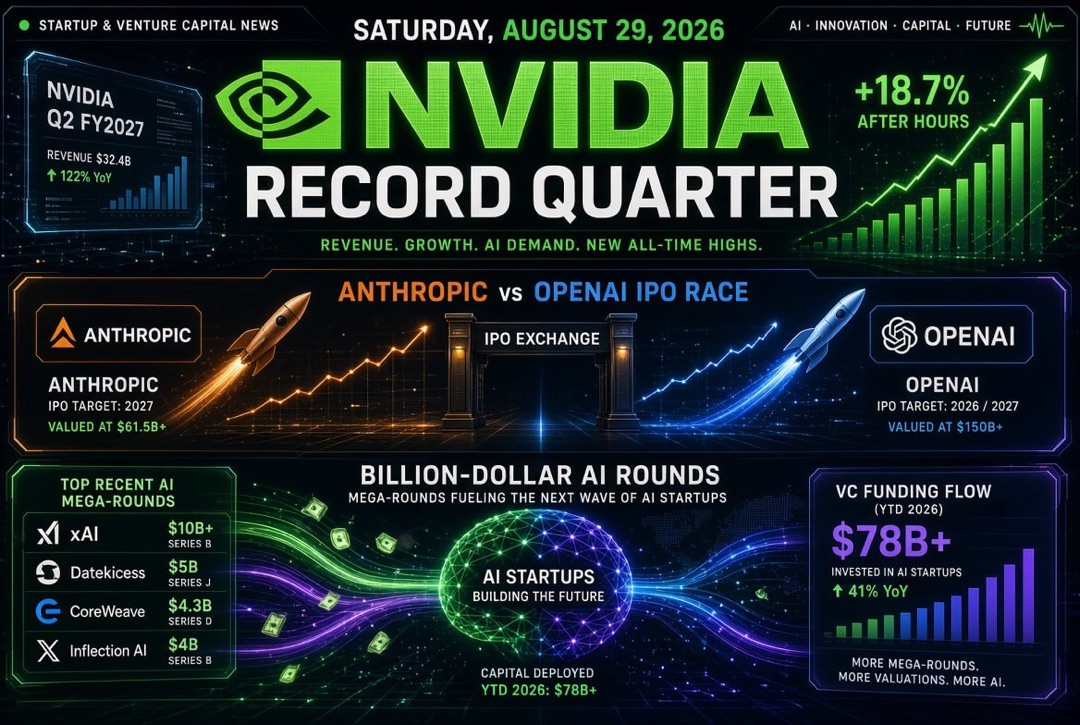
- OpenAI remains at the core of investment interest: the market is discussing both new access channels to the company through private markets and an expanded corporate monetization model.
- DeepSeek is intensifying its impact on the global AI landscape and becoming a key story for Asian tech capital.
- New AI labs and infrastructure startups are receiving valuations that were previously deemed impossible even for mature tech companies.
Against this backdrop, venture investments increasingly resemble a market for strategic bets. Funds are competing not only with each other but also with private equity, corporations, sovereign structures, and platforms willing to pay a premium for access to the best assets. As a result, rounds are accelerating, and bargaining power is increasingly shifting to startups with confirmed demand.
Capital Geography Shifts: US Leads, China Regains Scale, Europe Intensifies Specialization
The global startup market in 2026 is becoming even more polarized. The United States maintains dominance in late stages and in the largest AI rounds. China, meanwhile, is building its own technological framework through state-supported funds in AI, robotics, and semiconductors. Europe does not compete in the number of mega-rounds but is strengthening its positions in fintech, climate tech, industrial software, and applied robotics.
For funds, this means that a universal strategy is underperforming compared to regional specialization. The market currently looks like this:
- The United States — the center for the largest venture checks, private markets, and prep for future IPOs;
- China — rapid formation of a national pool of tech champions;
- Europe — growth in deal quality in fintech, climate tech, and deep tech;
- Asia and the Middle East — increasing interest in cross-border investments, infrastructure, and defense technology projects.
From a geo-logic perspective, this is an important shift: venture investors are increasingly allocating capital not according to fashionable sectors as a whole but rather according to regional chains of competency.
Early Stages Revive, but Seed Market Remains Strict
Despite the noise surrounding mega-rounds, early stages are also showing signs of revival. However, this is not a return to the previously broad seed deal market but rather an increase in the average check size for the strongest teams. Simply put, startups with pronounced technological advantages are raising more capital, while others are finding it increasingly challenging.
This establishes a new standard for seed and Series A rounds:
- Funds expect more mature product logic even at an early stage;
- valuation growth must be justified by market entry speed;
- AI add-ons without a deep moat are valued more cautiously;
- teams that can combine software, data, and automation gain an edge.
What This Means for Venture Funds
For early-stage investors, the current market presents both opportunities and risks. The opportunity is to enter the next cycle of tech leaders before they reach later stages. The risk is overpaying for companies whose differentiation may diminish rapidly. Therefore, diligence becomes more crucial than hype once again.
Fintech, Climate Tech, Robotics, and Space Expand Opportunity Fields
While AI consumes a significant share of attention, the startup market in April 2026 is not limited to just artificial intelligence. On the contrary, venture investments are increasingly being distributed across sectors that either benefit from AI or solve fundamental infrastructure issues.
- Fintech. Investors are returning to payment solutions, stablecoin infrastructure, cross-border transactions, and AI tools for financial services.
- Climate Tech. Capital is flowing into industrial projects with long cycles but high strategic value, especially in Europe.
- Robotics. One of the major beneficiaries of the new wave are companies at the intersection of AI, industry, and autonomous systems.
- Space and Defense Technologies. Here, the venture market is increasingly intersecting with government agendas, expanding the scale of available capital.
For global investors, this is particularly significant: the next major growth may come not only from pure software but also from tech companies that combine hardware, data, contracts, and infrastructure.
The IPO Window Has Opened, But Going Public Remains a Privilege for the Strongest
The topic of IPOs is back at the center of discussions. The market anticipates major offerings and closely watches whether new public debuts can serve as a real test for the entire technology sector. However, the current IPO window cannot yet be described as fully open. It is primarily accessible to companies that already possess scale, recognition, and a clear economic structure.
For startups and funds, this means the following:
- the public market is once again an exit option, but not a mass one;
- investors prefer stories with strong revenue and structural leadership;
- some companies will opt for a sale to a strategic investor or a significant secondary offering instead of an IPO;
- preparation for listing begins significantly earlier than in the previous cycle.
The venture market is already benefiting from the mere existence of the IPO window, as it provides a benchmark for valuations and increases interest in late-stage investments.
M&A and Private Markets Emerge as Viable Alternatives to Traditional Exits
Another important trend is the growing significance of M&A and private markets. When the public market remains selective, corporations, private equity, and large platforms start playing the role of primary buyers of tech assets. This is particularly evident in enterprise software, fintech, data infrastructure, and applied AI.
For funds, this market is advantageous for two reasons. First, it creates additional liquidity scenarios. Second, it allows for maintaining high valuations for companies that are not yet ready for IPOs but are deemed strategically valuable. Thus, in 2026, M&A transactions and structured private rounds are becoming a normal part of the venture cycle rather than a sign of weakness.
Key Risks for Investors: Overheating Valuations, Excess Concentration, and Pressure on Exit Models
Despite the market's strength, the current phase is not without vulnerabilities. Key risks remain evident:
- excessive concentration of capital in AI startups;
- valuation growth outpacing fundamental business metrics;
- dependence of late-stage investments on a few upcoming IPOs;
- overvaluation of companies lacking a sustainable moat;
- intensified competition among funds, private equity, and strategic investors.
This is why strong venture investors are currently operating in two modes: aggressively competing for the best assets while simultaneously reinforcing discipline regarding entry prices, deal terms, and liquidity scenarios.
What Venture Investors and Funds Should Watch for on Thursday, April 23
- Will the growth of AI company valuations continue beyond a narrow circle of leaders?
- Will new signals emerge regarding IPOs and major secondary deals?
- Will the capital influx into China and Asian AI startups persist?
- Will there be an increase in rotation into robotics, fintech, and climate tech?
- Will major funds and corporations expedite deals, fearing even higher valuations this summer?
Startup and venture investment news for April 23, 2026, reveals a market where capital is moving quickly again but no longer chaotically. Venture investments are growing, the number of strong companies is increasing, the IPO window is gradually reopening, and M&A and private markets are creating new routes for exit. Nonetheless, the main principle of 2026 remains unchanged: not all startups will win, but only those capable of proving technological leadership, commercial scalability, and strategic value for the global market.