Current Startups and Venture Capital News as of April 17, 2026, with a Focus on AI, Major Funds, and Global Market Trends
As of April 17, 2026, the global startup and venture capital market is entering a new growth phase. However, this growth is characterized not by a broad upswing across the entire ecosystem but by a stringent concentration of capital in several priority segments. AI startups, infrastructure for artificial intelligence, semiconductors, robotics, fintech, and select industrial projects capable of swiftly transitioning from technology demonstration to revenue scaling remain in the spotlight.
For venture investors and funds, this marks a shift in paradigm. The venture capital market is delivering significant deals, elevated valuations, and notable exit signals once again. However, the cost of error is also escalating. Funds are not merely investing in startups, but in companies that can become the infrastructure for the next technological cycle.
Headline Topic of the Day: Market Growth, Yet Capital Concentration Among a Select Circle of Winners
Looking at the global startup market, a key takeaway is clear: venture investments are returning, but they are distributed exceedingly unevenly. The majority of funding is being captured by AI companies, computing platforms, chip startups, infrastructure players, and mature tech companies that can proceed to IPO or become targets for strategic acquisitions.
This serves as an important signal for funds. The old adage that capital should be broadly diversified across early stages is yielding to a more selective model. Today, investors prefer to:
- bet on categories with strong structural demand;
- support startups that already exhibit industrial or corporate monetization;
- carefully monitor companies creating critical infrastructure for AI, automation, and deep tech.
This is why generative models, physical AI, robotics, semiconductors, industrial software, and corporate AI applications are at the heart of the global venture agenda today.
AI Continues to Set the Pace for the Entire Venture Capital Market
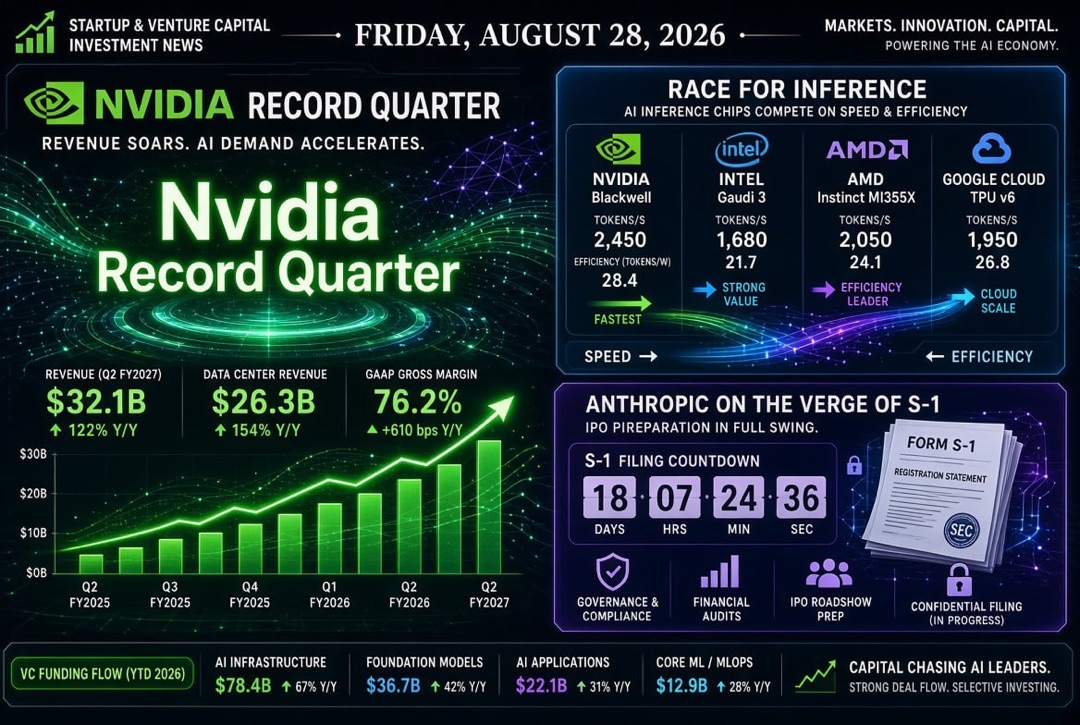
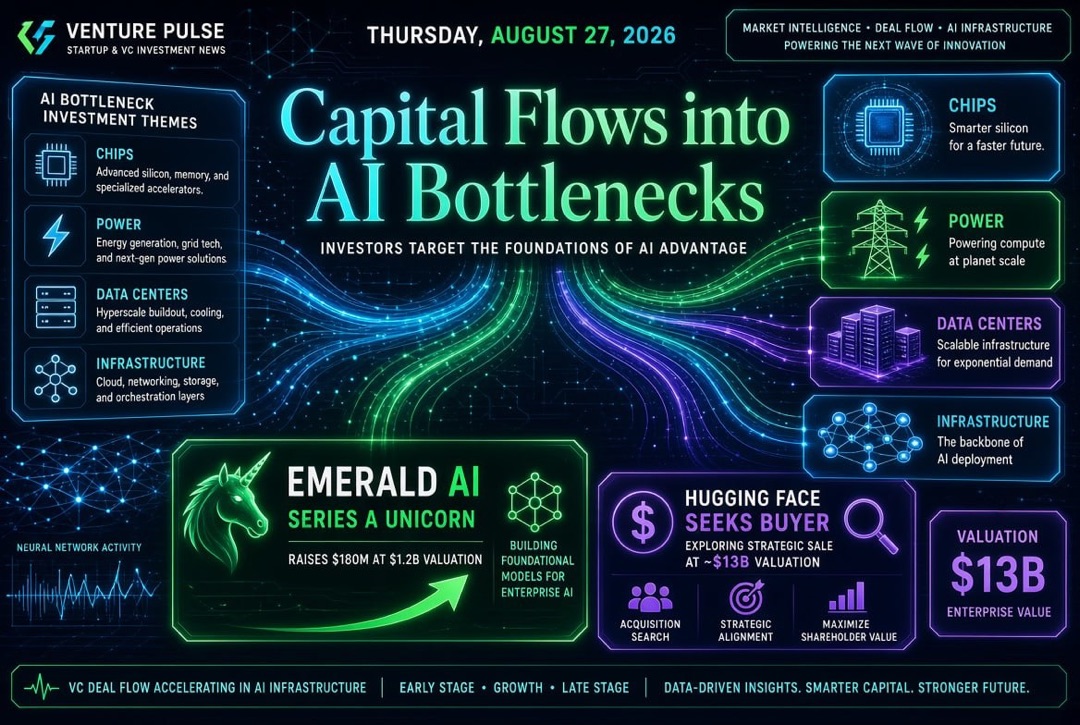
Artificial intelligence remains the primary magnet for capital. However, the market is undergoing qualitative changes: investors are no longer limited to investments in applied AI services. Large funding rounds and heightened interest are shifting toward those building foundational elements—computational architectures, chips, network infrastructure, tools for enterprise automation, and robotic systems.
This creates a new hierarchy within the segment of AI startups:
- Frontier AI and foundation layer. These are companies around which ecosystems, partnerships, and substantial valuations are forming.
- AI infrastructure. This includes chip startups, networking, inference platforms, and hardware solutions.
- Enterprise AI. The next wave of capital is directed towards products that enable corporations to save time, money, and labor.
For venture funds, this means that the classic software-only pitch is no longer sufficient. In 2026, the focus is on startups that either own a critical technological layer or can embed themselves into large corporate workflows and quickly become industry standards.
New Funds Confirm: Big Money is Returning to the Market
A significant signal comes from the capital market itself. This week, it became evident that major funds are ready to increase exposure to late-stage investments and larger checks. This is especially important for those startups looking not for seed funding, but for growth rounds, international expansion, and preparations for exit.
The most notable takeaways here are:
- major management structures are once again prepared to raise multi-billion dollar funds;
- investors are ramping up their focus on late-stage and growth rounds;
- physical AI, manufacturing, defence tech, and infrastructure are no longer niche investments but have moved into the mainstream investment stream.
This intensifies competition for quality assets. For startups with strong revenue and technological advantages, the market is becoming more favorable. Conversely, for companies without proven product-market fit, the bar for accessing serious institutional capital is rising.
Asia Emerging as a Key Center of the New Venture Wave
The Asian startup market appears increasingly heterogeneous, which makes it attractive to investors. In China, state-supported pivot towards technologies is bolstering funding for AI, robotics, and strategic sectors. In South Korea, interest is growing in chip startups aspiring to become alternatives to global leaders in on-device AI. Southeast Asia continues to maintain its appeal in fintech and digital payments.
Of particular importance is that Asia is currently providing not just early rounds but also more mature opportunities:
- startups are beginning to move towards IPO;
- local champions are receiving support from major corporations and government ecosystems;
- the number of companies deemed infrastructure platforms rather than merely regional players is increasing.
For global funds, this signifies that Asia is no longer an adjunct to the North American market but rather an independent source of returns and strategic deals.
Europe Shows Growth, Yet Funds are Flowing to Fewer Companies
The European venture capital market is also rejuvenating, albeit its growth is more selective in nature. Capital is concentrating around AI, industrial software, energy transition, hardware, and sustainable industrial projects. This is evident from the significant rounds in climate tech and deep tech.
Europe is currently interesting to investors for three reasons:
- Strong engineering talent. The region remains a source of quality teams in AI, semiconductors, and industrial automation.
- Industrial demand. European corporations are actively seeking solutions for decarbonization, production optimization, and energy efficiency.
- Focus on sustainability. Climate tech and industrial transition continue to attract substantial institutional capital.
Nevertheless, the European market is not becoming mass-market. Rather, it is increasingly splitting into a small number of leaders that secure significant funding and a broad layer of companies that find it more challenging to close rounds on favorable terms.
Physical AI, Chips, and Robotics Move to the Forefront
One of the most notable shifts in April is the transition of investors' attention from abstract "AI software" to tangible technology. Physical AI, new chip architectures, AI networking, robotics, and edge/inference solutions are becoming central to investment agendas.
This is a crucial pivot for the startup market, as the next wave of sizable corporate contracts is being formed here. Investors are increasingly inquiring not about whether a company can showcase an impressive demo, but whether it can become a primary technology supplier for factories, autonomous systems, robotics, financial processes, or data center ecosystems.
For funds, this creates a new roadmap of priorities:
- semiconductor startups are receiving a higher strategic status;
- robotics and on-device AI are moving out of the category of "distant bets";
- infrastructure solutions for computing are becoming one of the most valuable asset classes.
Fintech and Enterprise Automation Back in the Game
While AI remains the primary driver, the venture capital market is not confined solely to models and chips. Fintech and enterprise software are reclaiming their significance due to applied economics. Startups aiding in expediting cross-border payments, automating corporate expenses, and embedding AI into accounting and financial processes are back as compelling targets for growth or M&A.
The reason is simple: in 2026, investors are seeking not only technological leadership but also operational usefulness. Companies that reduce clients' cost bases, enhance transaction transparency, and accelerate decision-making are more likely to attract strategic interest from major players.
For venture investors, this is one of the most practical market segments: here, the dependency on abstract expectations is lower, and the likelihood of clear corporate exits is higher.
The Window for IPOs and M&A Deals is Gradually Opening
Another important signal for the startup market is the improving sentiment surrounding IPOs and strategic deals. While a fully open window has yet to manifest, investors are already seeing that quality companies can once again prepare for listing or sale to a strategic buyer.
This alters fund behaviors:
- growth investors are becoming more active in mature companies;
- corporations are beginning to scrutinize AI assets more closely as potential acquisition targets;
- the valuation of startups is increasingly depending not only on revenue but also on their suitability for future IPOs or M&A.
This is positive for the ecosystem. When realistic exit scenarios emerge in the market, the entire venture capital cycle becomes more resilient: funds invest more readily, founders receive better pricing, and LPs see a clearer path to capital return.
What This Means for Venture Investors and Funds
As of April 17, 2026, the strategy in the venture capital market is becoming crystal clear. Winners will not merely be "hot" startups but companies that meet several criteria:
- operate in a category with long-term structural demand;
- possess technology that is difficult to replicate quickly;
- have a pathway to substantial revenue, industrial implementation, or corporate exit;
- are capable of becoming part of the infrastructure for the next technological cycle.
This is why the focus of the day is not just on the growth of venture investments but also on their qualitative regrouping. The market is rebounding, but it is coming back different: larger, tougher, more infrastructure-oriented, and significantly more demanding regarding asset quality.
In the coming weeks, investors should particularly keep an eye on AI infrastructure, physical AI, semiconductor startups, fintech automation, climate tech, and new signals regarding IPOs. It is in these segments that the new pinnacle of the global startup market is currently being formed.