Startup and Venture Investment Overview as of April 20, 2026: Key Deals, AI Startups, and the VC Market
The global venture market enters a new week in noticeably stronger form than a year ago, yet the recovery is far from uniform. Capital has returned, but it is distributed unevenly: the bulk of the funding is flowing into AI infrastructure, defense tech, select fintech, climate tech, and mature companies with a clear route to IPO or M&A. For venture funds, this signals a shift in focus: today, it is not merely the fact of market growth that matters, but the ability to identify segments where capital has not yet fully priced in future returns.
The main theme at the start of the week is the transition from the private AI boom to a model of sovereign AI. Governments, sovereign funds, and national programs are increasingly becoming not just regulators but direct market participants: they are creating funds, subsidizing computing power, accelerating access to talent, and shaping demand for strategic technologies. For startups, this changes the rules of the game as significantly as the funding rounds themselves.
Key Takeaways for Venture Investors
- Venture investments are rising again, but the market has narrowed. The headline numbers for the quarter appear record-breaking; however, the lion's share of capital is concentrated among a small number of large players.
- AI has definitively split into two classes. One consists of overheated frontier companies, while the other includes infrastructure and applied startups with a clear economic model that still allow for market entry.
- The IPO window is slightly ajar, but not for everyone. Only those companies ready for the public market can proceed; for the rest, the primary scenario remains strategic exit.
The Market Grows, But Money Concentrates Among Major Players
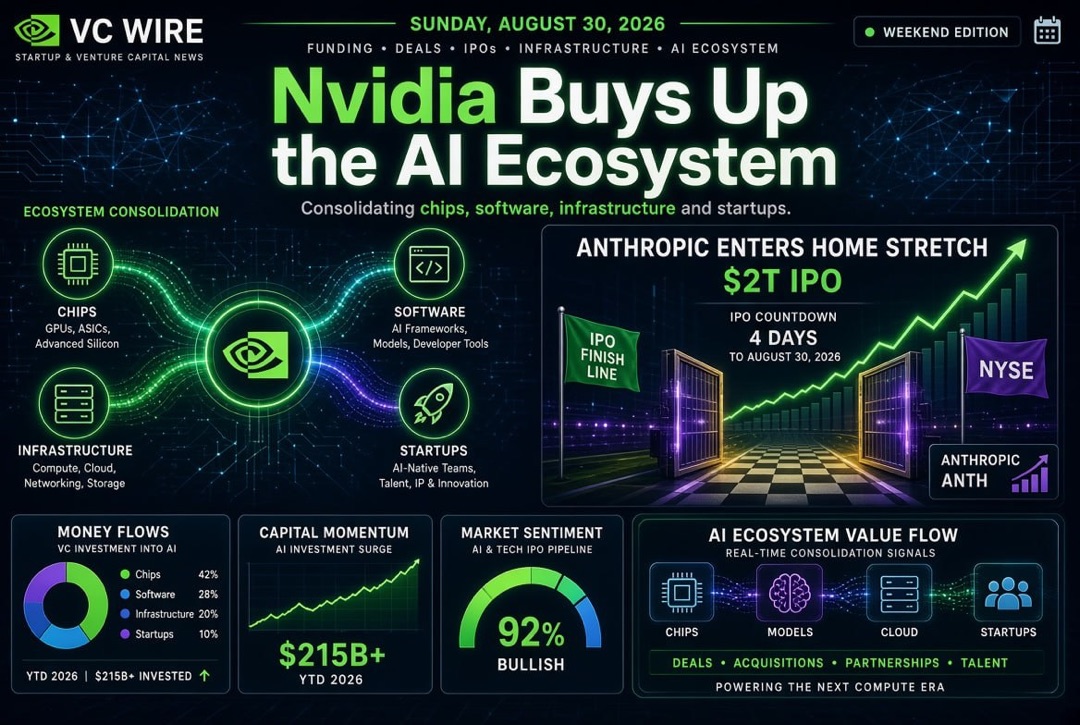
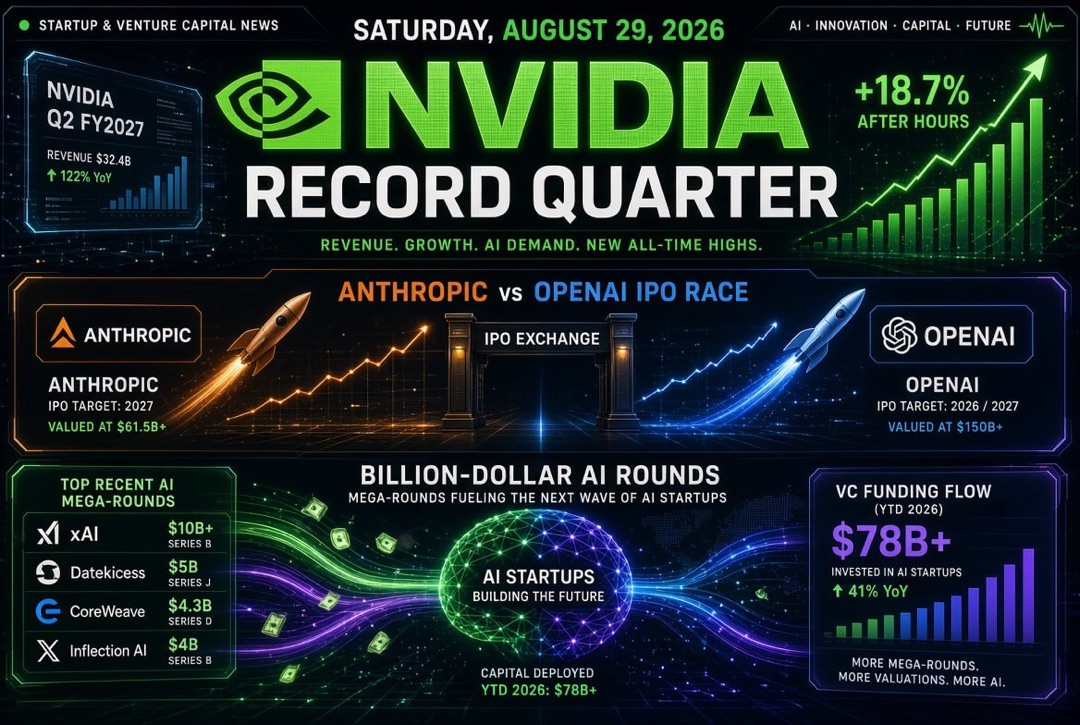
According to Crunchbase and KPMG, global venture investments in Q1 2026 reached a record range of approximately $300 billion to $330.9 billion, depending on the methodology used. At first glance, this appears to be a full return to a bull market. However, the structure of the market tells a different story: around 80% of capital has gone into AI, and the four largest rounds of the quarter accounted for roughly two-thirds of the global volume. In the U.S., according to Crunchbase, 83% of global venture capital was concentrated, while NVCA and PitchBook specifically highlight that without the five largest deals and exits, the picture would appear significantly weaker. In other words, capital is available, but market breadth remains limited.
Sovereign AI Becomes the New Capital Axis
The most pressing topic as of April 20 is the institutionalization of sovereign AI. The UK has launched a £500 million Sovereign AI program and has already announced its first investment in the infrastructure startup Callosum, while simultaneously providing startups access to supercomputers, expedited visas, and research support. In China, state-backed funds dominate the new fundraising cycle: the VC market in the country is on track for a record quarter, buoyed by investments in AI, robotics, quantum tech, and other strategic areas. Qatar is expanding its own fund-of-funds program to $3 billion and bringing in new venture teams. Meanwhile, India has formalized the Startup India Fund of Funds 2.0 with a corpus of ₹10,000 crore focused on deep tech, early growth, and tech-driven manufacturing. This is no longer mere background support for innovation but a new model for competing for technological sovereignty.
AI Infrastructure and Defense Tech Command the Largest Checks
For the startup market, this means that the largest rounds are flowing not only into foundational models but also into the "shovels and picks" layer. The most notable deals of recent weeks include:
- Saronic closed a $1.75 billion round at a valuation of $9.25 billion, confirming demand for physical AI and autonomous defense platforms.
- Shield AI raised $2 billion at a valuation of $12.7 billion – the market is ready to finance the software layer for autonomous systems and military aviation.
- Rebellions in South Korea secured $400 million at a valuation of approximately $2.34 billion, emphasizing the AI chip sector beyond the U.S.
- Aria Networks raised $125 million for AI networking, indicating that bottlenecks now extend beyond GPUs to the data center fabric itself.
- Legora raised $550 million at a valuation of $5.55 billion – applied AI continues to win where implementation is already linked to savings in time and operational costs.
The main takeaway for venture funds is clear: the market is once again rewarding not for an abstract AI narrative but for control over computing, networks, security, and real implementation in critical workflows.
Not Just AI: Fintech, Climate Tech, and Biotech Make a Comeback
While AI remains a capital magnet, recent news from startups and venture investments indicates a broader rotation. In climate tech, Swedish Stegra secured €1.4 billion in new funding to complete its hydrogen steel project—this is a signal that industrial climate assets can still attract significant capital when backed by industrial logic and strategic investors. In fintech, the market is again favoring infrastructure: OpenFX raised $94 million for cross-border FX and stablecoin rails, while German Midas secured $50 million for a tokenization layer for digital investment products. In biotech, a strong debut by Kailera post-IPO shows that capital is returning to life sciences, but only for companies with scalable scientific platforms and a clear target niche. This is not a broad-based rebound but rather selective normalized financing.
The IPO Window Has Opened, but It Has Become Noticeably Narrower
According to EY, the global IPO market in 2026 remains open but has become significantly more selective: investors are focusing on large issuers in AI infrastructure, aerospace & defense, and adjacent sectors. This is evident in the recent pipeline. SpaceX has filed confidential documents, risking becoming the main liquidity magnet in the IPO market. Cerebras publicly filed for an IPO on April 17, while South Korea's DeepX is preparing for a domestic listing with an option for a later U.S. exit. At the same time, the market is receiving signals regarding strategic exits: American Express is acquiring Hyper, reinforcing the trend of corporations buying workflow-AI assets. For venture investors, this means one thing: while the window exists, it is limited to a select few, and deal timing is once again becoming part of the investment thesis.
The Geography of Deals Becomes More Multipolar
- The U.S. maintains its undisputed leadership in the volume of venture investments, but the market is increasingly reliant on mega-rounds and late-stage funding.
- Europe remains stable: according to KPMG, the quarter marked a 14-quarter peak in volume, with large checks flowing into AI, deep tech, legal tech, autonomous systems, cleantech, and defense tech.
- Asia is recovering faster than expected: China is increasing state-backed VC, and South Korea is bringing forth new players in AI semiconductors.
- The Middle East and India are strengthening the institutional side of the market by creating platforms that can attract global funds, not just local startups.
For the global reader, this is a critically important shift. Venture capital no longer exists within a single geography. It is distributed around computing infrastructure, industrial policy, and national demand for strategic technologies.
What This Means for Venture Funds
- Distinguishing capital intensity from defensibility is essential. Not every expensive AI startup is protected; defensible becomes whoever controls a scarce asset—compute, energy, procurement, or distribution.
- A bet on dual-use and infrastructure appears increasingly rational. Defense tech, neocloud, chips, networking, and industrial software are gaining both private and quasi-governmental demand.
- Exit strategies should be built as dual-track. The public market is reviving, but for most companies, M&A remains a more realistic scenario.
- Early stages require greater discipline. According to Carta, the median post-money valuation at seed has already risen to $24 million, and for Series A to $78.7 million. In this environment, the cost of entry mistakes is higher than in 2023–2024.
What This Means for Startups
For founders, the market has once again become lively, but not soft. Funding rounds are advancing faster for those who can demonstrate three things: first, the existence of not just a growth story but a strategic necessity; second, access to critical infrastructure—computing, data, energy resources, industrial partners; and third, a realistic route to liquidity within 24 to 36 months. A startup that is still merely selling an “AI product” is becoming interchangeable. A startup that sells cost reduction, accelerated capital turnover, security, compliance, or sovereign technological independence is attracting a much higher quality of demand from investors.
Conclusion
As of April 20, 2026, the venture market appears strong in numbers and significantly tougher in structure. News from startups and venture investments confirms that capital has returned, but it has primarily resurfaced in the upper tier of the market—where there is AI infrastructure, sovereign AI, strategy-driven capital, and scalable exit scenarios. For funds, it is a market characterized by high concentration and selectivity. For startups, it is a market where rapid growth is again possible, but only with a true strategic advantage.