Current Startup and Venture Capital News as of March 13, 2026: Record Rounds in Artificial Intelligence, Strengthening Mega Funds, Growth in Robotics and Defense Tech, and the Return of Interest in IPOs, SPACs, and Private Capital Markets.
By mid-March 2026, the global startup and venture capital market is entering a new phase of acceleration. Capital flows are once again concentrating in the largest tech sectors, primarily in artificial intelligence, while parallel interests are intensifying in legal tech, robotics, defense tech, space tech, and infrastructure solutions for the new digital economy. For venture funds, this signifies the return of large checks, heightened competition for the best deals, and a gradual recovery of liquidity mechanisms.
Friday, March 13, 2026, marks a significant moment for the market as a time of reassessing priorities. Investors are already witnessing a shift from the previous model of "broad capital distribution" to a strategy of concentration: funding is directed not just towards promising teams, but towards startups capable of rapidly securing an infrastructural or platform position. In this context, the role of the largest funds, strategic partners, and corporate investors is growing, as they increasingly shape the agenda of the private market.
Below are the key themes shaping the news surrounding startups and venture investments as of March 13, 2026:
- record capital concentration in AI and infrastructure;
- new mega-rounds and intensified competition for computing resources;
- rapid growth in legal AI and applied B2B models;
- a shift in venture interest from software to robotics, industrial tech, and defense tech;
- strengthening of mega funds and increased "dry powder" among large managers;
- revival of exits through IPOs, SPACs, and private market instruments;
- maintenance of a global market character amid US dominance.
Record Venture Capital Volume: The Market is Rising Again, But Funds are Distributing Unevenly
The global venture market at the beginning of 2026 shows a sharp increase. However, this growth is far from uniform. The key takeaway for investors and funds is that while the volume of available capital is rising, a significant portion is channeled into a limited number of companies with pronounced technological advantages.
Currently, the startup and venture investment market looks as follows:
- capital is actively flowing back into tech deals after a period of caution;
- the main beneficiary is artificial intelligence and its associated infrastructure;
- late-stage investments are gaining an advantage over a broad early-stage market;
- funds are increasingly betting on companies that can become platforms rather than standalone products.
For global venture investors, this signals that 2026 will be a year of selective acceleration rather than mass recovery. The highest valuations are reserved for startups capable of monetizing computations, data, corporate demand, and applied AI scenarios.
Artificial Intelligence Remains the Primary Capital Magnet
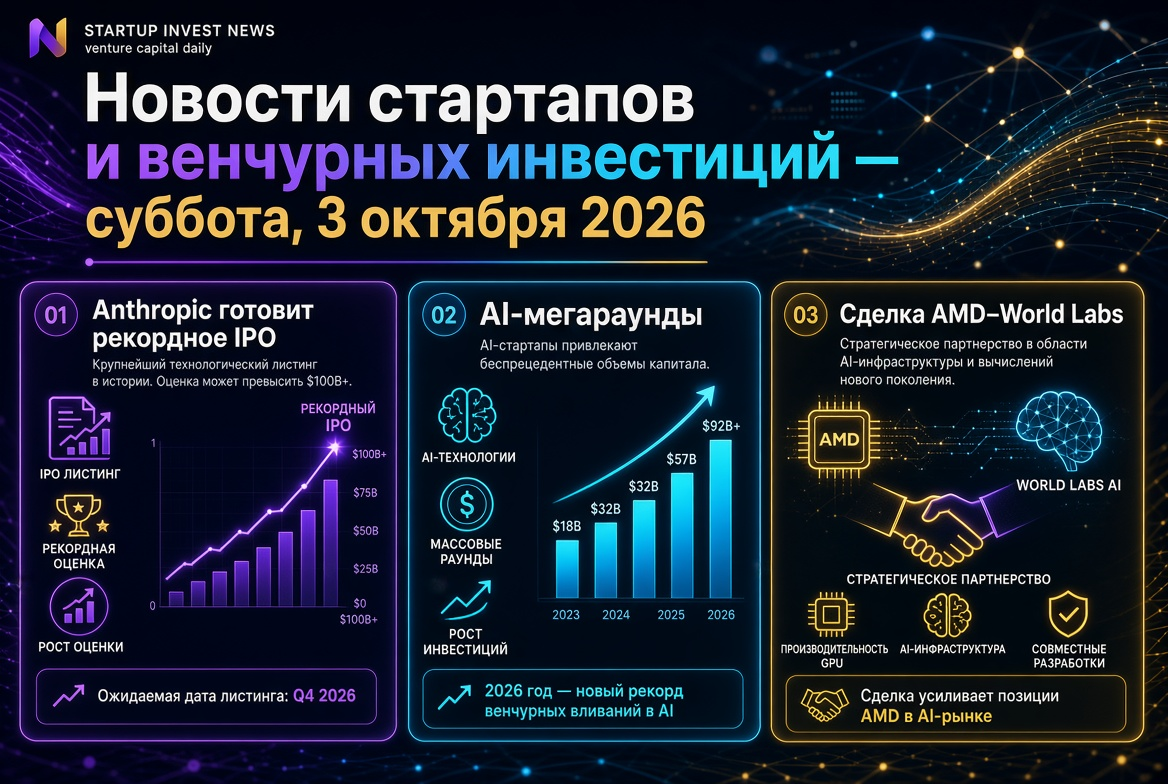
AI is defining the current architecture of the venture market. In recent weeks, several high-profile deals have confirmed that investors are willing to fund not only generative models but also alternative approaches to artificial intelligence, industry solutions, and infrastructure platforms.
Particularly noteworthy is the $1 billion round for AMI. This deal is significant not only due to its size but also because it indicates that the market is willing to invest in new AI architectures, promising deeper world understanding, causal modeling, and applied autonomy. Simultaneously, Thinking Machines has strengthened its position through a major partnership with Nvidia and access to large-scale computing resources. This underscores a new principle of the market: in 2026, the victor is not only the best algorithm but also the best access to chips, energy, and learning infrastructure.
For venture funds, this means:
- valuation of AI startups is increasingly dependent on access to compute;
- strategic investors are becoming nearly as important as traditional VCs;
- rounds are being structured more frequently around long-term partnerships rather than just capital;
- the AI infrastructure layer is becoming a distinct investment class.
Legal AI is Emerging as a Leader in Applied Corporate Demand
One of the most intriguing signals of March has been the robust growth in legal tech. The Legora round revealed that corporate clients are already moving from pilot tests to full-scale implementation of AI in legal processes. This marks a significant shift for the entire startup and venture investment market as it demonstrates the maturity of applied B2B models.
Not long ago, investors viewed legal AI as a niche segment. That situation is changing. Legal departments, large enterprises, and international firms are willing to pay for tools that truly reduce the time spent on document analysis, risk management, and contract preparation. In practice, this means that venture capital is increasingly directed not only to "big models" but also to applied solutions with quick ROI.
For funds, this presents an attractive deal profile:
- clear corporate clients;
- high revenue repeatability;
- strong monetization in the enterprise segment;
- potential for international scaling.
Robotics is Becoming the Next Major Sector After Pure Software
While 2024 and 2025 were characterized by software AI, 2026 is increasingly shifting investor interest toward robotics. The large rounds for Rhoda AI and Apptronik confirm that the market wants to invest in the physical layer of artificial intelligence—from industrial robots to humanoid systems and real-world motion control platforms.
This means that venture investments are increasingly flowing into startups that combine software, hardware, data, and industrial application. This model is more complex, more expensive, and more capital-intensive, but it creates higher barriers to entry for competitors.
The key drivers of growth in robotics currently include:
- labor shortages in manufacturing and logistics;
- decreasing computing costs relative to useful output;
- growing demand for automation in warehouses, factories, and defense supply chains;
- corporate interest in real, rather than demonstration, implementation scenarios.
Defense Tech and Space Tech are Solidifying Their Positions in Venture Portfolios
Another important trend is the definitive establishment of defense tech in the mainstream global venture market. Negotiations around a significant round for Anduril and the new capitalization of Sierra Space indicate that investors are willing to support not only software companies but also complex engineering platforms, provided they work at the intersection of defense, space, security, and national infrastructure.
For the global investor audience, two conclusions are critical here. First, the market is ceasing to differentiate between "pure venture" and "industrial capital": the best defense tech startups are receiving valuations comparable to the largest tech names. Second, government demand and lengthy contracts are beginning to mitigate the traditional risks associated with capital-intensive sectors.
This strengthens the role of funds with sector expertise and alters the structure of future deals at late stages.
Mega Funds are Setting the Pace: Major Managers are Increasing Pressure on the Market
The largest venture players continue to build their resource base. A prominent example is the new funds from a16z, demonstrating that institutional capital is actively flowing back into technology assets. This is an important factor for the entire global startup ecosystem: large funds not only increase capital volume but also set the demand structure by themes, stages, and geographies.
As a result, startups and venture investments in 2026 are increasingly adhering to the logic of major platform funds:
- more capital is available to market leaders;
- higher checks at late stages;
- sharper competition for quality deals;
- greater dependence of valuations on the strategic agendas of funds.
For founders, this is good news regarding capital accessibility. For investors, it serves as a reminder that they need to enter strong companies early, before valuations rise too significantly.
Exits are Back: IPOs, SPACs, and Private Funds are Once Again Tools for Liquidity
One of the most positive changes in 2026 is the gradual restoration of liquidity channels. This pertains not only to classic IPOs but also to SPAC deals, public funds providing access to private markets, and new formats for secondary liquidity.
There are already illustrative examples. Robinhood brought to market a fund for private technology companies, expanding access to late private assets. Pasqal is preparing to go public via SPAC, while expectations are rising in the US market for a broader IPO window. For venture investors, this is especially crucial, as the availability of real exits directly influences the readiness to invest more actively in early-stage and growth-stage companies.
These exits could serve as the mechanism sealing the new acceleration in the venture market in the second half of 2026.
What This Means for Venture Investors and Funds on March 13, 2026
At this juncture, the global startup and venture capital market is forming a new hierarchy. At the center is AI, but no longer as an abstract topic; it is emerging as a system of interconnected verticals: models, infrastructure, legal tech, robotics, defense tech, and space tech. Successful teams are those that do not just build a product, but rather a critically essential layer for the future technology-driven economy.
For venture investors today, it is particularly important to:
- monitor infrastructure-focused AI companies, not just applications;
- evaluate applied B2B segments with rapid corporate demand;
- keep an eye on robotics and defense tech as the next cycle of revaluation;
- consider that the largest funds will intensify competition and raise valuations of leaders;
- closely watch the exit market, as it will determine the pace of new deals in the second half of the year.
The conclusion for Friday, March 13, 2026, for the global venture market is clear: capital has returned, but it is noticeably more disciplined and concentrated. This creates strong opportunities for quality startups while simultaneously raising the bar for growth models, differentiation, and the ability to quickly secure a strategic position in the value chain.