The Global Venture Market Enters a New Phase: Capital Concentrates Around AI Infrastructure, Defense Tech, Space, and Biotech
Friday, July 17, 2026, marks a new investment asymmetry for the startup and venture capital market. There's plenty of money in the system again, but it is unevenly distributed: the largest funds, corporate investors, and strategic players are concentrating capital around artificial intelligence, computational infrastructure, defense technologies, space, robotics, and biotechnology. For venture investors and funds, this means the market appears strong on the surface, yet competition for the best deals is becoming increasingly fierce.
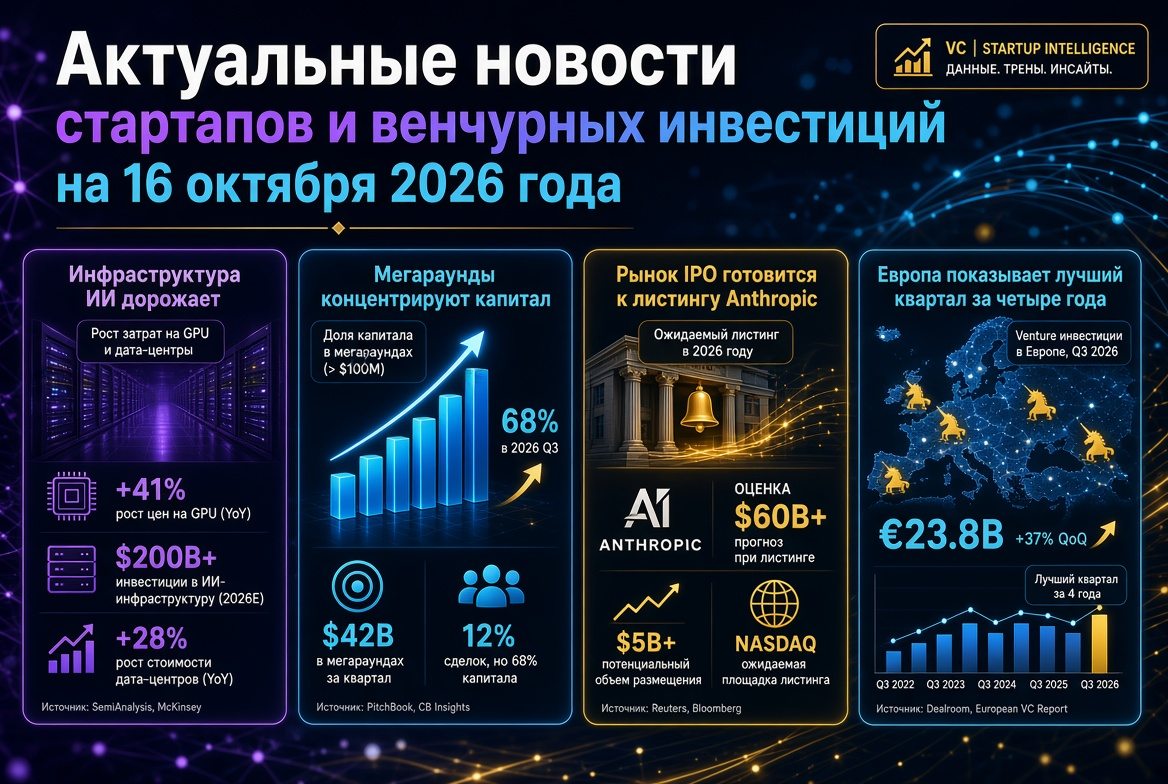
The main theme of the day is the transition from the classic venture cycle model to a market where megara rounds, IPOs, and strategic deals are shaping the investment agenda faster than traditional Seed, Series A, and Series B rounds. Startups with access to computing power, government contracts, industrial infrastructure, and large corporate clients receive premium valuations. The rest must prove not only growth rates but also the resilience of their unit economics.
AI Remains the Main Magnet for Venture Capital
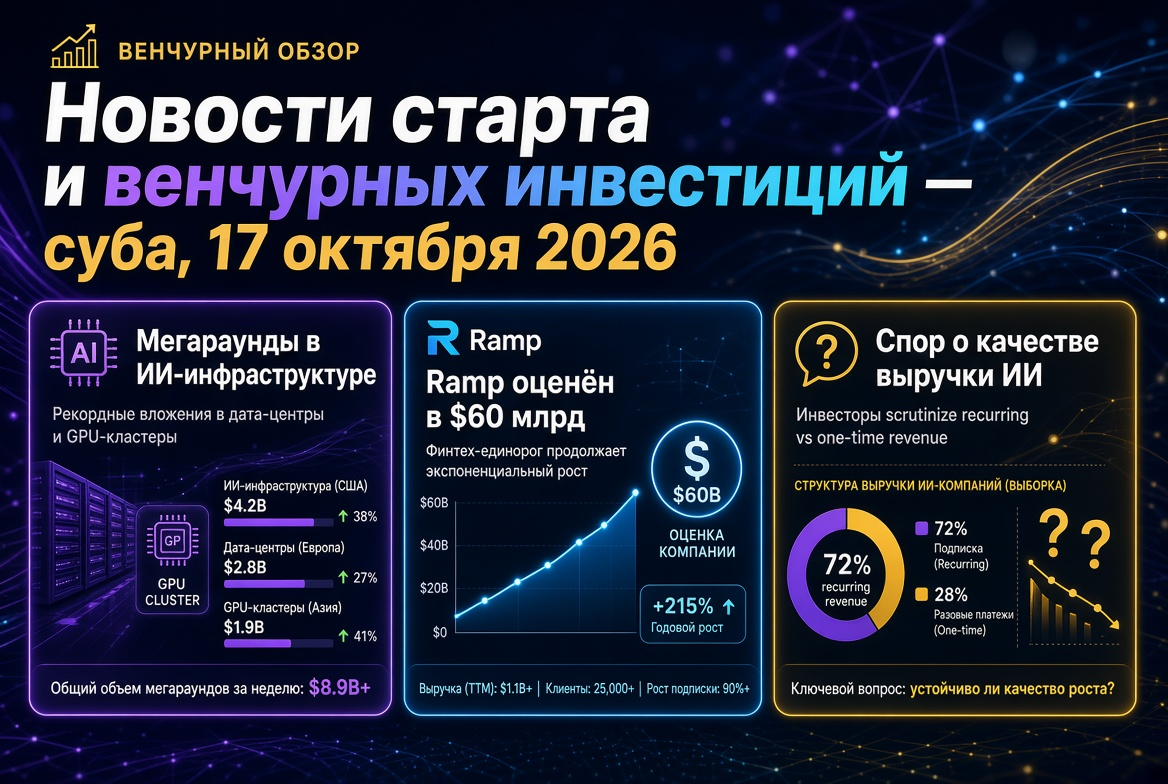
Startup and venture capital news from July 17, 2026, indicate that artificial intelligence continues to be the central theme of the global market. Investors are still putting funds not only into fundamental model developers but also into the infrastructure surrounding AI—chips, data centers, computation optimization systems, model customization tools, agent platforms, and corporate applications.
A key shift is that venture funds are increasingly evaluating AI startups not as typical SaaS companies, but as infrastructure assets. The focus lies on:
- access to computing power and GPU clusters;
- cost of training and inference of models;
- quality of corporate revenue and long-term contracts;
- data security and regulatory compliance;
- scalability without sharp deterioration of margins.
This creates a new standard for due diligence: mere rapid user growth is no longer sufficient. Investors are increasingly analyzing capital intensity, reliance on chip suppliers, the structure of contracts with hyperscalers, and the ability of a startup to retain clients in a highly competitive environment.
Thinking Machines Amplifies Competition in Open AI Models
One of the noteworthy events of the week was the launch of a new open AI model by Thinking Machines, founded by former OpenAI CTO Mira Murati. For the venture market, this event is significant not only as a technological release but also as a signal: the Western ecosystem is trying to regain traction in the open-weight model segment, which has been increasingly dominated by Chinese labs in recent years.
Open models are becoming a distinct venture investment direction. Their value for corporate clients lies in the potential for local deployment, customization for industry-specific tasks, and data control. For funds, this boosts the investment attractiveness of startups that develop not just a model, but a comprehensive platform for AI customization.
What Matters to Investors
- Open AI models can reduce companies' dependence on closed suppliers.
- Corporate clients will prefer solutions with transparent inference economics.
- Startups providing model customization tools could become an essential infrastructure layer in the market.
Defense Tech Becomes a New Hub of the European Venture Market
The European startup market is increasingly shifting toward defense technologies. A significant round for Helsing confirmed that defense tech has ceased to be a niche direction and has become a fully-fledged investment class for global venture funds. Against the backdrop of rising defense budgets, technological competition, and the need for autonomous systems, investors are reassessing the perspectives of companies that operate at the intersection of AI, robotics, sensors, cybersecurity, and military analytics.
This trend is particularly important for Europe. Whereas before, most of the largest technological valuations were formed in the U.S., European startups in defense and industrial AI are now beginning to attract global capital. Investor interest is bolstered not only by private demand but also by government programs, long-term contracts, and the strategic significance of technologies.
Key areas of defense tech in 2026 include:
- autonomous drone systems;
- AI battlefield data analysis;
- cybersecurity for critical infrastructure;
- underwater surveillance and sensor networks;
- software for defense platforms.
Space Startups Transition from a Niche to the Mainstream
The space sector is also becoming one of the key focus areas for venture investments. Following strong activity around the public market and rising interest in SpaceX, capital has begun to flow more actively into satellite networks, launch systems, orbital infrastructure, in-space computing, and defense-related solutions. For funds, this means an expansion of the investment mandate: space is no longer perceived solely as a long and capital-intensive deep tech segment, but is increasingly viewed as infrastructure for communication, surveillance, logistics, security, and data.
However, the venture market for space remains complex. Startups require substantial investments, access to engineering expertise, regulatory approvals, and long commercialization cycles. Therefore, companies that have already proven their technology and possess evident demand from government or corporate clients gain a competitive advantage.
AI Chips and Semiconductors Remain Among the Hottest Zones
The round for TYLSemi indicates that investors continue to seek opportunities in the semiconductor infrastructure for artificial intelligence. The startup is betting on chiplets—modular components for custom AI chips, which can help companies reduce dependence on closed architectures and accelerate the development of specialized solutions.
For venture funds, the AI chip market is attractive for several reasons. First, demand for computing continues to grow. Second, major tech companies are keen to optimize inference costs. Third, the shortage of manufacturing capacity and the high cost of GPUs create an opportunity window for alternative architectures.
However, risks in this segment remain high. Startups require capital-intensive R&D programs, access to manufacturing partners, and lengthy product market cycles. Therefore, investors will pay close attention to the team, the patent portfolio, strategic partners, and the presence of real customers.
Asia Strengthens Its Role in Global Venture Investments
The Asian startup market in 2026 has once again emerged as a driver of global venture activity. Chinese AI companies, including MiniMax and other tech groups, are actively utilizing capital markets, equity offerings, and convertible instruments to fund research, commercialization, and scaling. This reflects a broader trend: competition in AI is becoming not only technological but also financial.
For global funds, Asia remains a challenging yet important direction. On one hand, large AI ecosystems, strong engineering teams, and domestic demand are forming there. On the other hand, geopolitical risks, regulatory constraints, listing issues, and the availability of capital for foreign investors persist.
Biotech Returns to Venture Funds' Portfolios
Beyond AI and defense tech, investors are showing renewed interest in biotech startups. A resurgence in M&A activity, improved conditions in the IPO market, and strong clinical results are making biotech one of the most notable sectors of 2026. Unlike the overheated AI valuations, biotech offers funds a different risk profile: a long horizon, scientific uncertainty, but potentially significant strategic exits through pharmaceutical deals.
Companies operating in the following areas are particularly in demand:
- oncology and targeted therapy;
- radiopharmaceuticals;
- AI tools for drug discovery;
- diagnostic and personalized medicine platforms;
- clinical assets in late-stage trials.
Corporate Venture Investors Amplify Their Influence
Corporate venture capital is becoming an increasingly significant force in the startup market. Major tech, industrial, financial, and defense corporations are using venture investments as a means to access innovations, talent, and future supply chains. In the context of an AI supercycle, corporate investors often have advantages over traditional funds: they can offer startups not just capital but also clients, infrastructure, data, and sales channels.
This creates new competition for independent venture funds. The best deals are increasingly forming around strategic partnerships. Startups are choosing investors not only based on valuation but also on their ability to accelerate commercialization.
What Venture Investors and Funds Should Pay Attention To
The current situation in the startup and venture investment market looks favorable but uneven. Record amounts of capital do not mean a uniform recovery across all segments. On the contrary, the market is becoming more concentrated, more demanding in terms of asset quality, and more dependent on major themes—AI, defense, space, chips, biotech, and data infrastructure.
On July 17, 2026, venture investors should focus on five questions:
- Revenue Quality: Does the startup have repeatable corporate monetization or just pilots and PR interest?
- Capital Intensity: How much money will be required until the next growth stage, and will it dilute early investors?
- Technology Protection: Does the company possess data, patents, infrastructure, or contracts that are difficult to replicate?
- Exit Path: Is an IPO, strategic sale, or secondary liquidity possible within the fund's horizon?
- Geographic Risk: How do regulatory constraints, export control, and government programs affect the company?
The key takeaway of the day: the global venture market has entered a phase where not just fast startups win, but companies that can become part of critical technological infrastructure. For funds, this is a time of significant opportunities but also increased discipline. The best deals will be at the intersection of artificial intelligence, defense, space, biotechnology, semiconductors, and corporate demand. It is precisely there that the new map of global venture capital is being formed in 2026.