Top Startup and Venture Capital News for Monday, July 20, 2026: Mega Rounds in AI Infrastructure, Growth in Defense Tech, Investments in Biotech, Enterprise AI, and Global Concentration of Venture Capital
The first half of 2026 has solidified a key trend: global venture investments are rising, but this growth does not signify an equally favorable environment for all startups. Major funds and strategic investors are concentrating capital in a limited number of companies that have already demonstrated product scalability, access to corporate clients, and the ability to occupy critically important niches in the new technological architecture.
For venture funds, this means a shift in deal selection models. While the market in 2020–2021 was willing to fund a wide array of hypotheses, by 2026 the priority is on companies that meet at least one of three criteria:
- building infrastructure for artificial intelligence and corporate AI applications;
- creating technologies of strategic importance for defense, cybersecurity, energy, or space;
- demonstrating rapid revenue growth, high retention, and the ability to scale without excessive reliance on subsidized demand.
Databricks: A New Benchmark for Private AI Valuation
One of the main events in the venture market has been the new strategic valuation of Databricks at approximately $188 billion. For the startup market, this is a signal: the largest private tech companies are staying out of the public market for longer, raising capital at late stages, and effectively creating an alternative to IPOs.
Databricks is important for venture investors not only as a significant deal but also as an indicator of demand for enterprise AI. The company operates at the intersection of data, analytics, corporate machine learning, and AI model management. This is the segment where funds see long-term cash flow: large clients are already integrating AI into operational processes rather than just testing pilots.
The conclusion for funds is clear: in late-stage venture capital, platforms that control the data layer, infrastructure, and corporate workflows are becoming increasingly valued. Standard SaaS without an AI core or without deep enterprise integration will command a lower revenue premium.
Fireworks AI and SambaNova: Capital Flowing into Inference, Chips, and Computing Platforms
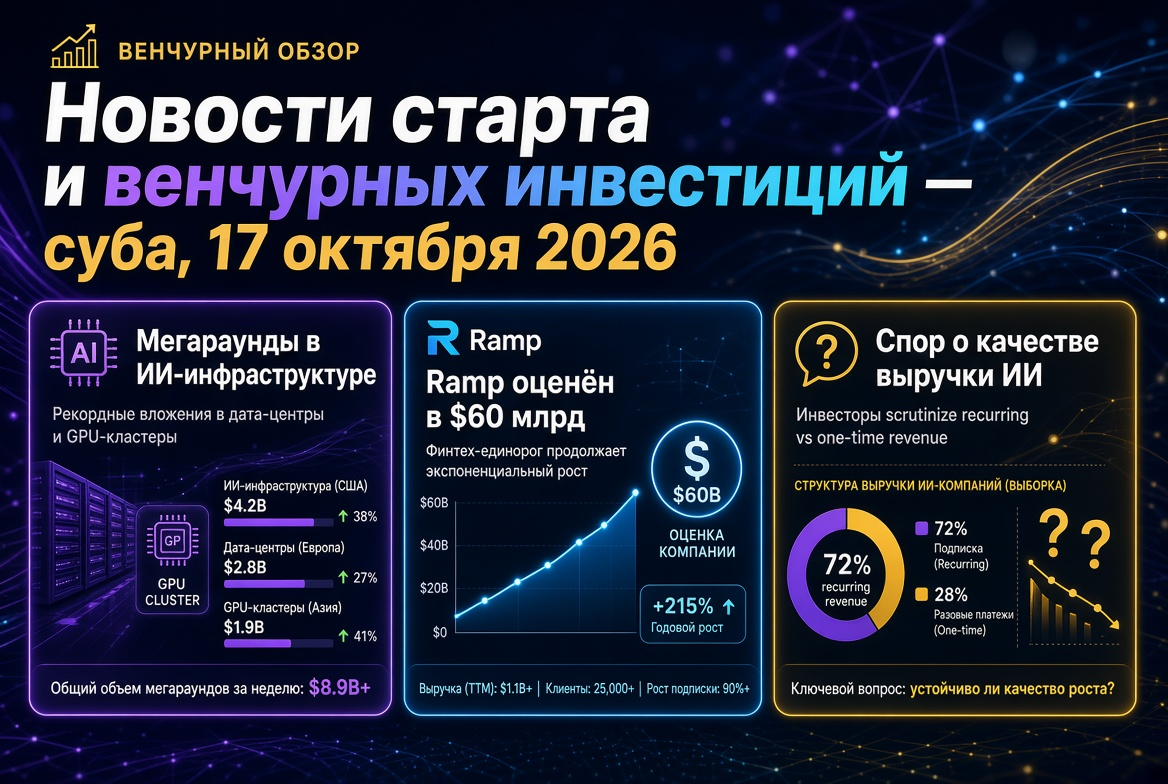
Venture investments in AI infrastructure remain the hottest area in July. Fireworks AI raised a large round for the development of a platform for specialized AI models, while SambaNova secured funding to scale AI chips and inference infrastructure. These deals show that the market is gradually shifting from a race for basic models to the applied and infrastructural level of artificial intelligence.
For venture funds, three investment theses are particularly essential:
- Inference is becoming a standalone market. As more companies adopt AI products, the demand for cost-effective, fast, and manageable execution of models increases.
- Open and specialized models are competing with closed frontier labs. Corporations aim to reduce dependence on a few suppliers.
- AI computing is becoming a capital-intensive yet secure segment. Access to GPUs, workload optimization, and proprietary chips create a high barrier to entry.
This is why startups operating at the intersection of AI, cloud, semiconductor, and developer infrastructure continue to attract significant checks, even amid discussions of potential overvaluation.
Helsing and Quantum Systems: Defense Tech Becomes a New Venture Vertical
European defense tech remains one of the most notable areas for venture capital. A significant round for Helsing reinforced the notion that defense technologies have ceased to be a niche solely for government contractors. Startups developing AI systems for battlefield analysis, autonomous drones, sensor networks, and software for military coordination are now viewed as strategic technological assets.
The rise in interest in defense tech is not solely driven by geopolitics. For funds, this sector is attractive because it combines:
- long-term government budgets;
- a high technological and certification barrier to entry;
- the potential for dual-use in industry, logistics, security, and robotics;
- the possibility of creating national champions in Europe, the USA, and Asia.
However, risks are also increasing. Valuations of defense tech startups are already compared to the multiples of public tech companies, while revenues for many players still depend on large contracts and political cycles.
Biotech and AI Drug Discovery: Chai Discovery Highlights Demand for Scientific Platforms
The AI drug discovery sector remains a focal point for venture investors. The round for Chai Discovery confirmed that the market is willing to finance not only traditional biotech startups but also platform companies that harness artificial intelligence for designing molecules, proteins, and therapeutic solutions.
This vertical is attractive to funds because it combines a high potential upside with opportunities for strategic partnerships with major pharmaceutical companies. If AI genuinely accelerates discovery timelines and reduces the costs of early-stage research, these startups may become an infrastructural layer for the entire pharmaceutical industry.
A key investment question here is not only the quality of the model but also the company’s ability to bring assets to the clinical stage, secure licensing deals, and validate economics through real agreements with pharmaceutical partners.
India, Europe, and Asia: The Geography of Venture Capital Expands
Startup news for July shows that venture investments are being distributed globally. The Indian AI coding startup Emergent has achieved unicorn status, Singapore’s PixVerse raised significant funding in AI video, and European companies are strengthening their positions in defense tech, quantum computing, and AI sovereignty. For global funds, this means that deal sourcing is becoming less confined to Silicon Valley.
Nevertheless, the USA retains an advantage in AI infrastructure, enterprise software, and scaling late-stage companies. Europe is strengthening in defense technologies, sovereign AI, and industrial deep tech. Asia remains strong in consumer AI, video, hardware supply chains, and fintech infrastructure. For funds, this creates a more complicated yet more diversified landscape of the venture market.
Fintech and Crypto Rails: Less Noise, More Infrastructure
Fintech startups are once again capturing attention in 2026, but investors have become more selective. The focus has shifted from consumer applications to infrastructure: stablecoin payments, corporate treasury solutions, tokenized markets, compliance platforms, and B2B rails for international settlements.
For venture investors, this is an important shift. Crypto and fintech are no longer marketed purely as speculative plays based on user growth. Successful startups must demonstrate regulatory resilience, clear monetization, and integration into real financial processes. Funds will pay closer attention to licensing, partnerships with banks, the quality of risk management, and the ability to operate across multiple jurisdictions.
What Matters to Venture Investors and Funds on July 20, 2026
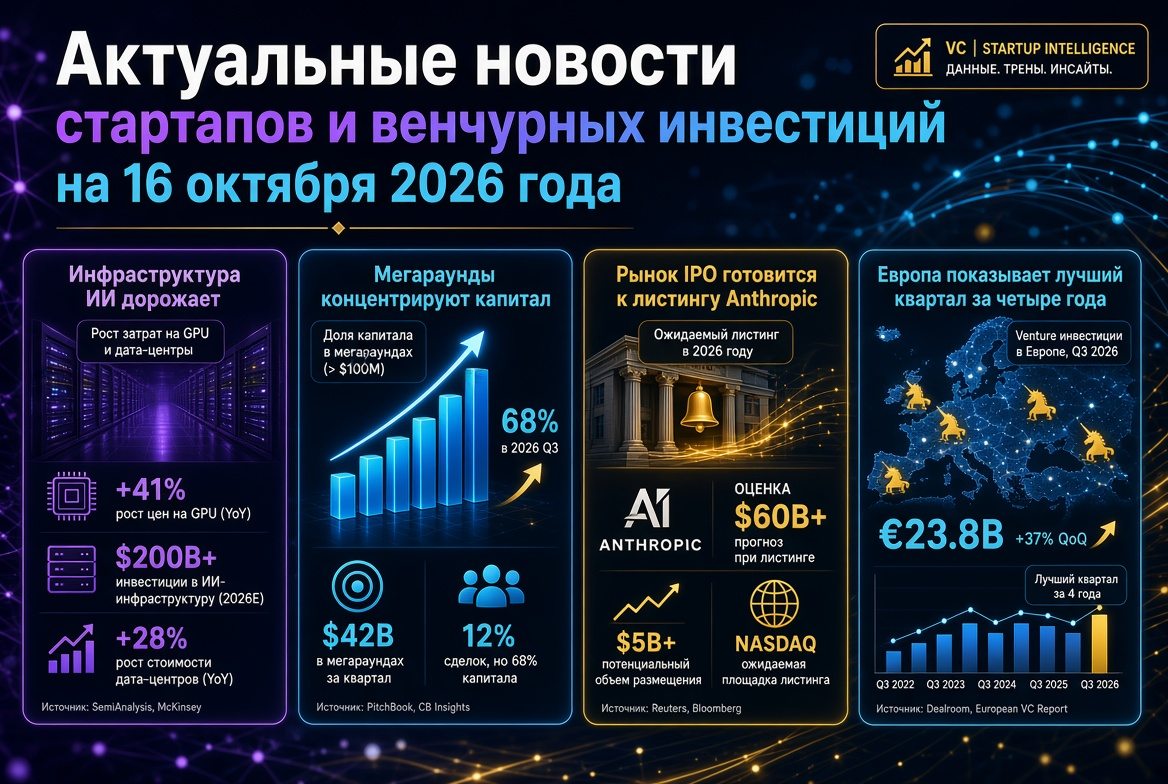
For venture investors and funds, the current agenda creates several practical conclusions. First, AI remains the main capital magnet, but the most attractive opportunities are not abstract AI applications, but infrastructure: data, inference, chips, agents, security, and enterprise workflow. Second, defense tech, space tech, and sovereign AI are transforming into institutional categories, where new specialized funds will emerge. Third, late-stage companies are receiving an disproportionately large share of capital, which exacerbates the gap between mature tech platforms and early-stage startups.
Funds should pay attention to the following areas:
- AI infrastructure: inference, GPU orchestration, model serving, enterprise AI gateways;
- Defense tech: autonomous systems, drones, battlefield software, anti-drone security;
- AI biotech: drug discovery, protein design, clinical AI tools;
- Sovereign cloud: data protection, localized AI platforms, compliance infrastructure;
- Fintech rails: stablecoin payments, tokenized assets, B2B settlement.
Conclusion of the Day: The Market Grows but Becomes Stricter on Quality
The main takeaway for Monday, July 20, 2026, is that the venture market is not slowing down, but it is becoming more concentrated and demanding. There is capital available, but it is flowing to startups that can prove technological depth, strategic significance, and commercial scalability. For founders, this means the need to build not just a product, but a secure platform with a clear economic model. For venture funds, this necessitates making quicker decisions on the best deals but with a stricter assessment of the risks of inflated multiples.
In the coming weeks, market attention will focus on new AI mega rounds, potential IPOs of tech unicorns, activity from defense tech funds, the growth of AI biotech, and valuations of late-stage companies. Venture investments remain one of the primary indicators of the direction of the global economy: in 2026, this vector increasingly runs through artificial intelligence, security, computing infrastructure, and technological sovereignty.