Startup and Venture Capital News as of April 13, 2026: Market Growth, AI Infrastructure, Major Deals, and Emerging Trends
The global startup and venture capital market is entering a new phase. While in 2023-2024 investors primarily discussed valuation corrections, discipline, and liquidity shortages, the agenda has shifted by spring 2026. Venture capital has picked up momentum again, yet the recovery is uneven: a significant portion of funding is concentrated around artificial intelligence, computational infrastructure, data centers, chips, and companies poised to become systemic platforms.
For venture investors and funds, this signifies a crucial shift. The market no longer operates under the logic of a “broad recovery” across all segments simultaneously. Instead, capital is becoming more selective. Major deals are returning, new funds are entering the market, and IPOs are once again being discussed as a viable scenario; however, the primary beneficiary remains the AI ecosystem. This sector dictates valuations, deal closure speeds, strategic investor interest, and the architecture of future exits.
The Venture Market is Growing Again, but Growth is Highly Concentrated
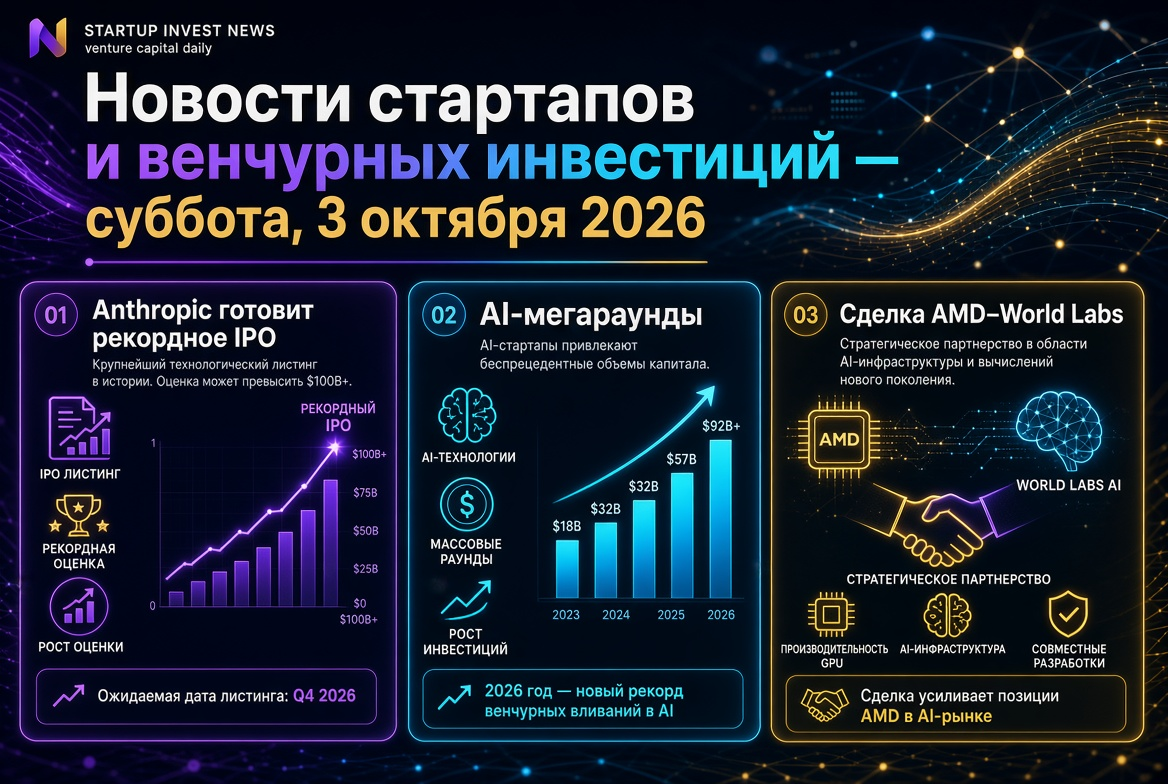
The first quarter of 2026 has emerged as one of the strongest periods for the global venture market in recent years. However, record metrics do not imply uniform improvement across the entire industry. Most funding has been concentrated in a limited number of large deals, particularly in the AI segment.
Practically, this creates a two-speed market:
- The upper segment is capturing mega-rounds and premium valuations;
- The mid-market is funded cautiously and under stricter conditions;
- Early stages still require strong differentiation, clear revenue, and a compelling go-to-market strategy.
In other words, venture capital has returned, but not for everyone. For funds, this necessitates a more precise selection of categories where capital can genuinely scale, while startups must prove not just technological viability, but strategic indispensability.
The Main Theme of the Week: AI Infrastructure, Chips, and Computational Powers
The most prominent trend in the global startup market is the race for AI infrastructure. Investors are increasingly funding companies that operate not only at the application level but deeper within the layers of computation, networks, chip architectures, power distribution, and cloud infrastructure.
This is why the market is closely monitoring recent deals involving SiFive, Aria Networks, Thinking Machines, and other companies operating at the intersection of artificial intelligence and hardware. For venture capitalists, this serves as an important signal: the next wave of value creation is occurring not only in AI applications but also in the foundational infrastructure without which model scaling is unfeasible.
For investors, three key takeaways emerge:
- The market begins to reward companies controlling scarce resources;
- Infrastructure startups can once again qualify for large rounds;
- The boundary between venture and strategic capital is becoming increasingly blurred.
This also explains the growing interest in “physical AI,” semiconductors, new cloud solutions, and tools that ensure the computational sovereignty of companies and governments.
Strategic Investors are Increasingly Shaping the Market
Another notable characteristic of 2026 is the enhanced role of corporations in the venture architecture. This is not limited to traditional corporate venture capital (CVC) divisions. The largest technology players are simultaneously becoming infrastructure providers, capital sources, distribution channels, and potential acquirers.
This format is particularly evident in the AI sector. When a large corporation invests in a startup and subsequently provides it with computational power or licenses technology, a new growth model emerges. This accelerates the startup's growth while simultaneously increasing dependence on a handful of dominant ecosystems.
For venture funds, this creates a dual picture:
- On one hand, corporate participation reduces scaling risks;
- On the other, it raises concentration risks and complicates the independent growth trajectory of the startup;
- In later stages, capital increasingly follows the infrastructure alliance rather than solely the product.
Europe is Betting on Its Own AI Champions
The European startup market is also evolving. Whereas the region was previously associated with caution and a lack of late-stage capital, the focus is now shifting towards building proprietary technology platforms. This is most prominently demonstrated by Mistral, which is enhancing vertical integration and building a more complete infrastructure framework around AI.
For the European venture market, this is a significant precedent. Investors are increasingly looking at not just individual products but also companies capable of controlling the entire tech stack: model, computation, cloud, enterprise access, and subsequent monetization. Concurrently, discussions about reducing regulatory and legal barriers for rapid company formation are gaining momentum in Europe, further favoring technological entrepreneurship.
If this trend continues, Europe has the potential to become not only a talent market but also a more autonomous growth pole for AI startups and the attraction of venture investments.
China Presents a Different Model of Venture Acceleration
In the Asian landscape, China stands out, where the venture market is receiving a new impulse due to government support for strategic industries. Funding is directed towards artificial intelligence, robotics, quantum technologies, and other sectors viewed as elements of technological sovereignty.
For global funds, this means that the competitive map of startups is shifting not only due to private capital but also due to industrial policy. The Chinese model is characterized by the influential role of state and quasi-state structures, accelerating funding in priority segments but potentially intensifying valuation imbalances.
Investors should bear in mind that the startup market in 2026 is increasingly diverging from a unified global system. It is fragmenting into regional clusters with their own logic:
- The US dominates in mega-rounds and AI platforms;
- Europe is seeking paths through sovereign infrastructure and regulatory reform;
- China scales technological industries with active state participation.
Fintech and Healthcare Are Still Relevant, but the Market Has Become Much Stricter
Amid the AI frenzy, it would be a mistake to believe that other sectors have lost significance. Fintech, healthcare, and enterprise software still attract capital, although the nature of deals has shifted. Investors now prefer fewer, but higher-quality rounds. This trend is particularly noticeable in fintech: while more money is flowing into the sector, the number of deals has decreased.
This indicates a mature market approach. Capital is directed toward where there is real efficiency, an infrastructural function, scalable revenue, and strong unit economics. Companies operating in cross-border payments, stablecoin infrastructure, enterprise payment solutions, and financial process automation are exemplifying this approach.
For venture investors, this creates a favorable environment: overvalued stories are filtered out more quickly, and companies with clear monetization strategies have the opportunity to close rounds on healthier terms.
The Exit Market is Gradually Returning to the Agenda
Another key signal for venture capital is the return of discussions around exits. The plans of major tech companies for IPOs and new expectations regarding public offerings are gradually changing market sentiment. Even if the IPO window remains selective, the mere fact that large private companies are once again discussing listing as a real step is crucial for evaluating the entire venture cycle.
As a result, funds now have a clearer picture across several areas:
- Late-stage assets can again be assessed through the potential for a public story;
- M&A is becoming a strategic mechanism for consolidation in AI and cloud infrastructure;
- Liquidity is ceasing to be an abstract scenario and is returning to investment models.
This does not mean a full opening of the exit window for all. However, for the best assets, the market is once again ready to discuss listing scenarios, strategic sales, or consolidation through a series of deals.
What This Means for Funds and Startups in the Upcoming Week
As we begin the week of April 13, 2026, the picture looks as follows: the venture market has become stronger but harsher; more capital is available, yet it is distributed less democratically; a startup’s valuation increasingly depends on its position within the infrastructure chain rather than solely on the growth rate of its user base.
For funds, the priorities are becoming:
- Identifying companies integrated into AI infrastructure and corporate workflows;
- Assessing startups' reliance on a single provider of computation or capital;
- Selecting regions where technological growth is reinforced by institutional support;
- Balancing high-conviction bets in AI with more rational deals in fintech, healthcare, and B2B software.
For startups, the main takeaway is even more straightforward: in 2026, the market is more inclined to finance not just “interesting products” but companies that solve systemic problems, work with scarce infrastructure, control a critical layer of the stack, or have a clear path to strategic value.
This is why the main theme for Monday is not abstract growth for startups, but rather the new structure of venture capital. Not everyone wins. The winners are those positioned at the center of the new technological framework of the global economy.