The main intrigue of the week is the preparation for Anthropic’s IPO. The company's Chief Financial Officer has begun preliminary meetings with institutional investors, while the market discusses a potential valuation of around $2 trillion upon listing on Nasdaq as early as October. Concurrently, capital is actively flowing into "hard" technologies: defense startups, nuclear energy, energy storage, and AI infrastructure. Below are the key events and trends shaping the venture market agenda for Saturday, August 15, 2026.
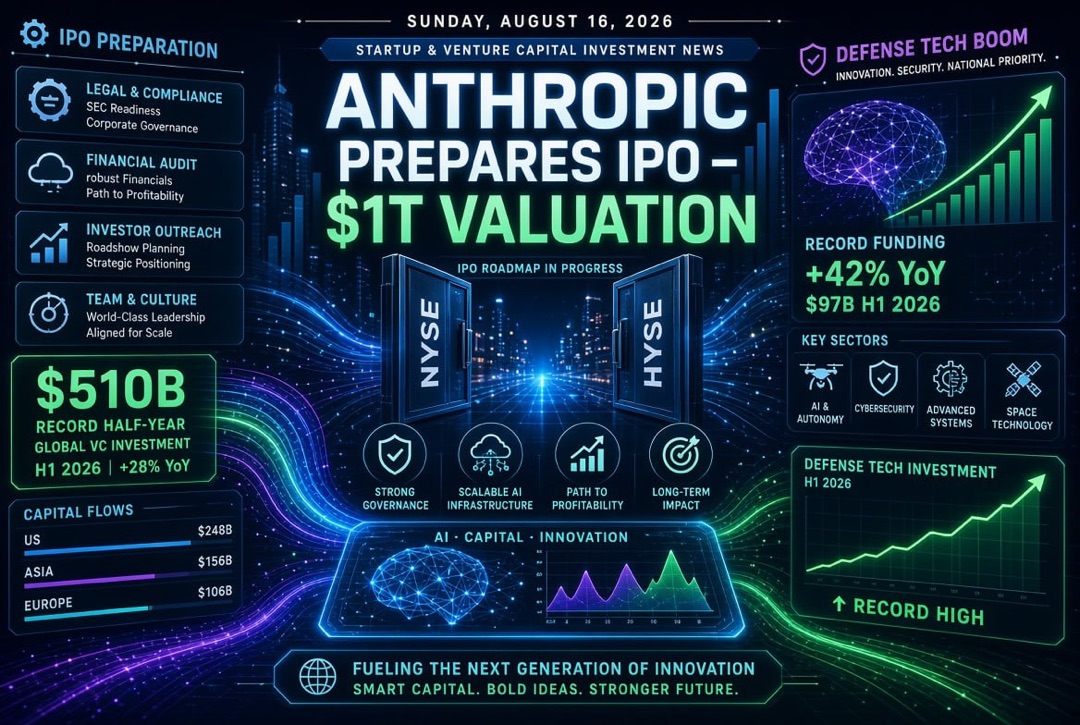
- Anthropic's IPO on the home stretch. Preliminary meetings with investors, targeted NYSE listing in October, and a predicted placement probability of 76–80% by prediction markets.
- Record-breaking half-year for the global venture industry. $510 billion in investments over six months and 16 rounds of funding at $1 billion or more just in the second quarter.
- Defense technologies hit historical highs. Over $14.6 billion invested in the sector since the beginning of the year—the previous year's record exceeded even before the end of summer.
- Energy becomes the second favorite after AI. Billion-dollar rounds in energy storage, nuclear projects, and data center infrastructure.
- New funds and "dry powder". Craft Ventures launches a $1 billion fund, and mega-funds' activity fuels the market with capital.
- Russia and the CIS: cautious recovery. Projected local venture market growth of 10–15% and launching of new funds totaling 10 billion rubles.
Anthropic IPO: Rehearsal for the Largest Offering in AI History
Anthropic, the developer of the Claude model family, is nearing public offering. The company's CFO is conducting a series of preliminary meetings with major institutional investors—a standard step before the formal roadshow. The company submitted a confidential S-1 registration application to the U.S. Securities and Exchange Commission on June 1, outpacing OpenAI by a week, and the consensus among underwriters now points to a Nasdaq listing in October 2026.
The scale of the deal is unprecedented. The last private Series H-1 round of $65 billion in May valued Anthropic at $965 billion, while the secondary market is already trading the company's shares at an implied valuation of $1.05–$1.15 trillion. Some forecasts allow for a capitalization of about $2 trillion in the case of a successful offering. Prediction markets estimate the probability of an IPO by the end of 2026 at 76–80%. Organizers include Goldman Sachs, Morgan Stanley, and JPMorgan, with an expected fundraising amount of at least $60 billion. OpenAI, according to media reports, is leaning toward postponing its own listing to 2027, relinquishing its competitor the status of the first public AI lab.
Record Half-Year: $510 Billion and Unprecedented Capital Concentration
The first half of 2026 has been the strongest in the history of the venture industry. Global investments reached $510 billion, surpassing the entire 2025 total ($440 billion). North America attracted $392 billion—a historic regional high. Meanwhile, capital is concentrating among a narrow circle of companies: in the second quarter, 16 startups closed rounds of funding totaling $108.6 billion, accounting for 53% of quarterly financing.
For venture funds, this means a dual reality. On one hand, the exit window is wide open: the second quarter has been one of the strongest periods for exits in recent years, with IPOs and M&A returning in full force. On the other hand, the number of deals is growing significantly slower than the volume, and competition for access to segment leaders has intensified to the extreme.
Megadeals of the Week: From Defense Equipment to Nuclear Reactors
The August series of billion-dollar deals underscores the shift in investor focus towards the "physical" layer of the tech economy:
- Hadrian — $1.37 billion in Series D round at a valuation of $7.87 billion for automated defense manufacturing; led by WCM Investment Management, Washington Harbour Partners, and Valor Equity Partners.
- Base Power — $1 billion Series D at a valuation of $13 billion for home energy storage; among investors are Ribbit Capital, Addition, and JPMorgan’s strategic division.
- Valar Atomics — $1 billion Series B led by Sequoia Capital for developing small nuclear reactors plus a $200 million credit line.
- Form Energy — $750 million Series G led by T. Rowe Price for scaling up iron-air batteries for long-term energy storage.
- Lovable — $400 million Series C at a valuation of $13.3 billion: the Swedish "vibe-coding" platform solidifies its status as the fastest-growing AI startup in Europe.
The overall message of the week is clear: the largest checks in venture history are going to companies that own heavy, physical, or regulated layers of the AI economy, not software add-ons built on top of others' infrastructure.
Defense Technologies: Historical Record Set Long Before Year-End
The sector of defense and national security startups is experiencing a structural boom. Since the beginning of 2026, over $14.6 billion has been invested in the industry—the previous year's record of $9.6 billion was surpassed even during the summer. The flagship remains Anduril Industries with a $5 billion Series H round at a valuation of $61 billion. Shield AI raised $1.5 billion at a valuation of $12.7 billion, while the developer of autonomous marine vessels, Saronic, secured $1.75 billion. A distinct trend is the record activity from corporations: defense giants like Lockheed Martin, BAE Systems, and Airbus participated in venture rounds totaling $4.1 billion, setting a maximum for historical observations.
IPO Market: Lessons from SpaceX and the Queue for Anthropic
Public markets remain open but demanding. The case of SpaceX is illustrative: the company conducted the largest IPO in history in June with a valuation of around $1.77 trillion, with shares soaring to $2.5 trillion, yet after its first quarterly report, which revised expectations regarding AI capital expenditures, the market capitalization retreated to $1.4 trillion. This serves as a reminder for investors that even cult issuers face significant reevaluation by the public market.
Nevertheless, the pipeline for offerings remains active: quantum developer Quantinuum raised $1.68 billion in a heavily oversubscribed IPO, and since the beginning of the year, the volume raised through initial public offerings in the U.S. has increased more than 2.5 times year over year, with Databricks, Cerebras, Wealthfront, and dozens of companies with confidential applications in the listing queue.
New Funds: "Dry Powder" Continues to Flow
The supply of capital is keeping pace with demand. Craft Ventures, led by David Sacks, announced a $1 billion fund focusing on AI. European players are strengthening their positions: Earlybird, with assets of around €2.5 billion, is lobbying for expanded institutional capital for startups on the continent. In India, on a single day, August 13, seven rounds closed involving Peak XV Partners, SMBC Asia Rising Fund, and Anicut Capital—emerging markets continue to maintain a high pace of early-stage deals.
Russia and the CIS: Recovery with the Support of Funds
The local market is gradually emerging from a prolonged stagnation. Industry participants predict that by 2026, the volume of the Russian venture market may grow by 10–15% and approach 17 billion rubles, with the first half of the year already showing around a 70% growth after several years of decline. The drivers include private and state funds: Kama Flow and "Medscan" launched funds of 10 billion rubles each, while the Moscow venture fund is increasing its deal portfolio with partners. The activity of angel investors, according to managers, will only return as the key interest rate decreases.
What This Means for Investors: Insights as of August 15, 2026
The venture market is entering the fall of 2026 in a phase of record liquidity and equally record selectivity. Key benchmarks for funds and LPs:
- Concentration is the new norm. Almost half of the global capital is going to two companies; access to segment leaders is becoming the primary competitive advantage for funds.
- Infrastructure trumps applications. Valuations are rising for owners of computing, energy, manufacturing, and data—software add-ons are undergoing stricter security checks.
- The exit window is open, but the public market disciplines. The reevaluation of SpaceX post-report serves as a warning for all planning placements at the upper end of the range.
- Anthropic's IPO will be a stress test for the entire AI wave. The success or failure of the October listing will set pricing benchmarks for private rounds for quarters to come.
Saturday, August 15, 2026, marks the market at a peak cycle: capital is becoming cheaper for the select few and more expensive for everyone else. For venture investors, it is a time for discipline—and perhaps the best time in a decade for those who know how to choose wisely.