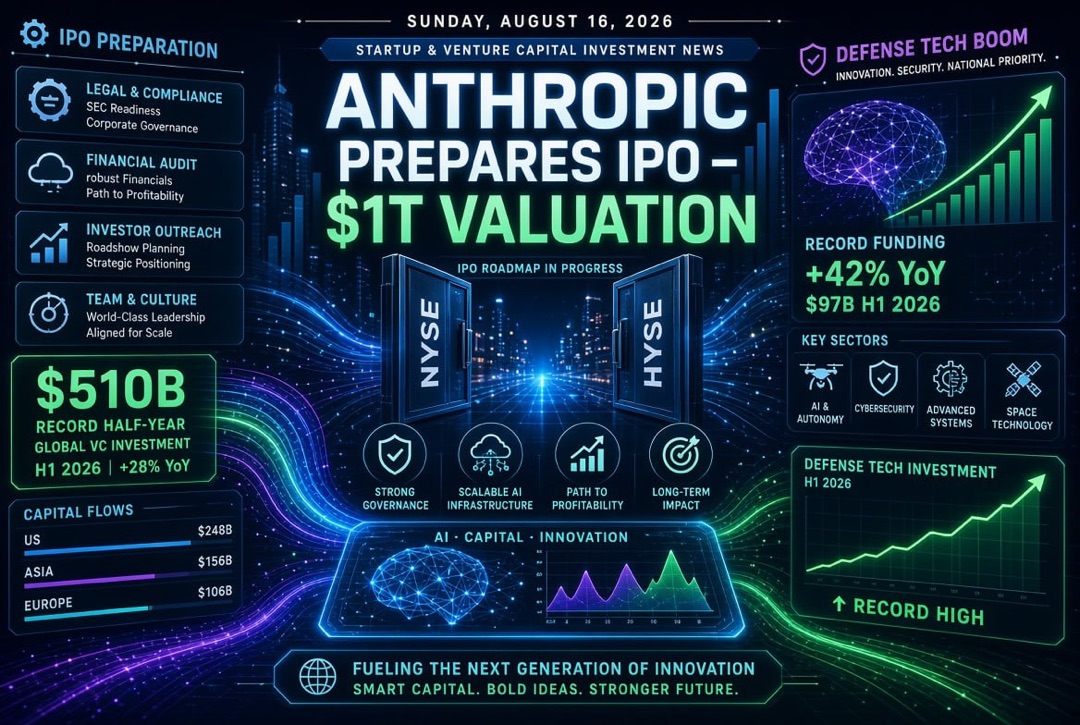
At the same time, the market is preparing for an event that could redefine the entire industry: Anthropic is moving towards an IPO with a targeted valuation exceeding $1 trillion. Against this backdrop, venture capital is increasingly flowing into "hard" technologies — energy for data centers, defense developments, and financial infrastructure. Below are the key events and trends in the venture market for Sunday, August 16, 2026.
- Anthropic IPO nearing the finish line. Following a confidential S-1 filing, the underwriters are conducting meetings with institutional investors; a listing on Nasdaq is expected in the fall.
- Record capital concentration. Half-year venture investment volume of $510 billion is accompanied by an unprecedented concentration of deals around AI sector leaders.
- Energy as the new AI trade. Billion-dollar rounds for Form Energy, Base Power, and Valar Atomics demonstrate that investors are financing the energy foundation for computational infrastructure.
- Surge in defense technologies. European startup Helsing raised $1.8 billion, while drone and air taxi manufacturers are securing large funding rounds amid a shift in defense budgets.
- Reconstruction of fintech infrastructure. Banking and payment projects for the tech sector are regaining interest from funds following the exit of niche players.
- Shift in capital geography. Gulf and Indian funds are becoming more active, while American investors continue to pull back from China.
Anthropic IPO: The race for the first trillion on the public market
The central theme of the week for venture investors is Anthropic's preparation for its IPO. The company submitted a confidential S-1 filing with the SEC on June 1, and subsequently closed a Series H round at $65 billion with a valuation of $965 billion, involving Sequoia Capital, Coatue, Fidelity, Blackstone, and strategic semiconductor partners — Samsung, SK Hynix, and Micron. Currently, Goldman Sachs, Morgan Stanley, and JPMorgan are conducting preliminary meetings with institutional investors: a public version of the prospectus is expected in August–September, with pricing anticipated in October–November on Nasdaq.
The secondary market is already pricing in a premium: the implied valuation of Anthropic on over-the-counter trading platforms exceeds $1.2 trillion, with an annual revenue (ARR) of around $70 billion. This IPO is crucial for the venture ecosystem: a successful debut will open an "exit window" for the entire cohort of AI companies, while a weak one could cool down the overheated segment. OpenAI, which filed its own S-1 a week later, is rumored to have moved its listing to 2027, conceding the first-mover advantage to its competitor.
Record $510 billion: Capital is there but concentrated
Global venture investments for the first half of 2026 reached an all-time high of approximately $510 billion. However, the market structure concerns fund managers: a significant portion of the capital has gone into a handful of mega-deals involving AI leaders. For companies outside the "magic circle," conditions are tougher — investors demand technological barriers, proven unit economics, and a clear path to revenue. The gap between "funded company" and "just an interesting idea" continues to widen: universal AI products are quickly replicated, so money is flowing into projects with proprietary data, infrastructure, and unique distribution channels.
Energy and AI infrastructure: Billions for "shovels and pickaxes"
The largest rounds of the week confirm that energy has become a direct extension of AI investments amidst record energy consumption by data centers.
- Form Energy raised $750 million in a Series G round led by T. Rowe Price, with participation from Sequoia Capital and Breakthrough Energy — the company is developing long-duration energy storage systems.
- Base Power from Austin closed a $1 billion Series D round at a $13 billion valuation — a bet on home storage in the context of overloaded U.S. power grids.
- Valar Atomics secured $1 billion led by Sequoia Capital, plus a $200 million credit line from a syndicate led by JPMorgan — nuclear energy is making a comeback on the venture agenda.
Of particular note is the Swedish company Lovable: the "vibe-coding" platform confirmed a $400 million Series C round at a valuation of $13.3 billion, establishing itself as one of the fastest-growing European unicorns.
Defense technologies: The new mainstream in venture capital
The defense tech segment has officially transitioned from niche status to mainstream. European defense AI developer Helsing raised $1.8 billion with participation from JPMorgan Chase, Lightspeed, and Iconiq — the largest round in the history of the European defense industry. Drone manufacturer Neros and electric air taxi developer Vertical Aerospace also closed significant deals. For funds, this represents a structural shift: the growth of NATO defense budgets and demand for autonomous systems creates a multi-year order cycle that venture investors are eager to monetize at early stages.
Fintech infrastructure: The market is completing the "banking layer"
Following the collapse of niche banks, investors are funding a new generation of financial infrastructure for startups. The Ohio-based banking project Erebor, aimed at serving tech companies, is in talks to raise approximately $1.5 billion with participation from Lux Capital, Andreessen Horowitz, and Valor Equity Partners. The restaurant financing platform inKind closed a $414 million credit line from Citi and Cross River Bank. The essence of the trend is clear: banks that understand cash cycles and startup risks are becoming strategic assets for the entire ecosystem.
Capital geography: Gulf and India versus China's contraction
The map of global venture flows continues to reshape. The sovereign fund MGX from Abu Dhabi closed its first fund at $49 billion — exceeding its target of $45 billion — and is building the largest AI campus in Europe near Paris with a capacity of 3 GW. In India, Mirae Asset conducted the first closing of a venture fund at 11.25 billion rupees, while Chennai-based Bluehill.VC fully raised its debut fund at 4 billion rupees focusing on frontier tech. Conversely, in China, U.S.-based SIG is winding down its venture team in Asia, continuing Sequoia and GGV's exit strategy from the region.
Russia and CIS: The market is contracting but changing structurally
The Russian venture market is moving against the global trend. In the first half of 2026, the investment volume decreased by about 39–48% year-on-year — to 4.6–5.2 billion rubles, while the number of deals fell almost by half, returning to crisis-level figures from 2023. The main reason is the high key interest rate, which means deposits compete with long-term risky investments. Meanwhile, the median check has increased by 23%, reaching 25 million rubles: investors are committing less frequently but with larger amounts. An unexpected leader by sector is industrial technologies, which showed a 58% growth surpassing business software. Moscow concentrates up to 80% of all investments, highlighting the need for regional startup ecosystem development programs.
Outlook for investors: Discipline in an era of records
The venture market enters the fall of 2026 in a state of paradoxical equilibrium: record liquidity coexists with maximum selectivity. Key considerations for funds in the coming weeks:
- publication of the open S-1 from Anthropic and the parameters of the book-building process — the primary indicator of public market appetite for frontier AI;
- round dynamics in energy and defense technologies as a test of the sustainability of the capital rotation from "pure" AI into infrastructure;
- the behavior of late-stage investors following the SpaceX correction — a test of the overvaluation in the pre-IPO segment.
The base scenario is continued growth with increasing concentration: capital will flow to companies with technological barriers, real revenue, and a clear exit trajectory. For venture funds, this is a time for discipline: market records do not negate the necessity of stringent deal selection.