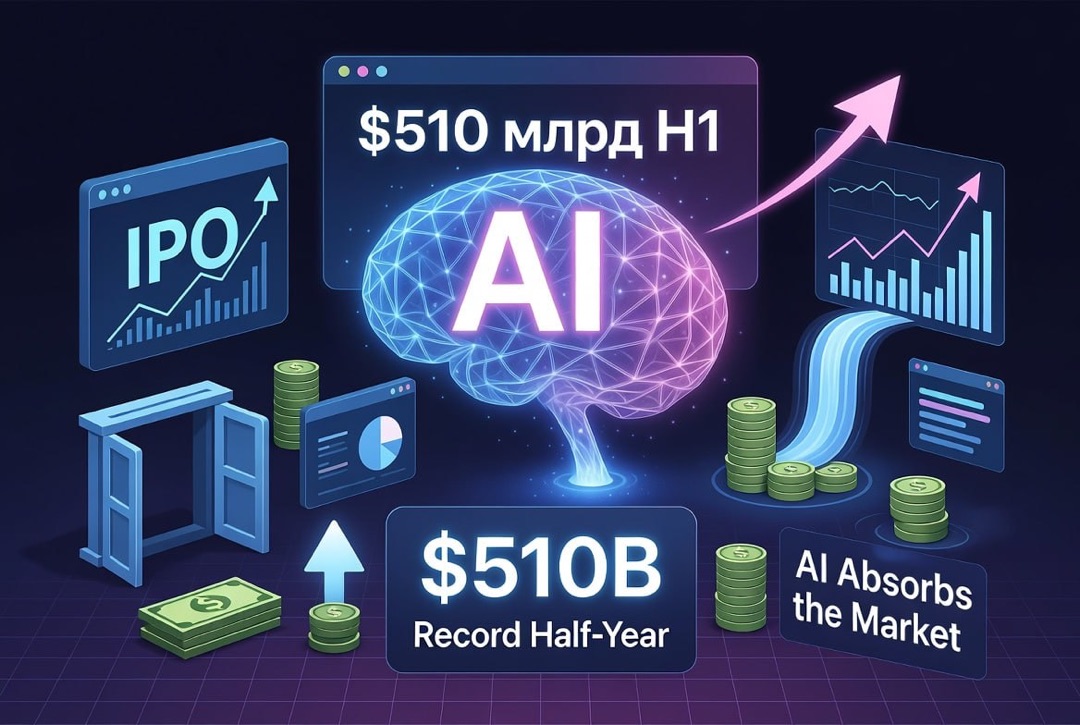
Startup and Venture Investment Highlights for May 25, 2026: Major AI Rounds, Growth in Defense Tech, Investments in Fintech and Healthcare AI, New Trends in the Global Venture Market, and the Development of AI Infrastructure
The global startup and venture investment market approaches Monday, May 25, 2026, with a pronounced shift of capital towards artificial intelligence, infrastructure platforms, defense tech, healthcare AI, and fintech services for the new generation of technology companies. For venture investors and funds, the main theme remains not just the increasing interest in AI startups, but the transformation of the market structure itself: capital is consolidating around companies that have already proven their ability to quickly scale revenue, attract corporate clients, and become the technological layer for other participants in the economy.
While in 2023–2024 the venture market was still evaluating generative AI as a promising direction, by 2026 investors increasingly view artificial intelligence as the foundational infrastructure for the next cycle of technological growth. Startups that address practical issues are coming to the forefront: access to computing power, search for AI agents, automation of medical processes, autonomous defense systems, and banking infrastructure for AI-native companies.
AI Infrastructure Becomes the Main Focus of Venture Capital
The main trend of the week is the continued strengthening of AI infrastructure as a central focus for venture funds. Investors are becoming less willing to finance abstract AI products without clear monetization and are increasingly supporting companies that are becoming the "rails" for the entire new technological economy.
Key areas where venture capital is currently flowing:
- infrastructure for AI inference;
- cloud computing for artificial intelligence;
- search engines for AI agents;
- platforms for testing AI code;
- corporate automation based on AI;
- AI cybersecurity;
- software layers for working with various chips and computing architectures.
For venture investors, this signifies that the market is gradually splitting into two parts. The first consists of startups that use AI as a function within a product. The second group includes companies that create the infrastructure needed to scale the entire AI ecosystem. It is the second group that receives the highest valuations and the largest rounds of funding.
Modal Labs: $355 Million for AI Code and Inference Infrastructure
One of the most notable deals in recent days was Modal Labs' $355 million Series C round, which resulted in a valuation of approximately $4.65 billion. This is an important signal for the venture market: investors are willing to pay a premium for startups that sit at the intersection of two key trends—the shortage of computing power and the growth of AI-generated coding.
Modal Labs provides developers with access to computational resources for AI inference, as well as an environment for testing AI-generated code. The growth in demand comes from biotechnology companies, hedge funds, weather-tech projects, and corporate AI teams.
Why This Deal Matters for Funds
- Modal Labs demonstrates rapid revenue growth and demand from enterprise clients.
- The company operates in a sector where computing power remains a scarce resource.
- The AI-coding market increases the need for a secure testing environment.
- Infrastructure AI startups receive above-average multiples in the venture market.
For venture funds, this deal confirms that AI infrastructure has already become a separate asset class within the technology market.
Exa: $250 Million for a Search Engine Designed for AI Agents
Another major news item is Exa's $250 million funding round, which brought its valuation to approximately $2.2 billion. The company is building a search infrastructure for AI agents that are designed to find, analyze, and utilize relevant information on the internet without human intervention.
From a venture investment perspective, Exa is positioned in one of the most promising segments: search for AI. If traditional search was built around human input, the new market model suggests that more requests will be handled by autonomous AI agents. This creates a new infrastructural niche where startups can compete not only with classic search engines but also with corporate data platforms.
Investors see several growth drivers in this direction:
- an increase in AI agents within the corporate environment;
- growing demand for up-to-date data for automated solutions;
- the transition from chatbot interfaces to autonomous workflows;
- the need for precise search capabilities for enterprise AI;
- the creation of a new layer of the internet, oriented not toward humans, but toward machines.
Anduril and Record Interest in Defense Tech
Defense tech remains one of the strongest sectors in the global venture market. Anduril raised $5 billion, increasing its valuation to $61 billion. This is not just a large round; it indicates a fundamental change in investor attitudes toward defense technologies.
Just a few years ago, defense startups were a niche area for a limited number of funds. In 2026, the situation has changed: geopolitical tensions, increasing defense budgets, the development of autonomous systems, and the integration of AI into military infrastructure are transforming defense tech into a fully-fledged institutional sector.
The most attractive areas within defense tech include:
- autonomous drone systems;
- military AI and data analytics;
- edge computing for defense tasks;
- robotic platforms;
- surveillance and reconnaissance systems;
- software for operational management;
- dual-use infrastructure.
For venture funds, this sector is appealing because it combines high barriers to entry, long-term government contracts, and strategic importance of technologies.
Healthcare AI: Commure Strengthens Its Position in Medical Automation
The healthcare AI sector continues to attract significant capital. Commure has secured $70 million in funding with a valuation of around $7 billion. The company is developing an AI platform for the medical industry and automates a significant portion of tasks related to revenue cycle management, billing, payments, and administrative processes.
For investors, healthcare AI remains one of the most attractive sectors since healthcare systems in many countries are burdened with operational costs. Startups that help clinics reduce expenses, expedite paperwork, and improve financial efficiency have a steady demand even amidst a cautious approach to venture risk.
Why Healthcare AI Receives High Valuations
- vast addressable market;
- high percentage of manual processes in medicine;
- willingness of clinics to pay for automation;
- potential for long-term contracts;
- strong economies of scale when implementing AI platforms.
For venture investors, this segment is especially important as it combines technological growth with defensive demand.
Fintech Makes a Comeback: Mercury Raises $200 Million
Fintech is once again back in the spotlight of venture capital. Mercury raised $200 million at a valuation of approximately $5.2 billion. The company focuses on servicing tech startups, including AI-native businesses that require banking products, treasury management, payment infrastructure, and financial tools for rapid growth.
Following a cooling period in the fintech market, investors have become more selective. Funding is directed not at mass consumer applications, but at infrastructure platforms with proven revenue, a large customer base, and the capacity to service the growing sector of tech companies.
For funds, the Mercury round is significant for three reasons:
- it demonstrates a revival of interest in quality fintech startups;
- it confirms the demand for financial infrastructure for AI companies;
- it showcases that profitability and scalable revenue have once again become key evaluation criteria.
A New Logic in the Venture Market: Fewer Deals, More Capital for Leaders
In 2026, the venture market is becoming less uniform. Capital is increasingly concentrated around a limited number of leaders. Mega-rounds are becoming the norm for late-stage AI companies, while early-stage startups find it more challenging to attract funding without strong technology, revenue, or access to strategic markets.
This concentration is particularly evident in the following sectors:
- AI infrastructure;
- frontier AI;
- defense tech;
- healthcare AI;
- robotics;
- fintech infrastructure;
- deeptech;
- enterprise automation.
For venture funds, this means a need for stricter selection criteria. Winners will no longer be just companies with strong storytelling, but startups that have already demonstrated product-market fit, growing revenue, and the capability to become platforms for other market participants.
Europe and Asia Intensify Competition for AI Ecosystems
While the United States remains the center of major venture deals, Europe and Asia are actively building their own AI ecosystems. The European market focuses on sovereign AI, deeptech, industrial AI, and data security. For France, Germany, and the UK, artificial intelligence has become an issue of technological sovereignty, apart from just venture profitability.
In Asia, there is continued strong activity in China, India, Singapore, and South Korea. Investors are seeking local leaders in AI agents, robotics, semiconductor software, enterprise automation, and medical technologies.
For global venture funds, this creates a more complex map of opportunities. The startup market is becoming not only technological but also geo-economic: capital follows regions with access to talent, computing resources, government programs, and large corporate clients.
What Venture Investors and Funds Should Pay Attention To
Monday, May 25, 2026, indicates that the global venture investment market continues to move toward maturity and concentration. Investors are increasingly focused on real metrics: revenue, infrastructural significance, corporate demand, and the ability of startups to become part of a long-term technological architecture.
In the coming months, venture investors should closely monitor several directions:
- AI Infrastructure—the primary sector for large rounds and strategic investments.
- Defense Tech—a sector increasingly reliant on government contracts and autonomous systems.
- Healthcare AI—where automation yields direct economic benefits.
- Fintech Infrastructure—a resurgence of interest in platforms for technology businesses.
- Search for AI Agents—a new niche at the intersection of search, data, and autonomous systems.
- Late-Stage AI—a zone of high valuations, but also increased quality demands on businesses.
The key takeaway for funds is that the venture market of 2026 is no longer a space for mass funding of all AI projects. It has become a selective capital market where investors are choosing infrastructure winners, and startups are competing not only for clients but also for access to computing resources, talent, and strategic partners.
For venture investors and funds, the current moment demands discipline, deep industry expertise, and the ability to distinguish between short-term AI hype and companies that can genuinely become the foundation for the next technological cycle.