Current Startup and Venture Investment News as of April 16, 2026: AI Growth, Infrastructure Projects, IPOs, and Key Global Market Trends
By mid-April 2026, the startup and venture investment market appears to be regaining confidence. Venture capital is returning to large deals, primarily driven by projects related to artificial intelligence, chips, computational infrastructure, enterprise software, and defense technologies. For venture investors and funds, this signifies not just an increase in the number of funding rounds but also a transition into a phase of stricter market selection, where capital becomes concentrated around a few strategic themes.
A key feature of the current cycle is that the global startup market is becoming more polarized. On one hand, AI startups, infrastructure companies, and mature tech players are attracting the largest rounds of funding. On the other hand, startups lacking strong technological differentiation, clear revenue models, and sustainable product-market fit are facing increasing challenges in fundraising. Consequently, news about startups and venture investments in April 2026 increasingly centers around a few power hubs: the United States, China, Europe, AI infrastructure, and preparations for exits.
AI Remains at the Core of the Global Venture Market
Artificial intelligence continues to set the pace for the entire startup market. AI is shaping the largest valuations, the most aggressive funding rounds, and the primary competition among funds. Investors are no longer financing an abstract "AI story"; they are betting on three specific layers:
- frontier models and platforms;
- infrastructure for computation and data centers;
- applied B2B solutions that rapidly monetize.
As a result, venture investments are becoming less fragmented. Funds prefer to invest in companies that are either already building critical AI infrastructure or are essential links in the corporate stack. This is an important signal for the market: startups providing access to computing power, chips, networks, agent solutions, and corporate automation are prioritized in capital allocation.
Against this backdrop, valuations of top AI companies continue to rise, while competition for stakes in late-stage rounds intensifies. For venture funds, this presents an opportunity to participate in the next significant technological cycle, while simultaneously increasing the risk of overpaying for assets where expectations may already partially exceed fundamental indicators.
Capital Shifts Toward Infrastructure: Chips, Networks, Computing
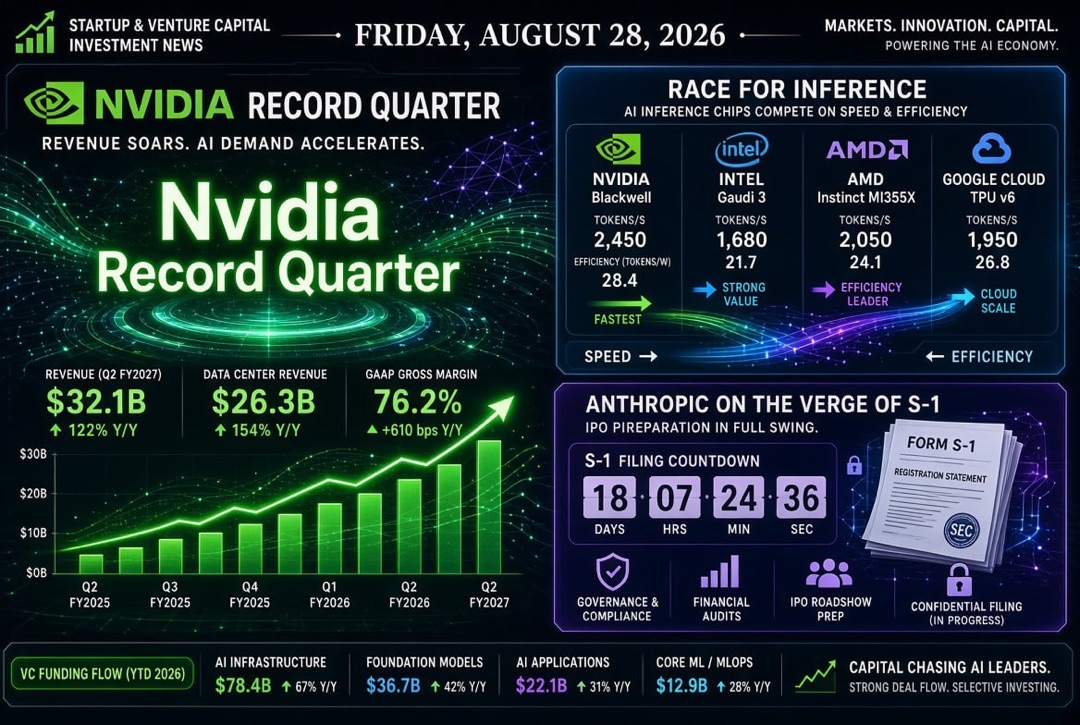
One of the most notable trends in April is the growing interest in infrastructure startups. While the market was focused on applications built on generative AI in 2024-2025, in 2026, venture capital is increasingly flowing into companies that are constructing the foundational technological layer. This primarily includes chip startups, developers of network architecture, computational optimizers, and creators of specialized AI hardware.
Such a shift is only natural. The mass adoption of AI has led to a performance deficit, rising computing costs, and a search for new architectures that can compete with the closed standards of major manufacturers. Startups in this segment no longer appear as niche experiments; they are becoming infrastructure bets for the entire market.
For investors, this is a significant turnaround. Venture investments are once again favoring companies with a long product development horizon, substantial CAPEX requirements, and high entry complexity. These are not quick SaaS stories but rather projects around which a whole ecosystem of suppliers, partners, and corporate customers can develop.
Europe Strengthens Its Position in AI and Deep Tech
The European startup market in 2026 appears markedly stronger than it was a year ago, particularly in the AI infrastructure, semiconductor, and sovereign technology platform segments. For Europe, not only profitability is essential, but also technological autonomy—hence the increased support from banks, development institutions, and private capital for deep tech projects.
Startup and venture investment news in Europe increasingly reflects that the region no longer wants to be just a consumer of American technologies. A unique growth logic is forming:
- building data centers and local AI infrastructure;
- supporting specialized chip manufacturers;
- growing interest in enterprise AI and industrial applications;
- strengthening national and supranational tech hubs.
For venture funds, this translates into an expanded set of opportunities. Whereas Europe was often viewed as a source of isolated strong startups, it now increasingly appears as a platform for developing self-sufficient platform players. Projects located at the intersection of AI, industry, energy, cybersecurity, and government demand are particularly attractive.
China Accelerates State-Supported Venture Cycle
Meanwhile, China showcases a different growth model. There, the startup and venture investment market increasingly relies on state-supported capital. This creates scale and speed, especially in sectors deemed strategic: artificial intelligence, robotics, quantum technologies, microelectronics, and industrial automation.
For global investors, the Chinese market remains both attractive and complicated. Its advantages are evident:
- a large domestic market;
- rapid scaling of production chains;
- government readiness to finance technological priorities;
- a high density of engineering teams.
However, there are limitations: the role of the state in risk pricing is growing, and valuations of specific assets may increasingly depend not only on commercial potential but also on political and strategic logic. For funds, this means that working with China requires a more nuanced selection model and greater attention to investor structure, regulatory environment, and the likelihood of future exits.
The IPO Window Gradually Opens for Mature Technology Companies
Another key storyline for the venture market is the revival of IPOs. After a prolonged period of restrained activity in public offerings, 2026 is slowly creating a more favorable environment for mature technology companies to go public. While volatility persists, the market mood is changing.
This is significant not only for late-stage startups but for the entire ecosystem. When the IPO window opens, funds can plan for capital returns, reassess entry strategies for late rounds, and more actively support companies on their path to listing. In fact, IPOs are once again starting to play a pivotal role in assessing venture assets.
For startups, this means stricter requirements. The public market in 2026 is prepared to consider not just any growth story but companies with a more mature financial architecture:
- clear revenue;
- improving margin;
- rational customer acquisition economics;
- convincing position within the technological supply chain.
Against this backdrop, startups from AI infrastructure, fintech, and semiconductors that are approaching late-stage development and able to become the next candidates for public markets are particularly interesting.
Fintech Evolves: Focus on Payments, Stablecoins, and B2B Platforms
By April 2026, fintech is not at the center of the general hype as AI; however, this makes the segment particularly appealing for selective capital. Venture investments are increasingly directed toward projects that address applied infrastructure challenges: international payments, currency exchange, treasury operations, embedded finance, and automating financial functions for businesses.
A new momentum for the market is generated by the growing interest in stablecoins and their use in cross-border transactions. For investors, this is not merely a crypto story but an attempt to restructure the old payment infrastructure through cheaper and faster processing rails. Startups that can connect regulated finance, corporate demand, and technological speed enjoy a noticeable advantage.
Fintech startups targeting B2B clients are looking more resilient in this cycle compared to consumer models. For funds, this makes sense: corporate fintech is easier to scale through specific unit economics rather than costly marketing and the race for mass users.
Defense and Cyber Startups Become Part of the Mainstream
The rise of interest in defense tech and cybersecurity deserves special attention. Previously, for some funds, these were more sensitive or niche directions, but in 2026, they are increasingly entering the mainstream of venture capital. The reason is clear: modern conflicts and the new structure of threats are changing the priorities of states and corporations.
Startups in defense technologies and cybersecurity are becoming attractive for three reasons:
- they address problems with high budget priority;
- their products are often deeply integrated into long-term contracts;
- they receive steady demand even amidst macroeconomic uncertainty.
For venture investors, this indicates an expansion of acceptable themes. Where consumer growth previously dominated, today, startups operating at the intersection of AI, autonomous systems, simulation, data protection, and critical infrastructure increasingly thrive.
What This Means for Venture Investors and Funds
Summarizing the current landscape, the startup and venture investment market in April 2026 cannot be characterized as evenly growing. Instead, it is growing selectively and requires a higher level of selection discipline. For funds, it is now crucial not only to act quickly and gain access to deals but also to accurately identify the segments where capital will perform best.
The following directions look the most promising in the coming quarters:
- AI infrastructure and computing platforms;
- semiconductors and alternative architectures;
- corporate fintech and cross-border payments;
- defense technologies and cybersecurity;
- European deep tech players with industrial applications;
- mature technology companies preparing for IPO.
The key takeaway for global investors is straightforward: the venture market has once again become one of great opportunities but no longer in the broad risk-on format. Instead, it is now characterized by concentrated bets on infrastructure, maturity, and strategic value. It is precisely these types of projects that will form the new upper layer of the market, around which competition for capital, exits, and future profitability will unfold in 2026.