Startup and Venture Investment News for July 21, 2026: Major Round for CuspAI, Rising Demand for Moonshot AI, AI Infrastructure, Cybersecurity, Deeptech, and Space Tech for Venture Investors and Funds, Space Technologies and the Return of the IPO Window
As of July 21, 2026, the global startup and venture investment market continues to experience active yet increasingly selective growth. The key theme of the day is the concentration of capital around artificial intelligence, infrastructure for AI models, new materials, cybersecurity, and space technologies. For venture investors and funds, this is more than just another cycle of interest in startups; it represents a structural market reshaping: capital is flowing into companies capable of controlling critical layers of the new technological economy.
Not only AI model developers are in the spotlight, but also startups creating computational infrastructure, software layers for AI chips, tools for corporate system security, platforms for scientific breakthroughs, and dual-use technologies. Venture capital is increasingly favoring projects with high capital intensity, strong engineering teams, and the potential to become infrastructure standards in their niches.
Key Deal of the Day: CuspAI and the Bet on AI Materials
A pivotal event in the venture investment landscape has been the significant round for British startup CuspAI. Working at the intersection of artificial intelligence, materials chemistry, semiconductors, and industrial manufacturing, the company secured $450 million in its Series B round. The startup's valuation has reached $2.6 billion, making CuspAI one of the most notable new unicorns in the European AI ecosystem.
Investor interest is driven not only by the AI trend. CuspAI addresses a fundamental industrial challenge: the search for new materials for semiconductors, batteries, clean energy, and high-tech manufacturing. For venture funds, this is an important signal: AI startups with applied scientific foundations are beginning to attract capital at par with the largest software companies.
- Segment: artificial intelligence and new materials;
- Stage: Series B;
- Key investment idea: AI as a tool for accelerating scientific discoveries;
- Market significance: increased interest in deeptech and industrial AI.
Moonshot AI: Demand for Models Outpaces Infrastructure Growth
Chinese startup Moonshot AI has become the second important focus of the day. The company has temporarily capped new subscriptions for its Kimi K3 model after a sharp increase in demand and pressure on its computing clusters. For the venture investment market, this serves as a telling case: even the largest AI startups are grappling with commercial demand outpacing the availability of GPUs, data centers, and inference infrastructure.
Moonshot AI remains one of the most closely monitored Chinese AI startups. The company has attracted significant capital, is discussing new funding rounds, and is considering a potential IPO in Hong Kong. For investors, this confirms two trends: first, the demand for robust AI products remains; second, the cost of maintaining such products is becoming a central factor in investment analysis.
Neo and the New Wave of AI Cybersecurity
In cybersecurity, a significant event has been the exit from stealth mode of the startup Neo, founded by former members of SentinelOne. The company raised $100 million at early stages, underscoring the high demand among venture funds for teams with proven experience in the security sector.
Neo's focus is on protecting corporate software in the age of AI agents. As more companies implement autonomous systems, the risks of uncontrolled data access, vulnerabilities in user permissions, and automated attacks increase. For venture investors, the AI cybersecurity sector is becoming one of the most promising areas, as it combines three sustainable drivers: growth in threats, regulatory pressure, and corporate budgets for data protection.
Infinity: AI Chip Infrastructure Emerges as a Standalone Category
Startup Infinity raised $15 million in seed financing at a valuation of about $100 million. The company is developing a software layer that allows new AI chips to become inference-ready more quickly. This serves as an important example of how venture investments are shifting from AI applications to the foundational infrastructure.
The main challenge in the AI chip market lies not just in hardware performance. Even a strong chip won’t achieve commercial success without a mature software stack, optimized computing cores, and compatibility with contemporary models. Therefore, startups helping alternative AI accelerator manufacturers to reach the market faster gain strategic value for the entire ecosystem.
Space Startups: SpaceX Boosts Interest in the Sector
Space technologies continue to attract capital following the revival of the public market and the increasing appeal of infrastructure assets. Investors are increasingly viewing space tech not merely as a niche sector but as a distinct class of technological assets related to defense, satellite networks, navigation, in-space computing, and government contracts.
For venture funds, the quality shift in demand is significant: space startups are no longer relying solely on long-term scientific scenarios. The market is becoming commercial, with some companies already demonstrating clear revenue sources—from satellite communication to defense contracts. This enhances the likelihood of large late-stage rounds and creates a potential base for future IPOs.
Venture Market in 2026: Capital Exists, but Distribution is Uneven
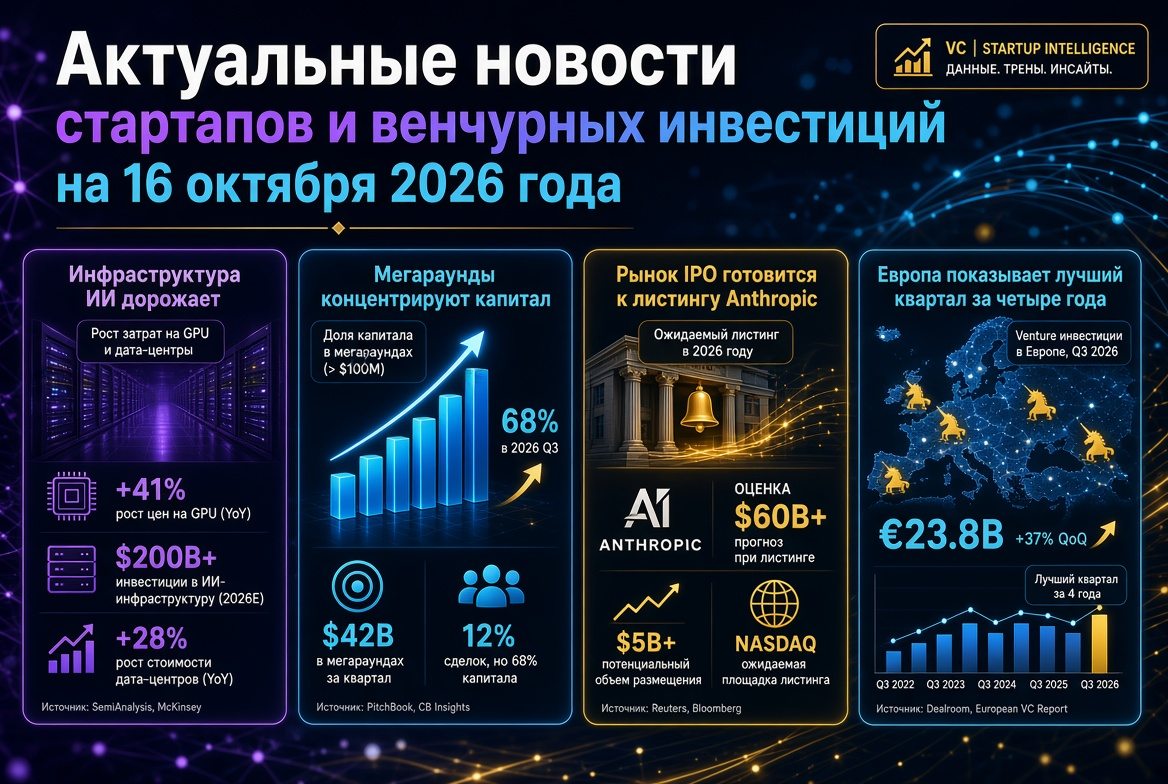
The global venture market in 2026 appears strong in terms of capital volume but uneven in quality of distribution. Large funds and institutional investors are actively participating in mega-rounds, while early-stage investments remain more competitive and metrics-sensitive. For startups, this means that a robust narrative is no longer sufficient; revenue growth, access to infrastructure, technological protection, and a clear monetization strategy are essential.
Key areas where venture investors maintain a high-risk appetite include:
- artificial intelligence and AI infrastructure;
- cybersecurity and protection of autonomous systems;
- semiconductors, inference, and data centers;
- deeptech, new materials, and industrial AI;
- space technologies and defense tech;
- healthtech, legaltech, and vertical AI platforms.
Europe Strengthens its Position in Deeptech
The European startup ecosystem is gaining new momentum from deeptech, AI materials, climate technologies, and a sovereign technological agenda. The major round for CuspAI highlights that European companies can attract world-class capital when they operate in strategically significant segments.
For funds, this signals a growing interest in European startups that previously lagged behind American competitors in terms of access to capital. Now, with a strong scientific foundation, international team, and global market, such companies can compete for large rounds with projects from the U.S. and Asia.
Asia: China and India Remain Key Growth Centers
The Asian startup market is developing along two distinct trajectories. China is enhancing its positions in large AI models, semiconductors, and infrastructure but faces limitations on access to advanced chips. In contrast, India continues to grow through consumer services, healthtech, fintech, SaaS, and logistics platforms.
For venture investors, Asia remains a region with high potential, albeit with a varied risk profile. Chinese AI startups can scale quickly and attain high valuations; however, they are reliant on the regulatory environment and computational infrastructure. Indian startups, in general, tend to exhibit clear commercial models but operate in more fragmented and price-sensitive markets.
What Matters to Venture Investors and Funds
The agenda for July 21, 2026, shows that the startup and venture investment market is entering a phase of qualitative selection. Capital is accessible but is increasingly concentrated among companies that control critical infrastructure or can quickly demonstrate the commercial applicability of technologies.
Investors should pay attention to several key factors:
- unit economics of AI products, considering inference costs;
- startup access to GPUs, data centers, and infrastructure partners;
- intellectual property protection and technological barriers;
- proportion of corporate clients and long-term contracts;
- likelihood of IPOs, M&A, or strategic buyouts;
- regulatory risks in AI, cybersecurity, and defense technologies.
The main takeaway for venture funds is that in 2026, the winners will not be the loudest startups but the companies that become the infrastructure for the next technological cycle. CuspAI, Moonshot AI, Neo, Infinity, and space projects illustrate that venture capital is increasingly seeking not just rapid growth but control over key layers of the future economy—computing, security, materials, data, and industrial platforms.