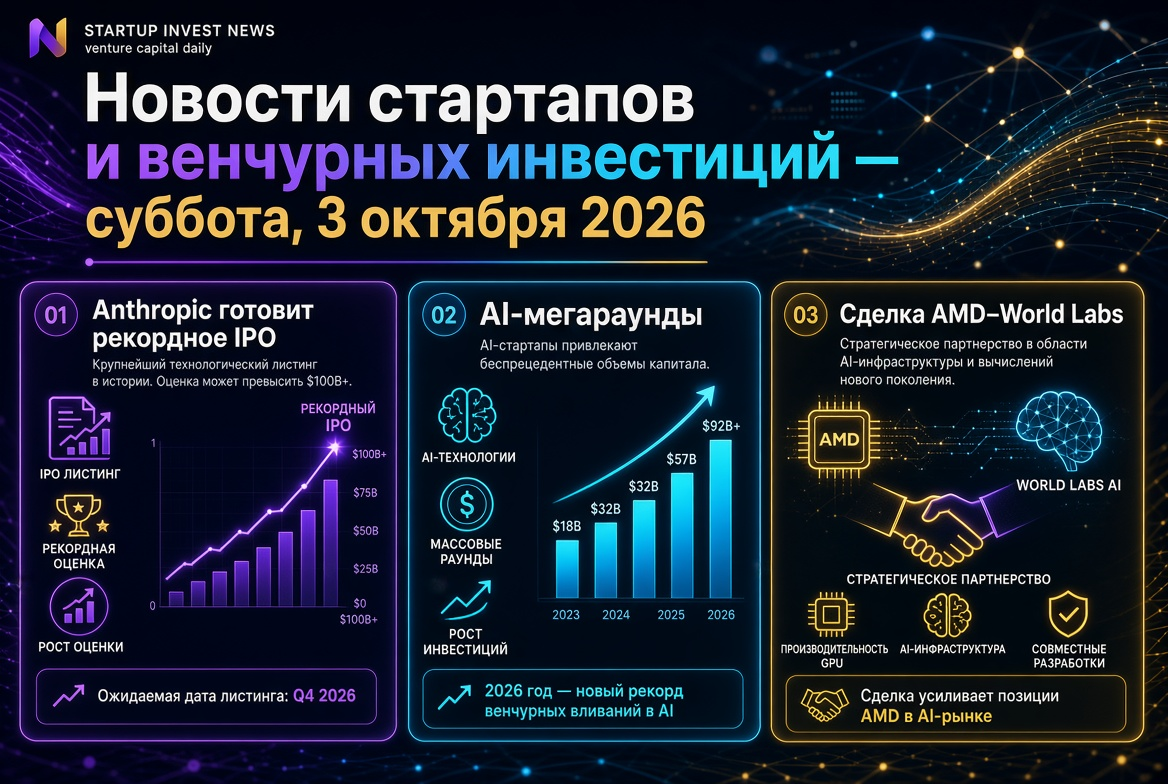
Startup and Venture Investment News November 7, 2025 – Mega-Funds, Record AI Rounds, and New Unicorns
The global venture sector is witnessing a robust revival. Major deals and the launch of new mega-funds signal a return of the risk appetite among investors. While startups in the artificial intelligence sector remain in focus, significant capital is also being attracted by projects in various other industries – from healthcare to automotive technologies. Let's take a look at key news and trends in the venture market as of Friday, November 7, 2025.
Global Venture Capital Market: Investment Recovery
Following a downturn in recent years, the venture market is showing signs of growth. By the end of the third quarter of 2025, the total volume of global investments in startups increased by approximately 38% year-on-year, reaching around $97 billion – figures not seen since 2022. Below are key metrics illustrating this trend:
- Increase in Large Rounds: Mega-rounds exceeding $500 million have once again become a significant part of the market, accounting for about one-third of all investments in Q3.
- Capital Concentration: Nearly half of all venture investments (≈46% in Q3) were directed toward companies related to artificial intelligence.
- Late-Stage Activity: Investments in late-stage startups increased by more than 60% year-over-year, while early-stage growth was about 10%.
Thus, venture capital is confidently returning to the market over the past year. Large investments are concentrated in the most promising sectors, although funding for young projects is also gradually increasing. Investors are showing a willingness to invest significant amounts once again, especially in leaders of their respective industries.
AI Investment Boom
The artificial intelligence sector continues to attract record amounts of funding. AI startups are raising rounds of unprecedented scale. In just the third quarter, the three largest global deals were with AI companies – American Anthropic secured approximately $13 billion, Elon Musk's xAI raised $5.3 billion, and the French startup Mistral AI attracted around $2 billion. Investors are eager to secure positions in the AI race, directing capital toward both model developers and applied AI services.
A prime example of a new round underscoring the hype surrounding AI is the startup Hippocratic AI, which combines medical technology and generative AI. This week, the company raised $126 million at a valuation of $3.5 billion. This round, led by the Avenir Growth Fund with participation from CapitalG (Google), General Catalyst, a16z, and Kleiner Perkins, nearly doubled the valuation of Hippocratic AI since the beginning of the year. This confirms the trend: investors are ready to value AI-oriented companies in billions of dollars for their rapid growth and potential to revolutionize industries.
Moreover, the excitement encompasses not only neural network developers but also infrastructure projects in the AI sector. The startup Vast Data, which creates data storage systems for AI computing, signed a strategic agreement with the cloud provider CoreWeave valued at approximately $1.17 billion. This multi-year contract will provide Vast with stable revenue and emphasize the growing demand for infrastructure catering to generative AI. Through such deals, companies operating "behind the scenes" of the AI sector also receive a significant boost for scaling. Overall, the investment boom in artificial intelligence continues across the stack – from applied services and models to chips and cloud platforms.
Healthcare and New Unicorns
Beyond the purely digital sector, significant capital is flowing into biomedicine and healthcare – an industry that has become the third largest in terms of venture capital investments in the last quarter (~$15.8 billion). This week, several major deals underscored the attractiveness of medtech to investors. The American medical startup Forward Health, specializing in preventive primary care, raised $225 million in a Series D round from SoftBank Vision Fund 2 and Founders Fund. This investment lifted Forward's valuation above $1 billion, making it one of the new unicorns in the market. The project, which offers clients personalized health programs based on biometric screening and analyses, has become in demand thanks to the trend toward preventive medicine following the pandemic. Capital from SoftBank and other investors will enable the expansion of Forward clinics across the U.S. and the launch of new service directions (cardio programs, cancer screening, stress management, etc.).
Overall, investors continue to actively support healthcare technologies, especially at the intersection with AI. In addition to Forward, several other medtech startups have received substantial venture capital funding this year. This interest is explained by the sustained demand for remote and personalized medical services that has emerged in the post-pandemic period. The success of companies like Forward and Hippocratic AI confirms that innovations in healthcare remain a priority for venture funds, and new unicorns in this space are attracting the attention of the global investment community.
Variety of Deals: Automotive Tech, Robotics, and Fintech
Outside the realms of AI and biomedicine, venture investments are also encompassing a wide range of industries. The week was marked by major deals in various directions:
- Automotive Technology and Mobility: The European startup Spotawheel, which offers a subscription model for used cars, raised €300 million (a mix of equity and debt) to expand into new markets. This Greek project aims to scale its approach to selling and renting cars on a subscription basis, and the new investment will serve as a growth driver in the transportation market.
- B2B Services (SaaS): From Silicon Valley came the news about the launch of the startup Reevo, which plans to consolidate disparate sales and marketing tools into a unified AI-based platform. As it exits "Stealth mode," Reevo secured an unprecedented $80 million in seed funding, co-invested by major funds Khosla Ventures and Kleiner Perkins. Such a large initial round signals strong investor confidence in the prospects of a new revenue management model for B2B companies.
- Robotics: The hardware segment is also witnessing record rounds. The California-based startup Figure, which develops humanoid robots for work and household tasks, has raised over $1 billion in funding this year, soaring to a valuation of around $39 billion. Such capital will enable Figure to increase its robotics production and move closer to the commercial deployment of humanoid robots, demonstrating that interest from venture funds extends to deep technological innovations.
Additionally, activity continues in other niches. Fintech companies collectively received approximately $12 billion in global investments in Q3 2025 (4th among industries) – despite a decline in hype, the fintech sector still attracts significant capital, particularly for sustainable business models in payments and finance. Climate-focused businesses are also gaining momentum: startups in renewable energy, energy storage, and sustainable technologies continue to receive funding against the backdrop of heightened attention to the ESG agenda. Thus, aside from AI’s dominance, venture money is being distributed across various industries – from transportation services to industrial innovations – indicating a diversity of growth points in the startup scene.
Major Venture Funds Expand Capabilities
The flow of capital into startups is supported not only by individual deals but also by the emergence of new record-sized venture funds. This week it was announced that Silicon Valley fund TCV has raised $4 billion for its latest (11th) fund – the largest in the firm's 25-year history. This indicates that leading players in the venture market are building up "dry powder" for investments in the coming years. TCV plans to actively allocate these funds into promising segments – from fintech and educational technologies to digital entertainment – doubling down on its most successful portfolio areas.
Growth is also observed among specialized funds. For example, the American firm CMT Digital recently closed a crypto-oriented fund of $136 million to invest in blockchain startups – signaling that even amid the volatility of the cryptocurrency market, specialized venture players are willing to support this sector. Meanwhile, in Africa, one of the continent's most active investors, the Ventures Platform fund from Nigeria, is entering the final round of raising $75 million for its second fund – confirming the global nature of venture expansion. These examples highlight that capital is being formed worldwide, targeting a new wave of startups. Large new funds – from global mega-funds to regional and sector-specific ones – will provide the startup ecosystem with significant resources and foster competition among investors for the best deals.
Corporations as Investors: Alliances and Strategic Deals
Another notable trend is the growing role of large technology corporations in the venture ecosystem. Instead of direct acquisitions, industry giants are increasingly entering partnerships with startups or acting as minority investors to avoid missing out on new technologies. A case in point is the company Snap Inc. (owner of Snapchat), which struck a $400 million deal with the AI startup Perplexity AI. As part of this agreement, Snapchat will integrate Perplexity's AI-powered search engine into its chatbot My AI, while the startup will pay Snap a combined compensation in cash and stock. For Perplexity, this alliance provides access to Snapchat's multi-million user base, while for Snap, it strengthens its position in the social media race for AI functionality. The market responded positively: Snap's shares surged in light of the news, reflecting investor confidence in such strategic moves.
Overall, corporations are actively investing in cutting-edge startups, particularly in AI. Microsoft, Google, Amazon, and other tech giants have invested billions in young companies over the past two years. For example, Microsoft’s share in OpenAI is now valued many times higher than its initial investment and is strategically important for its cloud business. Amazon has committed to invest up to $8 billion in the AI model developer Anthropic during 2023–24, while Google has supported a range of projects from vertical AI solutions to quantum startups. Concurrently, the industrial corporate sector is ramping up its venture activity: analysts report a significant increase in deals involving corporate venture units this fall. Corporations are particularly interested in robotics, drones, autonomous transport, and other sectors capable of strengthening their core business. This synergy between large companies and startups is mutually beneficial: corporations gain early access to innovations, while startups receive access to significant resources and market entry.
Exits and IPO Prospects
After a lull in 2022–2024, the exit market is beginning to revive, which is crucial for the venture ecosystem. In the third quarter of 2025, there was an increase in the number of large IPOs and exits. Among the most significant exits during this period were the stock placement of Chinese automaker Chery Automobile (which went public with one of the year's largest valuations), the completion of a multi-billion dollar sale of the American design service Figma to Adobe, and the preparation for IPOs by several well-known unicorns including the Swedish fintech giant Klarna and California-based cybersecurity firm Netskope, which, according to media reports, are seriously considering going public in the near future. The success stories of these companies inspire market participants with hope that the "IPO window" is gradually opening.
Notably, infrastructure-level companies in the AI domain are also capable of going public. The cloud startup CoreWeave, which provides access to GPUs for AI workloads, conducted an IPO in March 2025, demonstrating investor readiness to support AI-related businesses on public platforms. At the same time, investors and analysts stress that for the new wave of IPOs to be sustainable, startups must demonstrate healthy finances. Unlike the previous hype period, the focus is now on profitability and predictable growth. Only those unicorns that have proven their business model and can generate stable revenue can expect a warm welcome on the stock market. This more cautious approach means that not all high-profile startups will rush for public capital, but rather the most mature and prepared players will lead the way, setting the tone.
If current trends persist, 2026 could see a gradual increase in activity in the IPO and M&A markets. Successful exits will not only yield returns for venture investors but also reinvest significant capital back into circulation for new rounds and funds. Thus, the revival of exits completes a positive cycle in the venture market: from rising investments – to scaling startups – and finally to the long-awaited liquidity events that validate the value of the companies created.