Latest News in Startups and Venture Investments as of March 15, 2026: AI Mega-Rounds, Emergence of New Unicorns, Growth of European Venture Market, Deals in Fintech, Cybersecurity, and Digital Health, Analysis of Key Trends in the Global Startup Market for Investors and Funds.
AI Has Become the Primary Recipient of Global Venture Capital
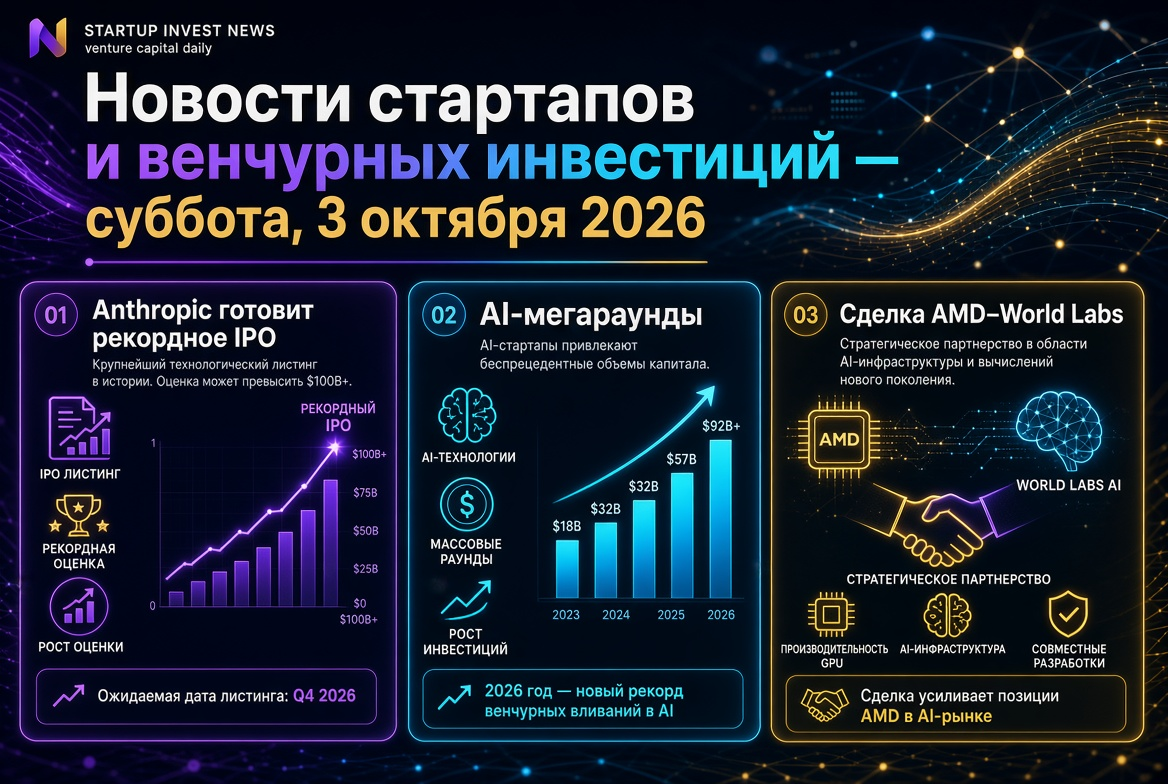
The central theme in the startup and venture investment market for March 2026 is not just the heightened interest in artificial intelligence but the accelerated emergence of a new class of massive AI companies. Mega-rounds are now comparable in scale to late-stage public tech companies.
This shift indicates that venture investors are increasingly focusing on a limited number of companies that have the potential to become infrastructural leaders in the next technological cycle, rather than spreading their bets across a broad portfolio of smaller hypotheses. This separation in the startup market has become more pronounced, delineating between select platform players with access to capital and computational resources, and a larger pool of companies vying for attention in a much more competitive environment.
- Focus areas include foundation models, AI infrastructure, agent systems, and applied enterprise AI.
- The second most appealing segment is cybersecurity, where AI boosts demand for new protective platforms.
- Projects lacking clear technological differentiation or viable revenue pathways remain on the periphery.
Mega-Rounds Set the Tone for the Whole Ecosystem
In recent days, the market has received several benchmarks on the capital being directed towards AI. The startup AMI, associated with a novel approach to AI development, raised over $1 billion, while Thinking Machines Lab solidified its position through a partnership with Nvidia, gaining access to a colossal volume of computational power. This serves as an important signal for the global venture market: funding is once again based on access to chips, data, engineering teams, and the ability to scale model training rapidly.
For investors, this means that a startup's valuation increasingly depends not only on the product and team but also on its position in the supply chain of the AI economy. Companies that have partnerships with the largest suppliers of accelerators, a strong team of former leaders from OpenAI, Meta, or Google, and a clear enterprise monetization strategy automatically ascend to the premium segment.
- Capital is concentrating on startups that build the foundational infrastructure for AI.
- Traditional software companies must prove that AI is not merely a marketing overlay but a source of future margins.
- Rounds are becoming not just financial but strategic: funding is increasingly accompanied by computational resources and industrial partnerships.
New Unicorns Validate Market Rejuvenation
Amid major deals, a broader trend is emerging: the number of new unicorns in 2026 is rapidly increasing. This indicates that the rise in interest towards venture investments is no longer confined to a few emblematic AI companies. The market is gradually expanding towards cybersecurity, digital health, automation, fintech, and deep tech.
The emergence of new unicorns is significant for two reasons. Firstly, it revitalizes investor confidence in the growth potential of private companies. Secondly, it lays the groundwork for future secondary transactions, sales to strategic investors, and possibly a new IPO window. While the public market remains demanding, private valuations are beginning to rise again, particularly in sectors with high revenue growth and technological advantages.
Europe Strengthens Its Position in the Growth Segment
The European startup and venture investment market, as of March 2026, appears significantly more confident than a year ago. A key feature is the growing number of funds willing to support companies not just at the seed and Series A stages but also in later stages. This is particularly crucial for Europe, which has historically experienced a shortage of large growth capital and where startups often had to turn to American investors.
The launch of new growth initiatives and a stronger secondary market indicate that the European ecosystem is maturing. The challenge for funds is no longer just to find promising teams but to retain them in the regional orbit during the scaling phase. For founders, this means more options within Europe, while for funds, it increases competition for the best deals.
What This Means for the Market
- European funds are striving to close the traditional gap between Series B and late growth.
- There is a growing interest in secondaries as a tool for returning LP capital and providing partial liquidity for early shareholders.
- Deep tech and industrial tech remain among the most promising areas for European capital.
Fintech Redefines Growth Geography
Fintech deserves special attention. Within the global structure of venture investments, this segment no longer appears to be solely an American story. London is solidifying its position as a global fintech center, while the European market is increasingly demonstrating its ability to compete with the US regarding interest in fintech companies.
Meanwhile, the focus is shifting from classic payment solutions to infrastructure: payment orchestration, B2B fintech, stablecoin instruments, embedded finance, and automated settlements. For funds, this signals a return of interest in fintech, though not under a "growth at any cost" mindset but through more sustainable monetization models and stricter control over unit economics.
Cybersecurity Remains One of the Most Resilient Segments
If AI is the primary magnet for capital, cybersecurity stands out as one of the most disciplined and resilient sectors. New deals in this vertical confirm that investors are willing to finance companies offering a platform approach to protecting digital infrastructure. The reason is evident: the rise in AI tools simultaneously creates a new market for threats.
Cybersecurity attracts venture investors as it combines several attractive parameters: high enterprise check sizes, clear product necessity, robust demand from corporations and governments, and the potential for subsequent M&A activity from larger players. This makes the sector one of the few zones where stable deal flow can be expected, even amidst a deteriorating macro environment.
Digital Health and Applied AI Expand the Investment Landscape
A second significant shift is the broadening of AI applications beyond "pure" model companies. Increasing amounts of capital are flowing to applied players in digital health, accounting automation, insurance, credit analysis, and operational services. For the startup market, this is a positive indicator: venture interest is diversifying not just around infrastructure but also across vertical products with rapid paths to revenue.
Companies that embed AI into high-cost-error industries—such as medicine, finance, insurance, and enterprise operations—are particularly appealing. Here, investors see opportunities to build companies with high ARPU, long-term contracts, and protection against simple pricing competition.
The Exit Window is Slightly Ajar, but Not Wide Open
Despite an improved venture climate, the exit market remains cautious. Potential IPOs and deals surrounding large private tech companies sustain interest in the sector, yet a mass opening of the window has not yet occurred. This means that funds continue to rely not just on traditional public offerings but also on the secondary market, partial share sales, and strategic deals.
For LPs and managing partners, this is a critical moment. The 2026 strategy is no longer built solely around expectations of a fast IPO boom but rather a combination of liquidity instruments. As a result, a startup's valuation increasingly hinges on how appealing it can be to not just the public market but also to strategic buyers, secondary investors, or large growth funds.
What This Means for Venture Funds and Founders
The global startup and venture investment market as of March 15, 2026, showcases both strength and selectiveness. While there is ample money in the system, access to it is becoming increasingly unequal. Winning companies are those that can demonstrate one of three attributes: technological leadership, infrastructural indispensability, or a rapid pathway to substantial revenue.
For venture funds and founders, this creates a new agenda:
- Betting on AI remains justified, but only in segments with a real moat.
- Growth rounds are returning, but the quality demands have risen sharply.
- Europe is becoming noticeably more active and is trying to retain scaling within the region.
- Cybersecurity, fintech infrastructure, and digital health stand out as the most resilient verticals following core AI.
- Liquidity is gradually reviving, but exit strategies need to be planned in advance rather than postponed until the last round.