The refineries, with a combined processing capacity of around 40 million tons of oil per year, have resumed fuel sales on the St. Petersburg Exchange. This information is outlined in a review from the Platts analytical agency, part of S&P Global. A portion of large enterprises, which account for more than 45 million tons of processing annually, has not yet returned to trading.
Since July 20, the St. Petersburg Exchange has also relaxed the permitted price fluctuation limits for certain types of fuel. For gasoline AI-92, AI-95, and diesel fuel under the terms "franco-tank" and "franco-destination," the increase corridor has been expanded from 0.01% to 5%, while a decrease of up to 10% is allowed. For the basis of "franco-car from the station of departure," the maximum increase remains at 0.01%, with a decrease of 5%. For aviation kerosene, increases are capped at 0.01%, with a possible decrease of up to 20%.
Sergey Tereshkin, General Director of Open Oil Market, states that the expansion of the price increase range on the exchange is aimed at invigorating trading, which is becoming an increasingly irrelevant price indicator.
According to him, the primary volume of fuel is being channeled through over-the-counter networks, and this trend has intensified in recent weeks. The government has previously reduced the sales standard for gasoline on the St. Petersburg Exchange from 15% to 10% of production levels, and a similar adjustment is planned for diesel fuel.
As of July 20, the price of AI-92 on the St. Petersburg Exchange, based on the European part of Russia, increased by 0.7%, reaching 72,290 rubles per ton. The price of AI-95 decreased by 2.3% to 74,610 rubles per ton, while diesel fuel quotes dropped by 0.38%, to 74,420 rubles per ton. The decline in quotes may indicate an increase in supply.
This may also be reflected in the rise in wholesale sales volumes. According to the National Exchange Price Agency, on July 17, the index increased by 4.6% compared to the previous day, reaching 13,740 tons. Despite 81.9% of total gasoline purchase requests remaining unfulfilled, the volume of unsatisfied solvent demand has decreased across all grades of gasoline, as noted in the review. The most challenging situation is in the AI-98 / AI-100 segment, where 92.9% of demand is still unfulfilled.
According to exchange data, from July 1 to 17, gasoline sales volumes decreased by 47.8% year-on-year to 277,300 tons. Since the beginning of 2026, a total of 4.74 million tons of gasoline have been sold in trading, which is 16.7% less than the previous year. Additional support for the market is being provided by fuel supplies from Belarus. Data from the exchange indicates that from July 1 to 17, sales of Belarusian gasoline reached 98,760 tons, exceeding June's total by 8.7%.
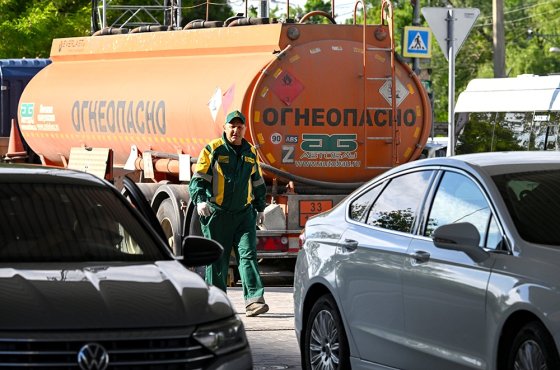
An industry source for “Kommersant” reports that the situation at Russian gas stations has started to improve: queues have shortened and many operators have resumed fuel dispensing without restrictions.
According to the source, independent networks continue to receive gasoline supplies from Belarusian refineries and possibly from vertically integrated oil companies. "The peak of the deficit has likely passed," the source believes. However, they point out the potential risk of gasoline reserves falling below 1.5 million tons. According to the Ministry of Energy, as mentioned by Russian President Vladimir Putin at the end of June, gasoline reserves have decreased year-on-year by 4% to 1.7 million tons. Another source within the industry states that currently, more capacities are being brought online than are closing down.
Managing Partner of NEFT Research Sergey Frolov does not anticipate a rapid market recovery. He notes that high seasonal demand will persist in the next two months, thus sharp improvements in the situation should not be expected. The balance of supply and demand, the expert emphasizes, cannot be restored instantly, with noticeable production increases only becoming possible closer to the end of the year as affected refineries return to operation. Senior analyst at investment company "Rikom-Trast" Valeriya Popova highlights that stabilizing the market requires the restoration of reserves, a decrease in exchange rate volatility, and alleviation of temporary restrictions.
Source: Kommersant