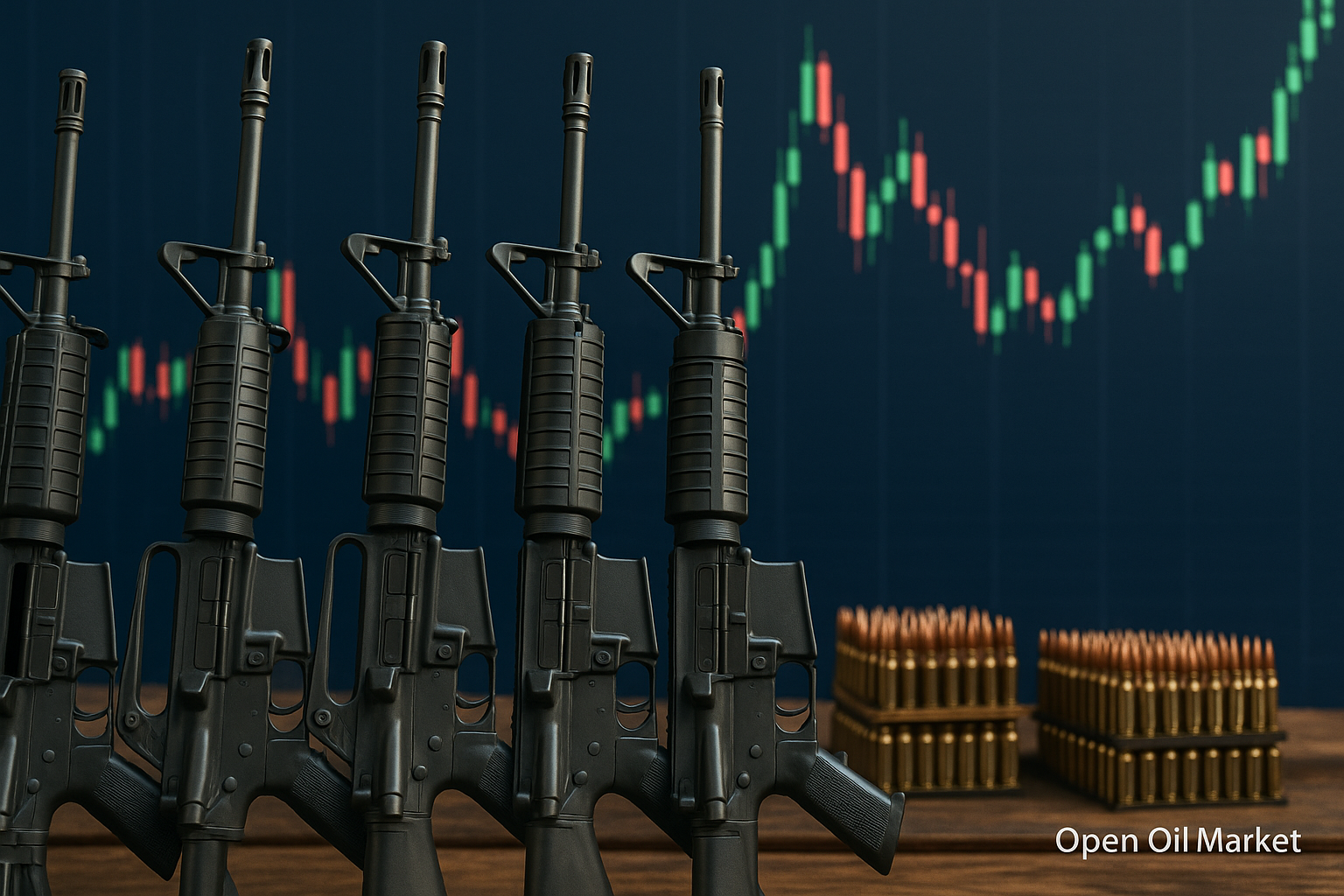
The Global Arms Market Sets a Historic Record: Sales Surge to $679 Billion. An Analysis of Trends, Key Companies, and Investment Opportunities.
The global defense industry is experiencing an unprecedented boom. According to the Stockholm International Peace Research Institute (SIPRI), the total revenue of the 100 largest arms manufacturers in 2024 rose by nearly 6% to a record $679 billion. Over the past decade, global arms sales have increased by 26%. Armed conflicts, geopolitical tensions, and a new arms race are driving this uptrend in demand and profitability for weapons companies.
U.S. Market Dominance
The U.S. maintains its unassailable leadership in the global defense industry. Five of the six largest arms corporations in the world are American. Among them are giants such as Lockheed Martin, RTX (Raytheon Technologies), Northrop Grumman, General Dynamics, and Boeing. American companies account for approximately half of the total global arms sales (expected to reach $334 billion in 2024).
The world’s largest manufacturer, Lockheed Martin, increased its military order revenue by 3.2% to $64.7 billion, breaking a several-year period of stagnation. Other U.S. leaders also saw earnings grow for the first time since 2018.
Notably, SpaceX, led by Elon Musk, entered the list of the top 100 defense contractors for the first time, doubling its military project revenue over the year to $1.8 billion. SpaceX's emergence in the rankings highlights that even relatively new players can quickly carve out significant niches amidst rising demand.
Europe Accelerates Defense Production
The European defense sector is demonstrating the highest growth rates. In 2024, the combined revenue of 26 European companies on the SIPRI list (excluding Russia) grew by 13% to $151 billion, accounting for approximately 22% of the global arms market. European countries are ramping up weapon and equipment production in response to the war in Ukraine and the heightened threat from Russia. Twenty-three out of the 26 European firms saw an increase in sales, with some achieving impressive results:
- Rheinmetall (Germany) – a 46.6% increase in defense revenue over the year, driven by demand for tanks, artillery, and ammunition.
- Czechoslovak Group (Czech Republic) – a record growth of 193% (almost tripling to $3.6 billion) due to the production of around 1 million artillery shells for Ukraine under a Czech government initiative.
- JSC Ukrainian Defense Industry (Ukraine) – a 41% increase (to $3 billion) thanks to mass production of weapons for the nation’s needs amid ongoing conflict.
Neighboring countries in Eastern Europe are also enhancing their defense manufacturing capabilities. Poland has sharply increased its military budget (to 4.2% of GDP) and is investing in local production of military equipment and ammunition. The European defense sector is experiencing a rise, although challenges lie ahead, from supply chain overloads to shortages of specific materials.
Russia: Growth Amid Sanctions
The Russian defense industry is demonstrating robust growth despite sanctions and restricted access to components. Two Russian companies appear in the SIPRI rankings: the state corporation Rostec (7th in the world) and the United Shipbuilding Corporation (41st). By the end of 2024, their combined revenue rose by 23% to $31.2 billion, with Rostec's weapons sales increasing by 26.4%, reaching around $27 billion.
Western sanctions have not halted production; explosive internal demand has offset declines in exports. Russian factories have significantly ramped up the production of munitions and equipment for military needs. For instance, the production of 152 mm artillery shells in Russia was quintupled in 2024 compared to pre-crisis levels. As a result, the Russian defense industry has maintained resilience and, following stabilization, hopes to return to the global markets. The export intermediary Rosoboronexport has already formed a record backlog of foreign orders exceeding $60 billion, indicating deferred demand for Russian weapons.
Asia: New Leaders and China's "Pause"
The Asian arms market is experiencing mixed trends. On one hand, South Korea has emerged as a growth leader: four South Korean companies from the Top 100 increased their combined revenue by 31% to $14.1 billion. Seoul is actively developing its arms exports, securing multi-billion-dollar contracts with European and Middle Eastern clients. For example, Hanwha Group boosted its sales by 42% to $8 billion, driven by deliveries of self-propelled artillery and multiple launch rocket systems both domestically and abroad.
Other Asian manufacturers are also gaining traction. India is promoting an import substitution policy: three Indian companies from the SIPRI ranking increased their combined revenue by 8% to $7.5 billion, thanks to government defense orders. Countries like Pakistan, Indonesia, and Taiwan are developing their industries, but their performances remain modest.
Conversely, growth in China has unexpectedly slowed — the second-largest arms market after the U.S. According to SIPRI, the revenue of the eight largest Chinese arms companies decreased by 10% to $88 billion in 2024. Some giants like NORINCO have reported a one-third drop in sales amidst anti-corruption investigations and delays in government orders in China. However, experts note that this "pause" may be temporary: China continues a large-scale military modernization program, and its actual defense spending is on the rise. Statistical declines may be linked to transient factors, with Chinese defense enterprises likely returning to growth in the coming years, furthering competition in the market.
The Middle East Enters the Top Ranks
Countries in the Middle East and adjacent regions are rapidly increasing arms production, displacing traditional suppliers in some markets. For the first time, SIPRI's ranking includes nine companies from the Middle East with a total revenue of approximately $31 billion (+14% year-on-year). Notably, Israel: three Israeli defense firms (including Elbit Systems and Israel Aerospace Industries) collectively increased sales by 16% to $16.2 billion. The high demand for Israeli drones, missile defense systems, and precision weapons persists despite geopolitical risks and criticism of Israel's actions — clients around the world continue their purchases.
Turkey has solidified its position as an exporter of drones, armored vehicles, and missiles. Turkish companies (such as drone manufacturer Baykar) have received substantial orders from Ukraine, Asian, and African nations, raising the export component to 95% in certain projects. The success of the Turkish defense industry is supported by active government backing and a focus on foreign markets.
The Persian Gulf is also emerging on the global stage. The United Arab Emirates has created a diversified conglomerate, EDGE Group, which reported arms sales of $4.7 billion in 2024. Saudi Arabia, Qatar, and other oil-rich nations are also investing billions of dollars in local production of drones, munitions, and military technology, aiming to reduce dependence on imports and eventually become net exporters of arms.
Conclusions and Outlook for Investors
The record figures in the arms sector reflect a new reality: the world has entered an era of heightened military expenditures and rearmament. For investors, the defense industry has emerged as one of the fastest-growing segments. The stocks of many arms companies have strengthened against the backdrop of increasing orders and government defense budgets. Major corporations are expanding their production capacities, acquiring contractors, and preparing for years of growing demand.
In the short term, this trend is likely to persist. Ongoing conflicts and general geopolitical instability compel nations worldwide to allocate more resources to security, ensuring that arms companies maintain filled order books. However, risks also exist: shortages of skilled labor, disruptions in supply chains, and political constraints on exports could impact project profitability. Nonetheless, from an investment perspective, the global defense industry is currently experiencing a surge reminiscent of the Cold War era, with many market players poised to capitalize on this opportunity.