Cryptocurrency News for Saturday, July 11, 2026: Bitcoin Holds Key Range, Investors Monitor ETF Flows, Ethereum, USDC, Stablecoin Regulation, and the Top 10 Popular Cryptocurrencies
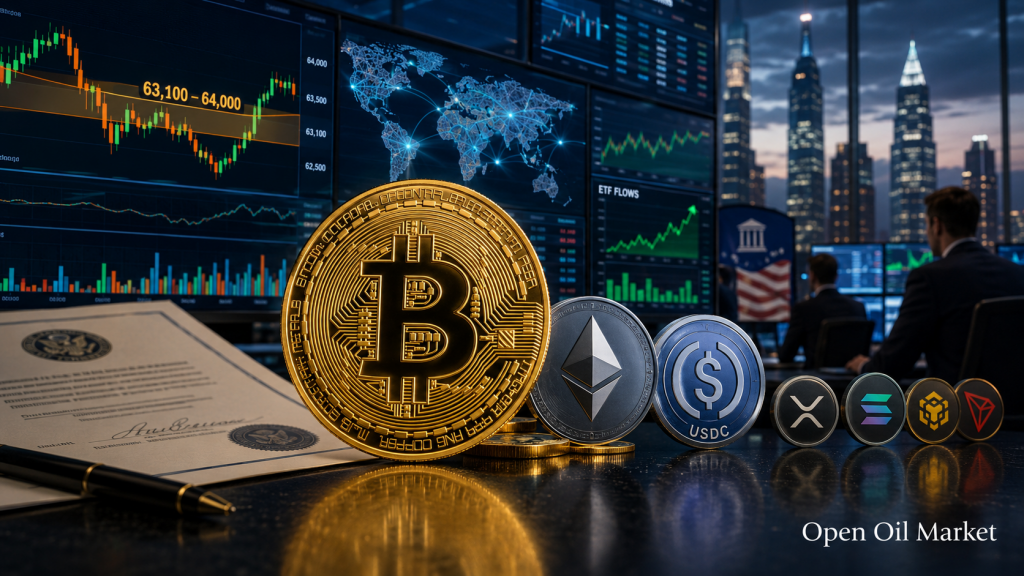
The cryptocurrency market approaches Saturday, July 11, 2026, with a state of cautious recovery following a volatile week. For global investors, Bitcoin remains the primary benchmark; the original cryptocurrency is holding steady in the range of $63,000 to $64,000 despite the pressure from ETF flows, profit-taking, and increased attention to option expirations. The market remains highly sensitive to macroeconomic factors, geopolitics, USD dynamics, and risk appetites across global equity markets.
However, the main topic of the day is broader than just Bitcoin's dynamics. Cryptocurrencies are increasingly transitioning from speculative assets to infrastructural layers of global finance. This is evidenced by the regulatory breakthrough from Circle, the issuer of USDC: receiving approval to establish a national trust bank in the United States enhances trust in stablecoins and indicates that the digital asset market is entering a phase of institutional selection. For investors, this signifies a new risk structure: now, not only token prices matter, but also the quality of regulation, transparency of reserves, sustainability of business models, and the role of crypto infrastructure in the global financial system.
Bitcoin: The Key Crypto Asset Remains in Focus
Bitcoin continues to serve as the primary indicator for the cryptocurrency market. Maintaining the range around $63,000 to $64,000 is essential not only from a technical standpoint but also concerning the sentiments of institutional investors. Following sharp fluctuations in midweek, the market is testing whether Bitcoin can solidify above the consolidation zone and create a base for a move to higher levels.
For global investors, three factors are currently critical:
- ETF flows – inflows and outflows from spot Bitcoin ETFs remain the main indicator of institutional demand;
- Option expirations – large volumes of derivatives may amplify short-term volatility;
- Macroeconomic backdrop – dynamics of the dollar, US bond yields, and interest rate expectations directly influence the appetite for risky assets.
Bitcoin no longer trades in isolation from traditional markets. Its behavior increasingly resembles that of a high-liquidity global risk asset reacting to the same signals as technology stocks, gold, emerging market currencies, and commodity assets. For portfolio investors, this enhances the significance of risk management: Bitcoin remains a high-potential asset, but its volatility requires discipline.
Ethereum: The Infrastructure Story Outweighs Short-Term Price
Ethereum maintains its status as the second key asset in the cryptocurrency market. While Bitcoin is seen as a digital reserve asset, Ethereum remains the foundational infrastructure for smart contracts, DeFi, tokenization of real assets, NFTs, stablecoins, and corporate blockchain solutions.
For investors, Ethereum is appealing not just as a cryptocurrency but also as a technological platform. The main question in the coming weeks is whether institutional products based on Ethereum can attract sustainable capital comparable to the interest in Bitcoin. An additional factor is the staking theme: the ability to earn returns within regulated investment products could enhance ETH’s appeal to long-term holders.
At the same time, Ethereum remains sensitive to competition. Solana, BNB Chain, TRON, and other networks continue to vie for fees, users, and developers. Thus, the investment rationale around Ethereum is increasingly shifting from a simple bet on the price of ETH to an analysis of network activity, revenue from fees, DeFi market share, and the role in asset tokenization.
Stablecoins and USDC: Regulation Becomes a New Investment Theme
One of the most significant events for the cryptocurrency market is the strengthening of the regulatory status of Circle and USDC. The approval to create a national trust bank in the United States means that the infrastructure of one of the largest stablecoins will receive a higher level of federal oversight. For investors, this signals that the stablecoin market is becoming a systemically important element of digital finance.
Stablecoins serve several key functions:
- They provide dollar liquidity within the cryptocurrency market;
- They are used for settlements between exchanges, funds, and traders;
- They become instruments for cross-border payments;
- They act as a bridge between traditional finance and blockchain infrastructure.
For a global audience, this is especially crucial. In the United States, stablecoin regulation is becoming part of financial policy. In Europe, the MiCA regime is enhancing requirements for digital asset issuers. In Asia, the Middle East, and Latin America, stablecoins are increasingly being utilized as tools for accessing dollar liquidity. Therefore, cryptocurrency news will be increasingly shaped not only by Bitcoin dynamics but also by regulations for USDT, USDC, and other digital dollars.
ETF and Institutional Investors: The Market Matures
Cryptocurrency ETFs remain the primary channel for institutional capital to enter digital assets. Following the launch and expansion of exchange-traded products, the market has become more transparent, yet simultaneously more reliant on capital flows. When ETFs report inflows, Bitcoin and major altcoins receive support. Conversely, when outflows begin, the market quickly transitions into a correction.
For investors, this alters the structure of analysis. Previously, cryptocurrencies were primarily evaluated through on-chain metrics, wallet activity, hash rates, and retail trader sentiment. Now, this has expanded to include:
- Trading volumes in ETFs;
- Fund balances;
- Market maker activity;
- Derivatives dynamics;
- Positioning of large asset management firms.
This makes the cryptocurrency market increasingly similar to traditional financial markets. On one hand, liquidity is improving. On the other, the influence of Wall Street, regulation, and macroeconomic cycles is intensifying.
Top 10 Most Popular Cryptocurrencies for Investors
As of July 11, 2026, global investors continue to focus on the largest and most liquid digital assets. The top 10 popular cryptocurrencies based on market capitalization, liquidity, and recognition are as follows:
1. Bitcoin (BTC)
The leading reserve asset of the cryptocurrency market. Bitcoin remains the foundational indicator of trust in digital assets and a key tool for institutional portfolios.
2. Ethereum (ETH)
The largest infrastructure blockchain platform. Ethereum is vital for DeFi, tokenization, stablecoins, and smart contracts.
3. Tether (USDT)
The largest stablecoin by trading volume. USDT remains the primary source of dollar liquidity on many global cryptocurrency exchanges.
4. BNB (BNB)
The token of the Binance ecosystem and BNB Chain. Investor interest depends on the activity of the exchange infrastructure and the development of applications within the network.
5. USD Coin (USDC)
A regulated dollar stablecoin that is strengthening its position with the increased focus on reserve transparency and institutional storage of digital assets.
6. XRP (XRP)
An asset focused on cross-border payments and financial infrastructure. XRP remains sensitive to regulatory news and interest from payment companies.
7. Solana (SOL)
A high-performance blockchain attracting developers, traders, and projects in the DeFi, meme coin, payment, and tokenization segments.
8. TRON (TRX)
A network actively used for stablecoin transfers and inexpensive transactions. TRON maintains significance for global dollar crypto liquidity.
9. Dogecoin (DOGE)
The largest meme coin that remains an indicator of retail demand and market appetite for speculative assets.
10. Cardano (ADA)
A blockchain project focused on a research-driven approach, decentralization, and long-term ecosystem development.
Altcoins: Interest Returns, But Selection Becomes Stricter
Altcoins enter the weekend showing signs of recovery; however, the market is no longer buying everything indiscriminately. Investors are becoming more selective. Projects with genuine network activity, sustainable liquidity, and a clear tokenomics are in focus.
The most notable directions are:
- Payment Networks – XRP, TRON, stablecoin infrastructure;
- High-Speed Blockchains – Solana and competing L1 networks;
- DeFi – lending protocols, decentralized exchanges, liquid staking;
- Asset Tokenization – bonds, money market funds, stocks, and commodity instruments on the blockchain;
- Meme Coins – a high-risk segment dependent on retail demand and social media.
The key takeaway for investors: altcoins can offer higher returns than Bitcoin, but the selection risk is significantly higher. In a mature market, an edge is gained by projects with liquidity, infrastructural roles, and a clear regulatory outlook.
Geography of the Crypto Market: US, Europe, Asia, and Emerging Markets
The global cryptocurrency market is becoming increasingly segmented by region. The US remains the center for ETFs, regulation, institutional capital, and public crypto companies. Europe is betting on MiCA, issuer transparency, and control over crypto service providers. Asia retains its role as the largest center for retail activity, exchange liquidity, and technological experimentation. The Middle East is strengthening its position as a jurisdiction for fintech, digital assets, and capital from countries with high dollar liquidity.
For investors, global geo-targeting is important for two reasons. First, regulation can support some assets while constraining others. Second, demand for stablecoins, Bitcoin, and payment tokens is often generated not in the US, but in regions where there is a need for quick cross-border transactions and protection from currency instability.
Risks: Volatility, Regulation, and Liquidity Concentration
Despite the recovery in sentiment, cryptocurrencies remain a high-risk asset class. The main threats to investors in the coming days and weeks are associated with Bitcoin's volatility, changes in ETF flows, regulatory decisions in the US and Europe, and liquidity concentration in a limited number of major exchanges, stablecoins, and market makers.
Key portfolio risks include:
- A sharp reversal in Bitcoin after a failed attempt to solidify above resistance;
- Outflows from ETFs and a reduction in institutional demand;
- Pressure on altcoins amid a deteriorating global risk appetite;
- Regulatory restrictions for specific tokens or exchanges;
- Liquidity issues with stablecoins or crypto credit platforms.
Therefore, an investor's strategy must account for not only the potential for growth but also scenarios of decline. Diversification, position limits, leverage control, and liquidity analysis remain critically important.
What to Watch for Investors on July 11, 2026
Saturday, July 11, 2026, could be an important day for assessing the resilience of the cryptocurrency market following a busy week. If Bitcoin maintains its range around $63,000 to $64,000 and avoids a sharp correction post-option expiration, it will sustain interest in Ethereum, Solana, XRP, and other major altcoins. However, if ETF flows deteriorate and global risk appetite declines, the market could swiftly revert to a defensive behavioral model.
Investors should closely monitor the following indicators:
- Bitcoin's ability to hold above key support levels;
- Dynamics of spot Bitcoin ETFs and Ethereum ETFs;
- The market response to regulatory news regarding stablecoins;
- Trading volumes for XRP, Solana, BNB, and TRON;
- Changes in Bitcoin's share of the overall cryptocurrency market capitalization;
- Demand for USDT and USDC as indicators of dollar liquidity.
The main takeaway for the day: cryptocurrencies are entering a new phase where growth is determined not only by speculation but also by institutional infrastructure, regulation, ETF flows, and the real use of blockchain networks. Bitcoin remains the market center, Ethereum is the infrastructure bet, and stablecoins are becoming a bridge between the crypto economy and traditional finance. For investors, this creates a more complex but also a more mature digital asset market.