Cryptocurrency News for Saturday, June 27, 2026: Bitcoin Holds Around $60,000, Investors Monitor ETF Flows, MiCA Regulation, Stablecoins, and Dynamics of Top 10 Digital Assets
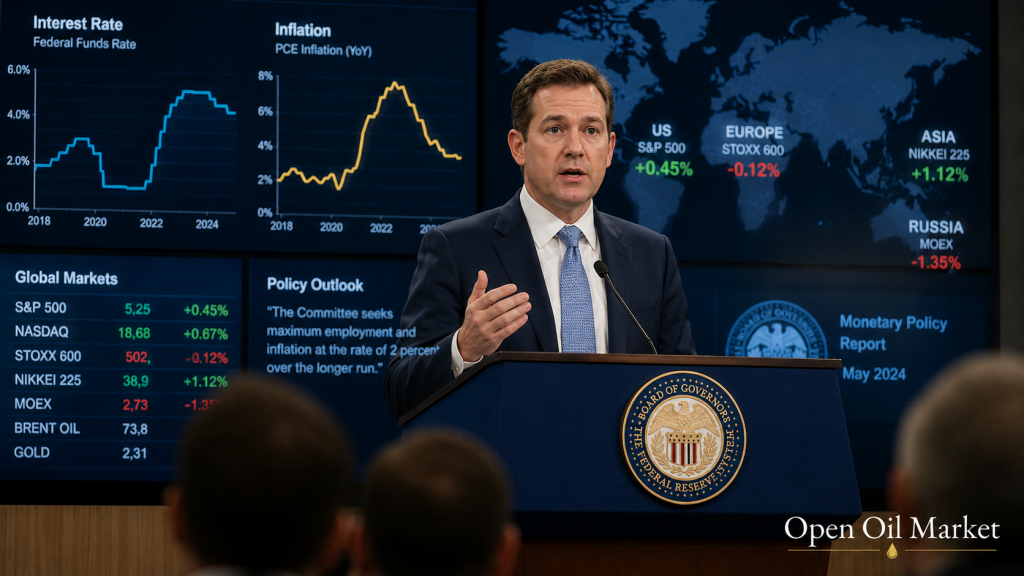
The global cryptocurrency market enters Saturday, June 27, 2026, with heightened caution. The main theme for investors is not a sharp rise in digital assets, but rather a test of market resilience following a period of pressure on Bitcoin, Ethereum, and major altcoins. Cryptocurrencies are increasingly influenced by macroeconomic factors, ETF flows, stablecoin regulations, and the quality of institutional demand.
For a global audience of investors, the current landscape appears more mature than in previous cycles: the market no longer reacts solely to retail hype. ETFs, liquidity, regulatory frameworks for crypto firms in Europe, central bank policies, and the role of stablecoins in transactions are taking center stage. This transforms cryptocurrency news into a part of the broader financial market, where Bitcoin is gradually being traded as a risky institutional asset rather than an isolated speculative phenomenon.
Market Overview: Cryptocurrencies Under Pressure
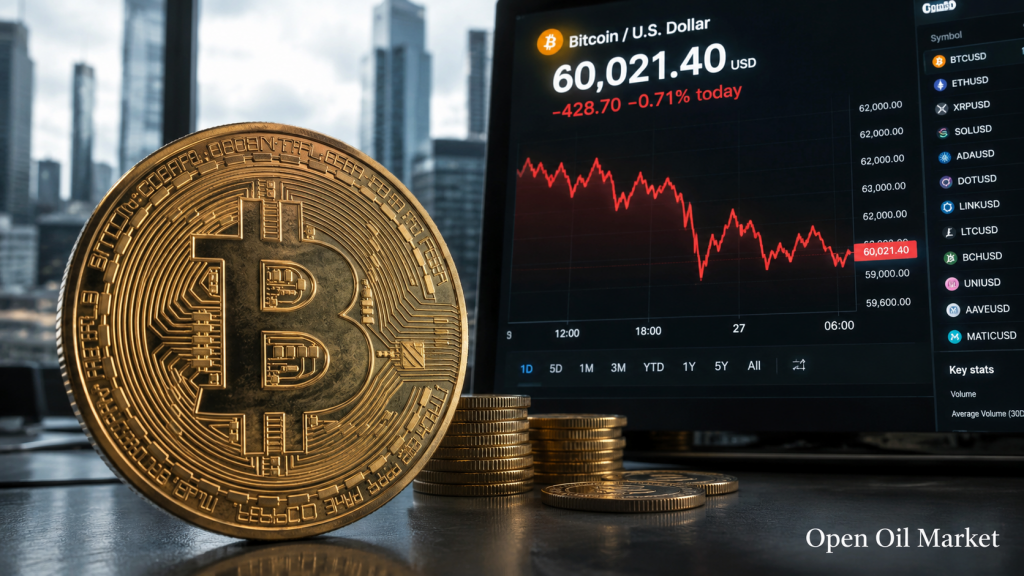
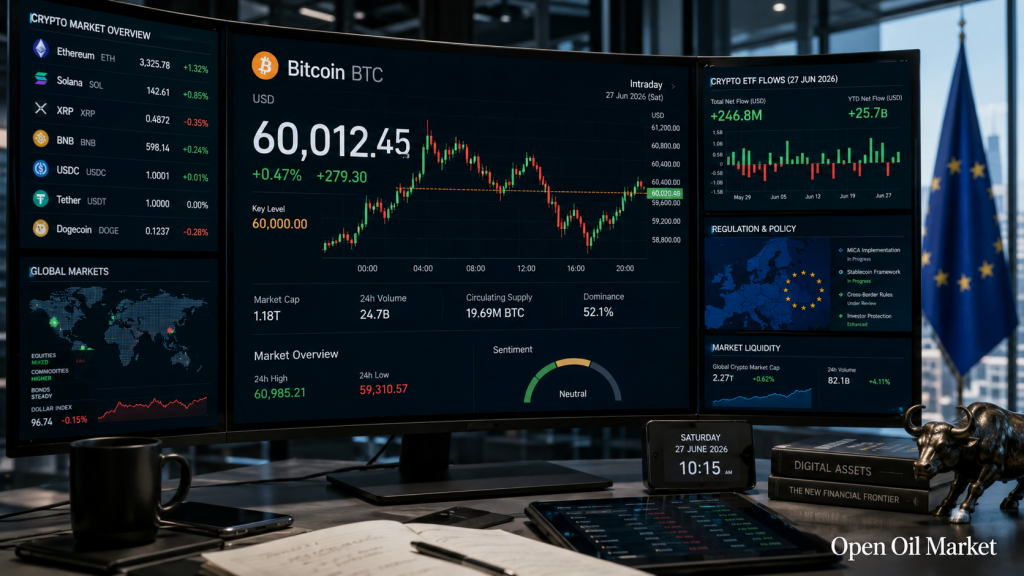
As of the time of writing, Bitcoin is trading near the $60,000 mark, with Ethereum around $1,580. These are not just price benchmarks; they represent significant psychological levels for the entire digital asset market. Following periods of strong growth, investors are evaluating Bitcoin’s ability to maintain its status as the foundational asset of the crypto market amid declining risk appetite.
Key factors affecting the cryptocurrency market include:
- Weak ETF flow dynamics following a series of outflows from spot funds;
- High sensitivity of Bitcoin and Ethereum to expectations regarding Federal Reserve interest rates;
- Stronger regulation of crypto firms in Europe through the MiCA framework;
- Increased importance of USDT and USDC stablecoins as market infrastructure;
- Selective interest in individual altcoins instead of broad rallies.
For investors, this indicates that the cryptocurrency market has transitioned from a “buy everything” phase to a selection phase. Liquidity is concentrating in the largest coins, while second-tier projects are increasingly evaluated based on real utility, transaction volumes, and the sustainability of their business models.
Top 10 Most Popular Cryptocurrencies: Market Leaders as of June 27, 2026
Investors are focusing on the top 10 cryptocurrencies by market capitalization and liquidity. The list of the largest digital assets indicates where significant market capital is concentrated and which coins are shaping the global narrative.
- Bitcoin (BTC) — the main reserve asset of the crypto market, trading around $60,000.
- Ethereum (ETH) — the foundational platform for smart contracts, DeFi, and tokenization, around $1,580.
- Tether (USDT) — the largest dollar stablecoin and the primary tool for transactions on crypto exchanges.
- BNB (BNB) — token of the Binance ecosystem, around $567.
- USDC (USDC) — a regulated dollar stablecoin in demand among institutional players.
- XRP (XRP) — an asset related to cross-border payments, trading around $1.05.
- Solana (SOL) — a high-performance blockchain for DeFi, memecoins, and consumer crypto applications, around $73.
- TRON (TRX) — a network actively used for stablecoin transfers, around $0.32.
- Hyperliquid (HYPE) — a notable new asset in the decentralized trading segment.
- Dogecoin (DOGE) — the largest memecoin, maintaining liquidity and recognition, around $0.076.
An important detail: Cardano (ADA) remains a popular cryptocurrency among retail investors, but in the current market snapshot, it gives way to newer and more liquid assets. This underscores a shift in market structure: capital is flowing more swiftly to where there are turnovers, infrastructure, and institutional interest.
Bitcoin: The Market Tests the $60,000 Level
Bitcoin remains the primary indicator of sentiment in the global cryptocurrency market. The $60,000 level is crucial not only technically but also psychologically. If this level holds, investors may speak of base formation following a correction; a downward breakout could lead to increased pressure across the sector.
The main question for BTC holders is whether stable inflows will return to spot Bitcoin ETFs. Previously, the market faced a record series of outflows, disrupting the balance of supply and demand. Institutional funds remain a key capital entry channel, making ETF dynamics more critical than short-term news regarding retail activity.
For long-term investors, Bitcoin maintains its role as a digital analogue of a scarce asset. However, in the short term, its price is increasingly dependent on macroeconomic factors: interest rates, bond yields, the US dollar, and overall demand for risk.
Ethereum: Price Pressure and Bet on Infrastructure
Ethereum appears weaker than Bitcoin in its dynamics but remains the central infrastructure for smart contracts, asset tokenization, DeFi protocols, and corporate blockchain experiments. For investors, ETH is currently not just a bet on the coin's price but a wager on the future of digital financial infrastructure.
The weakness of Ethereum can be attributed to several factors:
- A decrease in speculative demand for DeFi and NFTs compared to previous cycles;
- Competition from Solana and other faster networks;
- Dependence on ETF flows and institutional interest;
- General pressure on risk assets.
Nonetheless, Ethereum remains fundamentally significant for the cryptocurrency market. If the second half of 2026 brings increased tokenization of real assets, stablecoin settlements, and corporate blockchain products, ETH could once again draw the attention of global investors.
Stablecoins: USDT and USDC Become Financial Infrastructure
Stablecoins have emerged as one of the most resilient themes of 2026. USDT and USDC rank third and fifth among the largest cryptocurrencies, indicating that the market increasingly uses digital dollars not just for trading, but for international settlements, liquidity storage, and rapid capital movement between platforms.
Regulators are also intensifying their focus on this segment. The Bank of England has eased some requirements for stablecoins, eliminating individual ownership limits and proposing issuance caps for widely used stablecoins. This is an important signal: authorities are willing to recognize digital money as part of the payment system but want to integrate it into a controlled financial architecture.
For investors, stablecoins are not high-yield instruments but indicators of market maturity. The more liquidity is held in USDT and USDC, the faster capital can return to Bitcoin, Ethereum, Solana, and other digital assets when market conditions improve.
MiCA and Europe: Regulation Becomes a Market Factor
The European cryptocurrency market is entering a critical phase in adapting to MiCA. Crypto firms must obtain licenses to continue operating within the European Union, and regulators in Spain and France have indicated that there will be no leniency for platforms without permits.
For the global market, this signifies several implications:
- Major exchanges will accelerate legal restructuring in Europe;
- Some users may encounter access restrictions to certain services;
- Liquidity may redistribute in favor of licensed platforms;
- Institutional investors will benefit from a clearer legal environment.
MiCA transforms cryptocurrencies from a gray zone into a regulated class of digital assets. In the short term, this creates stress for certain platforms, but in the long term, it could enhance the trust of banks, funds, and corporate clients in the crypto market.
Altcoins: XRP, Solana, TRON, HYPE, and Dogecoin Trade Under Different Scenarios
Altcoins are no longer moving as a unified front. XRP is supported by the theme of cross-border payments and greater regulatory clarity. Solana remains a bet on speed, low fees, and mass applications. TRON maintains a practical role in stablecoin transfers, especially in emerging markets. Hyperliquid attracts attention as a representative of the new wave of decentralized trading. Dogecoin remains a liquid meme asset, but its investment logic is still dependent on retail market sentiments.
For investors, it’s important to distinguish popularity from the quality of an investment asset. High recognition does not always imply sustainable cash flow, technological advantage, or long-term capital appreciation. In 2026, the market increasingly demands evidence from altcoins: user engagement, fees, total value locked (TVL), real turnover, and institutional applicability.
What Investors Need to Know This Weekend
Saturday can traditionally be a period of lower liquidity, which means sharp market movements may not always reflect fundamental changes. Investors should pay close attention not only to Bitcoin’s price but also to the behavior of the entire digital asset complex.
Key benchmarks for the coming days include:
- Bitcoin holding in the $60,000 zone;
- Ethereum dynamics in relation to Bitcoin;
- Inflows or outflows from spot ETFs;
- News regarding licensing of crypto exchanges in Europe;
- Stability of USDT and USDC as the market's foundational liquidity;
- Behavior of Solana, XRP, and HYPE as indicators of demand for altcoins;
- Volatility against a backdrop of macroeconomic interest rate expectations.
The main takeaway for investors is that as of June 27, 2026, the cryptocurrency market remains in a phase of reassessment. Bitcoin and Ethereum continue to hold systemic significance, stablecoins are becoming the core infrastructure, and regulation in Europe and the UK is shaping a new industry architecture. For long-term capital, this is a period of not aggressively chasing growth but selecting quality digital assets, managing risk, and closely analyzing liquidity.