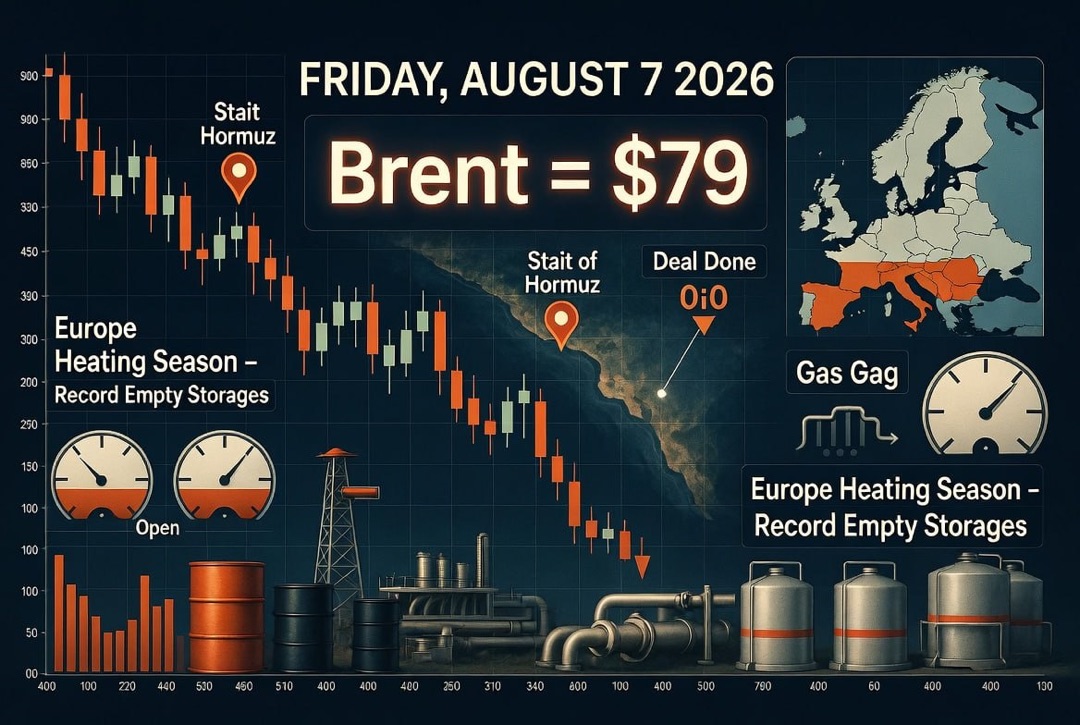
Cryptocurrency News: Friday, August 7, 2026 – Market Awaits US Senate Vote on CLARITY Act
The cryptocurrency market enters the last trading day of the week in a state of tense equilibrium. Bitcoin remains above the $64,000 mark, and spot ETFs are demonstrating an unbroken series of inflows since the beginning of August. However, the main focus of the day is not on the charts, but in Washington: August 7 is effectively the last working day of the US Senate before the summer recess, and this date serves as a window for procedural voting on the cryptocurrency market structure bill. Below is a detailed overview of the situation for investors.
Main Highlights for August 7, 2026: Regulatory Crossroads Define Market Sentiment
- Bitcoin (BTC) is trading around $64,800 after a rise of approximately 0.8% over the past day, recovering from a July low near $58,000.
- Total Market Capitalization of the cryptocurrency market remains in the range of $2.1–2.2 trillion.
- Spot BTC ETFs have not registered a single day of net outflow since the start of August — IBIT by BlackRock remains the primary channel for institutional demand.
- CLARITY Act (H.R. 3633) — procedural voting to end debates is possible on August 7; it requires 60 votes to overcome the threshold.
- Federal Reserve maintains the interest rate in the range of 3.50–3.75% for the fifth consecutive meeting, with Chairman Kevin Warsh's rhetoric remaining hawkish.
Bitcoin Price: Technical Picture Remains Corrective
Bitcoin has regained its position above the 20-day moving average but still faces resistance around the 50-day EMA near $64,500–64,600 — a level that has capped all growth attempts over the past three weeks. More significant benchmarks are positioned higher: the 100-day EMA around $67,000 and the 200-day EMA near $72,500. As long as the price remains below these levels, the medium-term trend officially remains corrective.
Key levels for investors to monitor include:
- Support Zone $62,500–63,000 — buyers have repeatedly held the market here in July and early August.
- Resistance $67,000 — breaking this level opens the path to the range of $69,000–72,000.
- Critical Level $57,500–58,000 — June and July lows; losing these would signify a resumption of the downward phase.
It is worth noting that Bitcoin's all-time high of around $126,200 was reached on October 6, 2025. Current quotes are nearly half the peak, making 2026 a period of prolonged consolidation following the record cycle.
Regulation: Why the CLARITY Act is More Important than Charts
The Digital Asset Market Structure Act passed the House of Representatives back in July 2025 (294 votes to 134) and received approval from the Senate Banking Committee in May 2026. However, it has yet to make it to the floor for a vote. The Republican majority holds 53 seats, indicating that at least seven Democratic votes are needed to overcome the procedural barrier. The main sticking point remains the provisions on ethical restrictions, which are absent in the combined version of the bill.
What the outcome of the vote means for investors:
- Successful Voting — is a signal that the legislative framework may be approved before the November 2026 midterm elections; XRP, SOL, and tokens of infrastructure projects are most sensitive to this scenario.
- Failure or Absence of Voting — shifts the issue to the overloaded September calendar and, according to some analysts, increases the risk of the law being postponed until 2027.
It's important to understand: even in the absence of the law, the market operates within the existing framework — the GENIUS Act on stablecoins and the joint classification by the SEC and CFTC from March 17, 2026, which recognized 16 digital assets as commodities. However, departmental clarifications could be overturned by the next administration, whereas a statute cannot. This represents the industry's strategic bet.
Institutional Flows: ETFs as the Main Driver of Demand
August has started off confidently for exchange-traded funds. Major issuers — BlackRock, Fidelity, Franklin Templeton — have resumed purchases, with Franklin Templeton returning to acquisitions after a pause of over 30 days. Daily net inflows in individual sessions have exceeded $200 million, and the dominance of IBIT within the flow structure confirms: demand is being driven by professional allocators rather than retail speculators.
For investors, this represents a fundamental shift: in 2026, institutional flows, rather than the four-year halving cycle, are becoming the marginal price driver. Consequently, weekly ETF statistics today are more informative than on-chain metrics from previous cycles.
Macroeconomics: Fed's Tight Pause and Correlation with Stock Market
In the July FOMC meeting, the vote was 9 against 3 to maintain the rate, with three regional Fed presidents advocating for a hike. Chairman Kevin Warsh emphasized that inflation above 2% is unacceptable. For crypto assets, this means expensive liquidity will remain and margin positions will become more costly.
The correlation of Bitcoin with the Dow Jones index remains around 58% — the crypto market remains a high-risk asset within the broader risk basket. A mitigating factor is geopolitics: progress in US-Iran negotiations and falling oil prices have eased pressure on risk assets.
Top 10 Most Popular Cryptocurrencies: A Brief Profile for Investors
- Bitcoin (BTC) — digital gold and market barometer; capitalization around $1.3 trillion. The main vehicle for institutional access through spot ETFs.
- Ethereum (ETH) — foundational settlement layer for stablecoins and tokenized assets; quotes around $1,900. Outperformed Bitcoin in July.
- Tether (USDT) — the largest stablecoin trading at parity with the dollar; an indicator of offshore and retail liquidity.
- XRP — cross-border payments token near $1.05–1.10; most sensitive to regulatory news and ETF approvals in global markets.
- BNB — asset of the largest exchange ecosystem, around $600; supported by network development and a flow of new listings.
- USD Coin (USDC) — regulated stablecoin preferred for institutional transactions; issuance dynamics serve as an indicator of market "dry powder."
- Solana (SOL) — high-performance blockchain around $74 with record network activity; focused on the Alpenglow consensus upgrade with block finalization in 100–150 ms.
- TRON (TRX) — network with high stablecoin transaction volume; quotes around $0.33.
- Dogecoin (DOGE) — the largest meme asset and classic high-risk instrument; weekly address activity has increased at double-digit rates.
- Cardano (ADA) — project emphasizing research-oriented approach and interoperability; focused on the development of the Ouroboros Leios scaling protocol.
Additionally, we note Hyperliquid (HYPE), which has secured a position at the top of the rankings in 2026 and is competing for a spot in the top ten — indicating that the structure of top assets is no longer static.
Corporate and Industry News of the Week
- Twelve crypto companies have received approval under the European MiCA regime, expanding legal access to the EU market.
- Robinhood has launched its own Layer 2 based on Ethereum, choosing Chainlink as the oracle and cross-chain transfer provider.
- The largest corporate holder of Bitcoin has not made purchases for six weeks and recorded a losing sale — a signal of a changing treasury management approach.
- A Swiss bank has added Litecoin trading directly to its banking app — an example of the ongoing integration of crypto assets into the regulated financial perimeter.
Risks: Cybersecurity Returns to the Forefront
An incident involving the theft of approximately $120 million linked to vulnerabilities in a popular hardware wallet reminded the market of the fundamental risk of self-custody. A long-term factor remains the discussion about the quantum threat to Bitcoin's cryptography. For investors, this serves as an argument for diversifying storage methods: a combination of regulated custodians, exchange products, and cold wallets from different manufacturers.
Global Context: The Market No Longer Centers on the US
While the US Senate's decision remains the main short-term catalyst, the geography of demand is expanding. Europe is building a licensing framework through MiCA, Singapore is testing settlements on the XRP Ledger at the central bank level, and Asian retail investors are creating a consistent preference for certain altcoins. For global investors, this means that regulatory risk is gradually becoming diversifiable — although it has not yet fully become so.
Scenarios for the Coming Weeks
- Positive. The Senate votes, ETF inflows continue, Bitcoin breaks through $67,000 and tests the $69,000–72,500 zone. High-beta altcoins outperform the market.
- Base. The vote does not provide clarity, and Bitcoin remains within the range of $62,000–67,000 until the September Fed meeting. The market trades sideways amid reduced August liquidity.
- Negative. The bill is pushed to 2027, the Fed's rhetoric tightens, and support at $62,000 fails — returning to June lows.
Conclusions for Investors
August is historically considered a month of low liquidity, and in 2026, the seasonal factor is compounded by two binary events — the fate of the CLARITY Act and the trajectory of the Fed's rate. In these conditions, the priority shifts from directional bets to risk management: control of position size, avoidance of excessive leverage, gradual dollar-cost averaging instead of lump-sum entries, and attention to the quality of assets in the top ten by market capitalization.
This material is for informational purposes only and is not an individual investment recommendation. Quotes are as of the trading session on August 6, 2026, and may change significantly. The cryptocurrency market is characterized by high volatility.