Oil Market: Hormuz Diplomacy Hits Prices
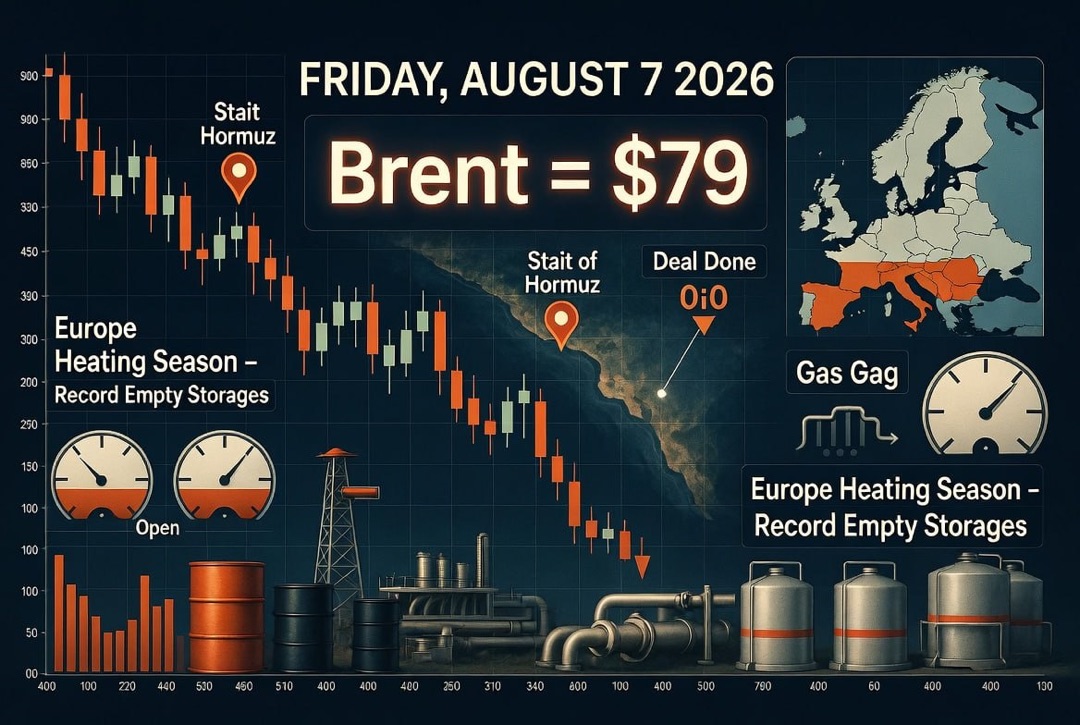
The oil market has witnessed one of the sharpest corrections of the year. Following the July rally when Brent prices soared above $90 per barrel due to the blockade of the Hormuz Strait, news of a forthcoming temporary agreement between Iran, Oman, and the USA reversed the trend. The parties are discussing a 60-day plan for dividing shipping flows: tankers heading to the Persian Gulf will follow Iranian routes, while vessels leaving the gulf will travel near Oman, with no tolls. Against this backdrop:
- Brent traded in the range of $78.5–79.7 per barrel by the morning of August 6, after a decline of more than 5% in the previous session;
- WTI fell to $74.8–75.2 per barrel;
- prices are consolidating in a narrow corridor of $78.6–81.3 following a sharp drop on August 3–4;
- the average analyst forecast for Brent price for the entire year of 2026 remains above $85 per barrel, indicating the market is pricing in geopolitical risk premiums.
The U.S. President publicly stated there has been "significant progress" in the negotiations and expressed readiness to lift some sanctions on Iranian oil exports and withdraw the military fleet from Iranian shores in the event of a deal. Meanwhile, Tehran officially insists that it is discussing shipping arrangements only with Oman, not directly with Washington, leaving room for new developments. For the oil and petroleum products market, the key question remains: Will the de-escalation solidify, or will tensions in the Persian Gulf return in September?
OPEC+: End of the Production Increase Cycle
The OPEC+ alliance has confirmed that starting in September, seven member countries, including Russia and Saudi Arabia, will increase oil production quotas by an additional 188,000 barrels per day. This decision concludes a phased return to the market of 1.65 million barrels per day of voluntary cuts that started earlier this year. Key details include:
- the combined allowable production level of the alliance will reach 36.206 million barrels per day;
- Saudi Arabia and Russia will both see an increase of 62,000 barrels per day, bringing their levels to 10.478 million and 9.949 million barrels per day, respectively;
- according to sources within the organization, no further increases in quotas are planned through the end of 2026;
- actual production in several countries is lagging behind quotas due to disruptions in export infrastructure — attacks on facilities in Russia and tensions in the Persian Gulf are holding back the full recovery of supply.
The next OPEC+ ministerial meeting is set for early September — the market will closely monitor the alliance's rhetoric regarding 2027, especially in light of the potential normalization of conditions around the Hormuz Strait.
European Gas Market: Record Low Inventories Before Winter
In contrast to oil, the situation in the European gas market remains tense. According to Gas Infrastructure Europe, as of early August, underground gas storage facilities (UGS) in the EU are only 57% full, which is below the previous anti-record of 2021 and significantly lags behind the European Commission's target of 90% by the start of the heating season. The main factors contributing to the deficit include:
- a reduction in LNG supplies through the Hormuz Strait — estimates suggest that up to 20% of global liquefied gas volumes have temporarily dropped out of logistics;
- a 7% year-on-year decline in LNG imports to Europe in August;
- spot prices at the TTF hub have stabilized at $696 per thousand cubic meters compared to an average of $626 in July — a rise of nearly one and a half times compared to August of last year;
- the contribution of wind generation to Europe's energy balance fell to 10% in early August from 14% a year earlier, further increasing the load on gas generation.
Analysts warn: if the current injection dynamics continue, Europe risks entering the heating season with storage levels no higher than 75%. For industrial gas consumers and energy companies, this means heightened price volatility and a risk of electricity price spikes during the winter of 2026–2027.
Sanctions and Geopolitics: Between Hormuz and Ukraine
The sanction backdrop remains a decisive factor for the oil and gas sector. Washington ties potential easing of restrictions on Iranian oil exports directly to progress on the Hormuz Strait, while the sanctions regime against Russian energy resources remains unchanged. Simultaneously, attacks on oil refining and export infrastructure continue to impact actual supplies of oil and petroleum products from Russia and Persian Gulf countries, which analysts from Kpler identify as one reason for delaying the forecast recovery of production in the Middle East from September 2026 to early 2027. For global traders and energy market participants, the scenario remains twofold: stable de-escalation could return oil to the $70–75 range, while breakdown of negotiations or new infrastructure attacks could propel Brent back to $90 and beyond.
Russian Fuel Market: Export Restrictions Continue
Within Russia, authorities continue to manage fuel shortages through a set of administrative measures. Key decisions made in recent weeks include:
- a complete ban on the export of gasoline, diesel, marine fuel, and gasoil for all producers has been extended until the end of September, and for gasoline, effectively until the end of 2026;
- from September 1, partial easing of regulations for diesel and gasoil by direct producers is anticipated;
- retail prices for auto gasoline have risen nearly 14% since the beginning of the year, while diesel prices have increased by almost 15%, significantly outpacing overall inflation;
- imports of petroleum products have been initiated to stabilize the domestic balance, and special pricing rules for state fuel procurement have been suspended until the end of the year.
Experts note that external markets, particularly Europe and the USA, suffer the most from the Russian export ban, where the diesel deficit has already affected exchange quotes, while Asia, with its own refining capacities, feels the impact less sharply.
Asian Demand: China and India Increase Purchases
The largest Asian importers continue to shape the balance of the global oil and gas market. China maintains its status as the leading buyer of Russian and Middle Eastern oil while simultaneously increasing its own production and investments in exploring oil fields. India retains favorable purchasing conditions for Urals oil while also developing deep water exploration programs to reduce long-term dependence on imports. Both countries remain the primary drivers of demand amid cooling consumption in developed economies.
Energy Transition: Renewables Prepare to Surpass Coal
According to the International Energy Agency (IEA), by 2026, renewable energy sources are expected to surpass coal for the first time in the global electricity generation structure. Solar generation is set to add around 600 TWh of capacity annually and become the second major source of "green" electricity after hydropower. Meanwhile:
- the gas crisis, driven by disruptions in the Hormuz Strait, has accelerated the transition of several countries to solar generation as a means of reducing dependence on imported fuels;
- global rates of new solar capacity installation in 2026 could slow down for the first time in 25 years due to saturation of key markets and regulatory policy changes;
- CO2 emissions from energy are projected by the IEA to rise by 1% in 2026 due to a temporary rise in coal generation as a result of expensive gas, but stabilization is expected in 2027.
Coal: Temporary Comeback Amid High Gas Prices
Rising natural gas prices have rekindled interest among energy companies in coal generation as a backup source of electricity. In the Asia-Pacific region, where most demand for thermal coal is concentrated, consumption remains close to record levels. Despite long-term decarbonization strategies, coal continues to serve as a buffer for energy systems against gas supply disruptions, especially during peak load periods.
Day’s Summary: What to Expect for Energy Sector Investors
The fuel and energy sector enters the weekend with a conflicting set of signals. The oil market is showing signs of de-escalation amid Hormuz diplomacy, but geopolitical risk remains high and could resurface at any moment. In contrast, the European gas market is entering a phase of structural tension ahead of winter, creating conditions for rising price volatility in electricity. The Russian fuel market remains under administrative control, while the global energy transition gains momentum, despite a temporary renaissance in coal generation. For energy market participants — oil and gas companies, refineries, renewable energy investors, and petroleum traders — the key indicators for the coming weeks are the outcomes of negotiations over the Hormuz Strait, the pace of gas injections into European storage facilities, and OPEC+ decisions during the alliance's September meeting.