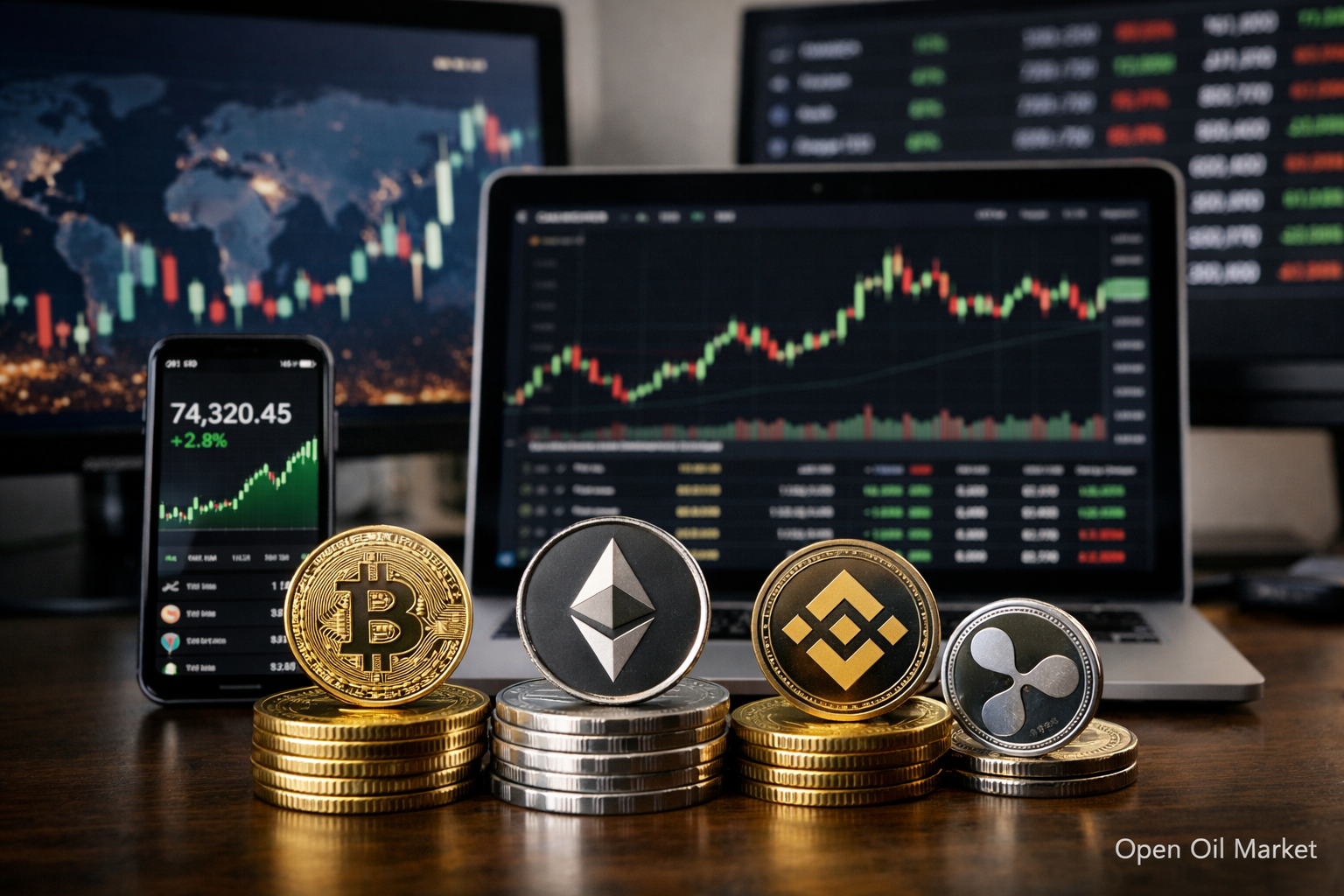
Current Cryptocurrency News for Thursday, February 12, 2026: Key Market Events, Response to U.S. Macroeconomic Data, Cautious Consolidation of Prices, Institutional Initiatives, and Overview of the Top 10 Most Popular Crypto Assets.
As of the morning of February 12, 2026, the global cryptocurrency market is striving to stabilize after yet another wave of volatility. The recent inflation data from the U.S. triggered a short-term intensification of sell-offs; however, some of the losses were later recovered. Bitcoin is trading around $68,000-$70,000, remaining above last week’s extreme lows due to the emergence of buyers on dips. Ethereum (ETH) is holding near the $2,000 mark after recent fluctuations, having rebounded from a local low (~$1,750 at the beginning of February). The total market capitalization of digital assets is estimated at approximately $2.4 trillion—almost $2 trillion below the historical peak of October 2025, underscoring the scale of the corrections observed in recent weeks. Overall market sentiment remains cautious: the cryptocurrency "fear and greed" index continues to linger in the "extreme fear" zone (below 20 out of 100), signaling prevailing caution among investors.
The sharp decline of the market at the beginning of February was caused by the confluence of several negative factors—from the hard signals from the U.S. Federal Reserve to mass liquidations on derivative exchanges. Additional pressure arose from news regarding potential tightening of monetary policy: the nomination of prominent proponent of a strict monetary regime Kevin Warsh to head the Fed heightened investor concerns. Consequently, this combination of triggers led to panic selling on February 6, with Bitcoin plummeting to around $60,000, accompanied by a cascade of margin liquidations. In the following days, the market attempted a technical rebound. A capital influx from some investors looking to take advantage of the declines supported a partial recovery in prices. Bitcoin managed to rise above the psychologically significant level of $70,000, although risk appetite remains weak. Market participants are now focused on external signals and analyzing macroeconomic data: yesterday’s U.S. inflation statistics indicated that price pressures remain elevated, and tomorrow the labor market report is expected. These indicators will largely set the tone for the future dynamics of the crypto market.
Market Overview: Cautious Consolidation After Macroeconomic Shocks
By the end of 2025, the cryptocurrency market was setting historical highs; however, the trend sharply reversed downward as 2026 commenced. Rapid tightening of monetary policy in leading economies and other external factors provoked a global decrease in risk appetite. The massive January 2026 sell-off resulted in a dramatic drop in the value of crypto assets: in the early weeks of the year, total market capitalization plummeted by tens of percentage points before finding a local bottom. Compared to peak levels in the fall, total cryptocurrency capitalization has contracted by approximately 40-50%. In a panic, many investors withdrew capital from the most volatile assets—turning to stablecoins or even temporarily exiting the market altogether to ride out the storm outside the crypto space.
In the second week of February, timid attempts at stabilization have emerged. Prices of leading cryptocurrencies are consolidating within a narrower range following the recent shock. Some previously oversold altcoins are showing short-term growth amid technical rebounds, but a wide-scale rally is yet to occur. General sentiments remain uncertain: traders are wary of new selling waves and hesitant to return to risk positions. Until there is greater clarity in the external macroeconomic environment, the market will likely continue to balance between cautious attempts at growth and fears of further declines.
Bitcoin: Volatility and Position Holding
The first cryptocurrency—Bitcoin (BTC)—experienced its deepest drop in over a year last week, swiftly falling to around $60,000 during the panic selling on February 6. Since the October high (~$125,000 in 2025), the price of BTC has dropped almost by half. The sharp decline in prices was driven by profit-taking from a number of large holders following an extended rally, as well as a decrease in overall liquidity in the market. Additional pressure came from heightened expectations of Fed tightening—the news of the nomination of the hawkish K. Warsh amplified concerns about further increases in interest rates. Together, these factors triggered a chain reaction: selling pressure and mass liquidation of positions pushed BTC to its annual lows.
Bouncing back from the lows around $60,000, Bitcoin quickly rebounded and is currently trying to hold above $65,000-$70,000. The breakthrough back above the key psychological level of $70,000 was made possible by the emergence of buyers who viewed the price drop as a favorable entry opportunity. Nevertheless, resistance remains on the path to recovery: the range of $72,000-$73,000 remains untested following the recent bounce. Bitcoin's dominance in the market has increased to now exceed 60-62% of total capitalization, underscoring the capital flow into the flagship asset as the more reliable choice. Long-term investors and large "whales" are not rushing to part with their BTC holdings, viewing the current drop as temporary. Moreover, some public companies—among the largest Bitcoin holders—express firm faith in the long-term potential of the asset and even hint at a readiness to increase their reserves, taking advantage of lower prices. Such interest from major players is helping the market avoid further declines. The main question in the near term is whether the ~$60,000 area will hold as a robust "bottom" for the current cycle or if this level may still be tested again. Some participants prefer to hedge risks, factoring in scenarios of a new decline to $50,000-$60,000 should external conditions continue to worsen. At the same time, positive macroeconomic signals could spur further growth in BTC from current levels.
Ethereum: Network Development Amid Market Correction
The second-largest cryptocurrency, Ethereum (ETH), has also experienced significant price declines in recent weeks. From its autumn peak (~$5,000 in 2025), the ETH price has fallen by approximately 50%, and during the recent sell-off, it briefly dipped below $1,800. The swift daily decline at the beginning of February (more than 10% in 24 hours) triggered a cascade of automated liquidations in the futures market, intensifying the downward momentum. However, despite the price correction, Ethereum retains its key role in the industry, and fundamental development of its ecosystem continues unabated.
In January, the Ethereum development team successfully implemented another protocol upgrade (a hard fork codenamed "BPO") aimed at enhancing the network’s scalability and efficiency. Concurrently, the expansion of layer-2 solutions continues, which reduce the load on the main blockchain and decrease transaction fees. A significant portion of issued ETH remains staked or held by long-term investors, limiting the supply of Ether in the market. Institutional interest in Ethereum remains high: in 2025, the first Ethereum-linked ETFs emerged in the U.S., attracting billions of dollars within a few months. Major investment funds and corporations continue to include Ether alongside Bitcoin in their core crypto portfolios, recognizing its technological value. Thus, even in the face of falling prices, Ethereum maintains strong fundamental positions, and the recent downturn is viewed by many as a temporary phenomenon.
Altcoins: Volatility and Capital Redistribution
A broad spectrum of alternative cryptocurrencies has been at the epicenter of recent turbulence, bearing the brunt of the sell-offs. Many secondary tokens, which showed impressive growth at the beginning of 2026, have depreciated by 30-60% from their highs in recent weeks. In a state of panic, investors primarily trimmed their riskiest positions, leading to a mass exodus from altcoins. Capital has flowed out of highly volatile alt-assets either into safer instruments or entirely out to fiat. This trend is confirmed by the increase in the share of stablecoins in the total market capitalization (many temporarily "parked" their funds in USDT, USDC, and similar assets) and the heightened dominance of Bitcoin, now exceeding 60%. Essentially, a capital redistribution is underway: amid the turmoil, funds are moving from the altcoin segment into the flagship Bitcoin and dollar-backed stablecoins, which are seen as a relatively "safe haven."
Just recently, significant altcoins—such as XRP, Solana, and Binance Coin—served as growth drivers for the crypto market, showing outperforming dynamics by the end of 2025. However, during the current correction, even these leaders have considerably retreated from their peaks. The market is now undergoing a phase of risk reassessment, and there is currently no widespread inflow of new capital into the altcoin sector. Only select niche tokens occasionally experience double-digit daily growth, attracting speculative interest, but such episodes are rather exceptions. Until there is a return of overall confidence and improvement in macro conditions, a large-scale rally in the "second tier" of cryptocurrencies remains unlikely.
Regulation: Integration of Cryptocurrencies and Varied Approaches
Regulators around the world are gradually integrating cryptocurrencies into the financial system, although their approaches vary. In the U.S., lawmakers are advancing a comprehensive bill on digital assets (the Digital Asset Market Clarity Act) to clarify the authorities of departments (SEC, CFTC, etc.) and establish clear "rules of the game" for the market, including 100% reserve backing for stablecoins. Despite a temporary pause in discussions due to industry disputes (e.g., on regulating DeFi), work on the legislation is expected to resume soon with high-level support. Concurrently, the U.S. executive branch is showing a favorable stance toward the crypto industry: recently, the president signed an executive order officially permitting the inclusion of cryptocurrencies in 401(k) retirement savings plans, thereby expanding investment opportunities and enhancing the integration of digital assets into traditional finance. Simultaneously, regulators are not easing oversight: at the end of 2025, the SEC shut down several blatantly fraudulent schemes (e.g., fake projects "AI Wealth" and "Morocoin"), while judicial precedents began to clarify the legal status of crypto assets—most notably the Ripple case, which recognized the XRP token as a non-security, reducing legal risks for the industry.
In Europe, a unified regulation known as MiCA came into force in January 2026, establishing clear rules for crypto assets across all EU countries. The EU is also preparing new reporting standards for crypto transactions (DAC8 package) aimed at enhancing transparency and tax compliance. In Asia, Japan announced a reduction in the tax on income from cryptocurrency trading (~20%) and is considering launching its first crypto-ETFs, seeking to strengthen the country's status as a hub for digital finance. Meanwhile, China is taking a hardline stance—this week, authorities effectively banned stablecoins pegged to the yuan due to fears of uncontrolled capital outflows. Overall, the global trend is shifting from bans to regulation and integration: as clear rules emerge, institutional investor confidence in the crypto industry is set to grow, opening up new opportunities for its development.
Institutional Trends: Waiting Period and New Steps from Major Players
Following a record influx of institutional investment into crypto funds in 2025, the beginning of 2026 has been marked by a pause. The volatility in January and February triggered an outflow of funds from several crypto-ETFs and trusts: many managers took profits and decreased risk positions in anticipation of stabilization. Nevertheless, the strategic interest of major players in digital assets remains intact. Traditional financial institutions continue to explore cryptocurrencies. Notably, in January, the Nasdaq exchange operator lifted the previous restrictions on position sizes for options on crypto ETFs (e.g., for BTC and ETH funds), aligning them with requirements for commodity ETFs. This move expands hedging and trading opportunities for major investors and demonstrates further integration of crypto products into the mainstream. The largest derivatives exchange, CME Group, also announced that it is considering launching its own blockchain-based token and transitioning to 24/7 trading for crypto derivatives upon regulatory approval. Even conservative players are keen to adapt their infrastructure to meet the demand for crypto assets.
The crypto sphere is also attracting the banking sector's interest. Denmark's largest bank, Danske Bank, recently announced that it would provide its clients access to investments in Bitcoin and Ethereum through exchange-traded products, effectively lifting a long-standing ban on dealing with cryptocurrencies. Meanwhile, international bank Standard Chartered has partnered with liquidity provider B2C2 to facilitate institutional access to crypto markets. Many public companies that previously invested in Bitcoin and other coins are also maintaining their positions despite falling prices, highlighting their long-term confidence. Overall, major banks and asset managers are holding off on new investments but are actively developing crypto products and infrastructure. They anticipate that with improved macro conditions and clearer regulations, client demand for digital assets will rise again, laying the groundwork for a new influx of institutional capital.
Macroeconomics: Central Bank's Stance and Inflation Challenges
At the start of 2026, the external macroeconomic landscape remains challenging for risk assets, and cryptocurrencies are feeling this pressure. A leadership change at the Fed is on the horizon: main candidate Kevin Warsh is known for his commitment to a stringent monetary policy. Markets are operating under the assumption that high interest rates will persist for a long time, and the Federal Reserve's balance sheet will continue to shrink—several experts do not expect any easing of policy until the end of 2026. These expectations were confirmed recently: inflation remains high. Since the previous years' liquidity surplus fueled rallies in crypto assets, the prospect of "expensive money" is prompting investors to reconsider their strategies towards Bitcoin and altcoins. By late January, uncertainty was further compounded by a political factor: a budget crisis in the U.S. nearly led to a government shutdown, temporarily undermining risk appetite.
The international arena also faces considerable risks. Trade tensions between the U.S. and EU and a spike in Japanese government bond yields in February prompted a "flight to quality": investors flocked to safe-haven assets. Gold prices soared to a record $5,000 per ounce, while the U.S. dollar strengthened significantly. Against this backdrop, some investors temporarily ceased to view Bitcoin as "digital gold," favoring more reliable instruments.
Yet, any signs of declining macroeconomic uncertainty could swiftly restore interest in cryptocurrencies. Market participants are currently awaiting new signals hesitantly: January's inflation data in the U.S. (published on February 11) showed only a moderate slowdown in price growth, while a key labor market report is on the horizon. These indicators will significantly impact forecasts regarding central bank policies. Signs of easing inflation or softening rhetoric from regulators could rekindle risk appetite and support the growth of crypto assets. Conversely, should statistics disappoint, demonstrating the need for further tightening, the period of caution in the markets may extend. Analysts note that inflationary risks and geopolitical tensions are still present; hence, the willingness of investors to actively return to volatile assets like cryptocurrencies directly depends on the developments of these factors.
Top 10 Most Popular Cryptocurrencies
- Bitcoin (BTC) – the first and largest cryptocurrency, holding about 60% of the total market capitalization. BTC is currently trading around $70,000 and remains the foundation of most crypto portfolios, serving as "digital gold" for investors.
- Ethereum (ETH) – the second-largest digital asset and leading smart contract platform. ETH's price is around $2,100; it underpins the decentralized finance (DeFi) ecosystem and numerous dApp applications.
- Tether (USDT) – the largest stablecoin pegged to the U.S. dollar at a 1:1 ratio. Widely used by traders for ease of trading and capital preservation between transactions; with a capitalization of about $80 billion, USDT is one of the main sources of liquidity in the crypto ecosystem.
- Binance Coin (BNB) – the proprietary token of the global cryptocurrency exchange Binance and the BNB Chain blockchain network. BNB holders receive discounts on fees and access to various ecosystem products. The coin is currently trading around $640 after a recent correction. Despite regulatory pressures on Binance, BNB remains in the top 5 due to its widespread use in trading and DeFi services.
- XRP (Ripple) – the token of the Ripple payment network, designed for fast cross-border transfers. XRP is holding around $1.4, which is about half of its recent local peak (over $3 in summer 2025 following a legal victory in the U.S.). Despite the retracement, XRP remains among the largest cryptocurrencies and attracts attention from the banking sector due to its fast payment technology.
- USD Coin (USDC) – the second most popular stablecoin, issued by Circle and fully backed by reserves in U.S. dollars. Known for its high transparency and regulatory compliance, USDC is widely used for settlements, trading, and in DeFi applications (market capitalization of around $30 billion).
- Solana (SOL) – a high-performance blockchain platform known for its low fees and transaction speed. In 2025, SOL rose above $200, rekindling investor interest, but is now trading at approximately half that price (~$85) following the overall market correction. Due to its scalability, Solana is viewed as a potential competitor to Ethereum in the DeFi and Web3 spaces.
- Cardano (ADA) – the cryptocurrency of the Cardano blockchain platform developed based on scientific research principles. ADA consistently ranks among the top 10 thanks to its large market capitalization (tens of billions of tokens in circulation) and active community. However, its current price (~$0.30) remains significantly below historical highs, reflecting the overall market correction.
- Dogecoin (DOGE) – the most famous "meme" cryptocurrency, created as a joke, but has since grown to be one of the largest digital assets. DOGE is trading around $0.10; the coin is supported by a dedicated community and periodic interest from celebrities. Despite high volatility, Dogecoin maintains a position in the top ranks, showing sustained investor interest.
- Tron (TRX) – the token of the Tron blockchain platform focused on decentralized applications and digital content. TRX (~$0.28) is sought after for issuing and moving stablecoins (a significant portion of USDT circulates on the Tron network due to low fees). This helps Tron stay among the market leaders along with other top capitalization assets.
Prospects and Expectations
In the short term, sentiments in the crypto market remain very cautious. Indicators reflect a state of "extreme fear," sharply contrasting with the euphoria of several months ago. If external risks do not ease, the recent correction may evolve into a more protracted decline. In a negative scenario, Bitcoin could retest the ~$60,000 level or drop lower—especially if fresh macroeconomic or geopolitical shocks undermine investor confidence or if regulators tighten pressures on the industry. Recent price collapses have served as a reminder of the importance of sound risk management: players who took excessive risks or believed that crypto assets "only go up" faced the reverse side of high volatility.
On a medium- to long-term horizon, many experts maintain a more optimistic outlook. The industry continues to evolve technologically, new projects are launching, and major companies remain interested in digital assets. Many investors view the current price decline as an opportunity to strengthen their positions, especially in fundamentally strong assets. Historically, after periods of rapid growth (e.g., in 2025), a cooling and consolidation phase typically precedes the next wave of ascent. Current fundamental drivers—from widespread blockchain technology integration in various sectors to the inclusion of cryptocurrencies in traditional finance—remain in place, creating a foundation for future market growth. Some forecasts even suggest that as macro conditions improve, Bitcoin could not only reclaim the $100,000 level but also establish new records in the coming year or two. Certainly, the realization of such a scenario depends largely on the actions of regulators and central banks: if the Fed transitions to a loosening policy as inflation slows, and if legislative clarity alleviates legal risks for the industry, the influx of capital into crypto assets could accelerate sharply. For now, analysts advise investors to balance vigilance with strategic vision. Volatility is an inherent feature of the crypto market and the downside of its high potential returns. It is important to adhere to risk management principles while also keeping long-term opportunities in sight as the digital asset market matures.