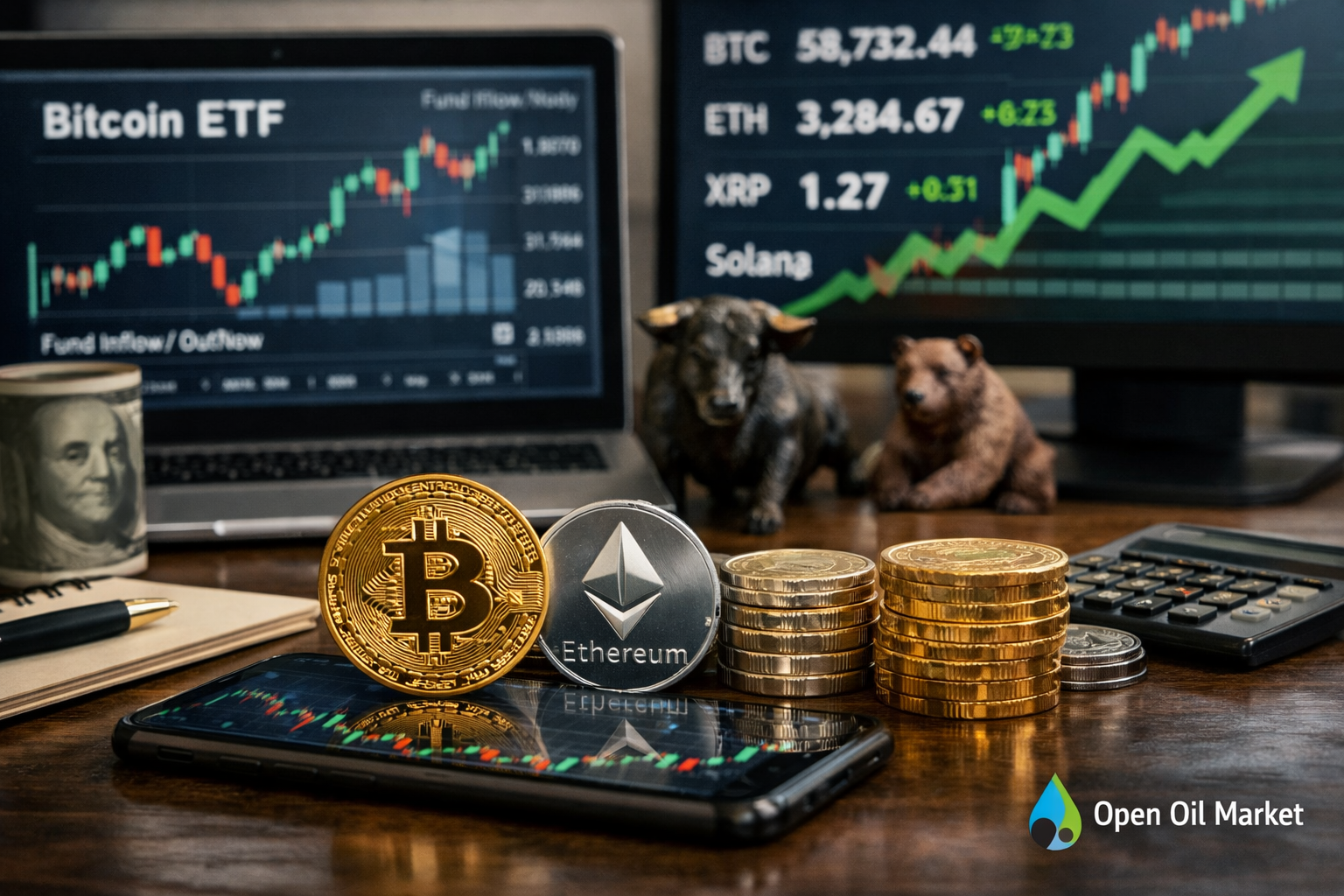
Cryptocurrency News for Friday, February 27, 2026: Bitcoin Dynamics, ETF Influence, Altcoin Volatility, and the Top 10 Most Popular Cryptocurrencies
The global cryptocurrency market is entering the end of the week with heightened sensitivity to macro events: upward impulses resemble more of a technical bounce and short squeezes rather than a sustainable trend. For investors, this is a typical phase of "re-evaluation of expectations": capital is not exiting the asset class entirely but is becoming more tactical, with shorter holding horizons. In practice, this is expressed in increased intraday volatility, uneven dynamics across sectors, and a heightened role of derivatives.
What this means for your portfolio:
- Cryptocurrency news is assessed through the lens of liquidity and risk appetite rather than the "narratives" of individual tokens;
- The priority is on quality: liquid assets and understandable catalysts (ETFs/regulation/network upgrades);
- Altcoins are more reactive: they respond strongly upwards during a "short squeeze" and downwards when risk-off sentiment increases.
Bitcoin: ETF Flows Become the Main "Barometer" of Institutional Sentiment
Bitcoin remains a magnet for liquidity: even when the dynamics appear "sideways," it is BTC that sets the pace for the entire cryptocurrency market. A key factor in 2026 is that a significant portion of supply and demand flows through exchange-traded products. Flows into spot ETFs effectively become a daily indicator: when a series of outflows occur, the market quickly slips into sell-offs; when there are days with notable inflows, risk appetite returns, albeit unevenly.
For investors, it is crucial to monitor not the "noise" of headlines but three metrics:
- Series of inflows/outflows (a few consecutive weeks carry more weight than a single day);
- Price reaction to flows (if inflows do not lead to price increases, the market is "heavy");
- Sentiment spreads between BTC and altcoins (if BTC remains stable while altcoins are weak, risk continues to be high).
Ethereum: A Focus on Scaling and Security in the 2026 Roadmap
Ethereum continues to position itself as a foundational layer for financial applications and tokenization, but in 2026, investors are looking at ETH pragmatically: focusing on scaling speed, user experience quality, and protocol security. Updates to the roadmap and development priorities strengthen expectations that the network will increase throughput and resilience – including through raised limits and the development of anti-censorship mechanisms, as well as long-term preparations for post-quantum risks.
For the market, this sends an important signal: fundamental changes in Ethereum typically affect the entire L2, DeFi, and infrastructure token sector. In practice, this could mean:
- Shifts in interest towards ecosystem assets during moments when the overall market stabilizes;
- Increased competition among L2s for liquidity and users;
- A more stringent selection of projects: a "narrative" no longer suffices; metrics are needed.
Altcoins: Rotation Occurs via Liquidations and Short Movements Rather Than a Long Trend
Altcoins are moving unevenly towards the end of February: parts of the market receive impulses from forced short position closures, while others remain under pressure due to decreased risk appetite. For investors, this creates an environment where "beautiful" daily candles may result from liquidations rather than fundamental demand. In such conditions, having risk limits and rebalancing discipline is especially important.
Practical tactics for investors:
- Do not confuse short squeezes with the start of a sustainable growth cycle;
- Separate "core" (BTC/ETH) from "satellites" (altcoins) with different stop/loss rules;
- Maintain a liquidity reserve: in a volatile market, it serves as an option for opportunities.
Regulation and Compliance: Stablecoins Shift to "Payment Infrastructure" Mode
On a global scale, cryptocurrency regulation is becoming more pragmatic: the focus has shifted to stablecoins, reserves, disclosure requirements, and emitter obligations. This transforms the risk structure for investors and businesses: on one hand, the market's "institutional suitability" increases; on the other hand, the cost of compliance rises, and jurisdictional segmentation intensifies.
Key consequences for the cryptocurrency market:
- Stablecoins are becoming more aligned with traditional payment instruments, which reduces the risk of "banking panics" within the crypto ecosystem;
- The role of regulated platforms and custodians is increasing;
- Within DeFi, there is heightened demand for transparent reserves and verifiable liquidity.
Institutional Investors: Interest Persists, But Has Become More "Portfolio-Oriented"
A significant share of demand for cryptocurrencies in 2026 is being channeled through institutional avenues, making the market both deeper and "capricious." Deeper due to the emergence of infrastructure (ETFs, custodians, risk procedures). Capricious because decisions are made with portfolio logic: if macro conditions worsen, crypto exposure is cut alongside other risk assets; if liquidity improves, positions are quickly reinstated.
For investors, this means:
- Strong movements in BTC can occur "without news" due to flows and hedging;
- Correlations with stock indices occasionally intensify;
- The rise of "quality" flows enhances the market's long-term resilience, even if short-term volatility pressures it.
Top 10 Most Popular Cryptocurrencies: Market Structure and Role of Each Asset
Below is a benchmark of the "core" of the cryptocurrency market, which often constitutes the foundation of global portfolios. The list reflects the most commonly traded set of the largest and most liquid assets; specific rankings may change depending on the market cycle, but the logic of roles remains consistent.
Top 10 (practical classification for investors)
- Bitcoin (BTC) — the foundational risk benchmark, the market's "digital reserve."
- Ethereum (ETH) — a key smart contract platform and ecosystem asset for DeFi/L2.
- Tether (USDT) — the primary dollar stablecoin for trading liquidity.
- USD Coin (USDC) — a stablecoin with a strong compliance profile and institutional use.
- XRP (XRP) — a token focused on payments and infrastructural scenarios.
- BNB (BNB) — an ecosystem token for a major exchange infrastructure and network services.
- Solana (SOL) — a high-performance network that often benefits during "rotation" phases of altcoins.
- Cardano (ADA) — a smart contract platform emphasizing formal approaches and sustainable development.
- Dogecoin (DOGE) — a high-beta asset sensitive to sentiment and liquidity.
- TRON (TRX) — a network widely used in stablecoin transactions and transfers.
Risks and Scenarios: What Investors Should Monitor Until Week's End
The key question in the coming sessions is whether the cryptocurrency market can solidify a recovery after sharp movements, or if volatility will continue to exhibit a "sawtooth" pattern. In such a configuration, it is beneficial for investors to work with scenarios rather than trying to guess a single outcome.
Basic scenarios:
- Stabilization: BTC holds the range, ETF flows stabilize, altcoins rise selectively.
- Risk-off: Deteriorating macro sentiment leads to renewed outflows; altcoins drop faster than the "core."
- Upward Momentum: A series of inflows and short liquidations accelerate growth, but require strict take-profit measures.
Risk management in practice: stagger entries, lock in part of the profits during spikes, maintain drawdown limits across the portfolio, and avoid overloading on altcoins in uncertain phases. For the long-term investor, 2026 increasingly resembles a story of infrastructure (ETFs, regulation, protocol upgrades) rather than just price "narratives."