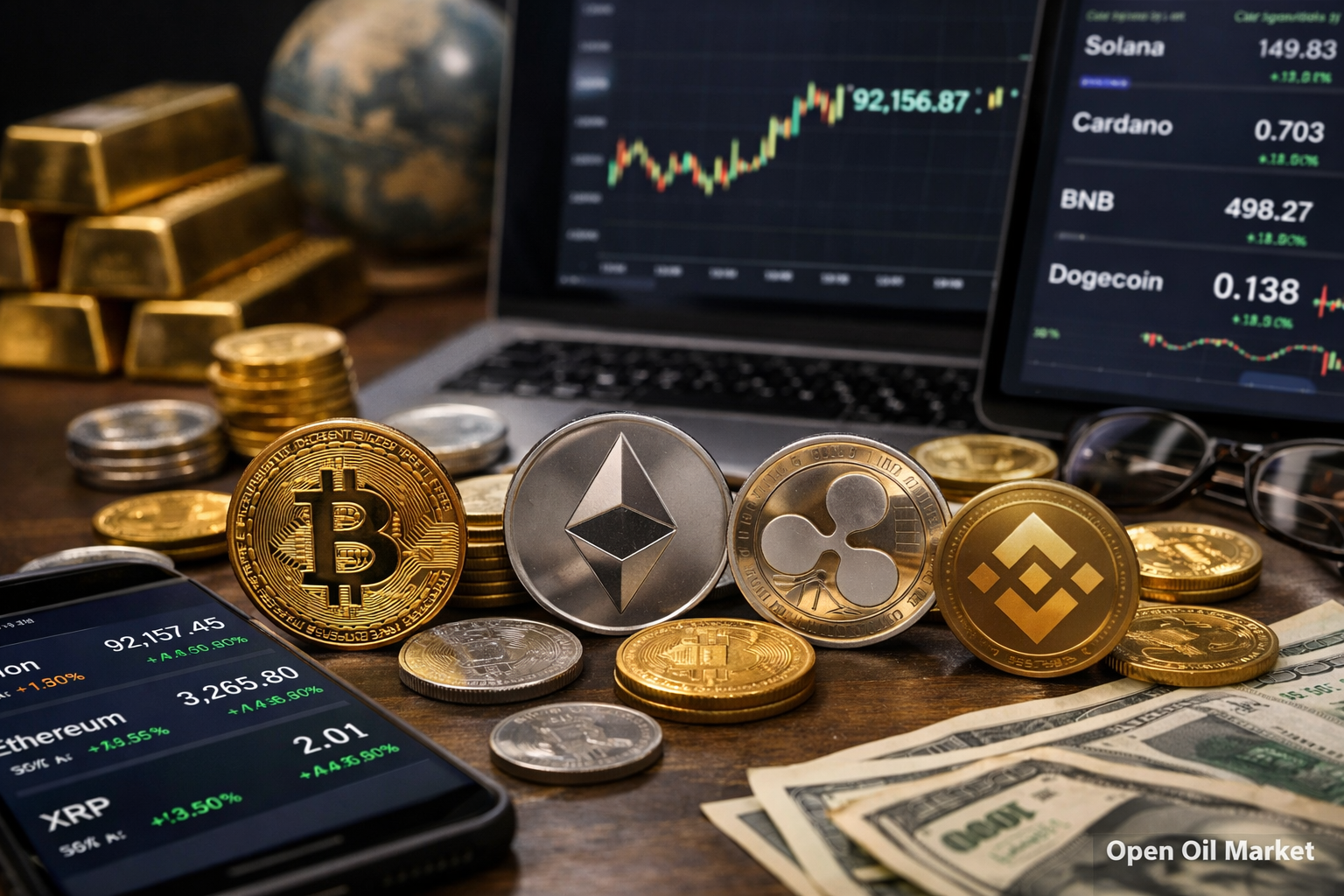
Current Cryptocurrency News for Monday, January 12, 2026: Bitcoin Holds Around $92,000, Ethereum and Major Altcoins Rise Amid Anticipation of U.S. Inflation Data, Institutional Interest Remains, Top 10 Popular Cryptocurrencies.
Market Overview
- The total market capitalization of the cryptocurrency market is estimated at approximately $3.2 trillion, remaining close to weekend levels. Over the past 24 hours, the overall market volume has changed slightly, reflecting a phase of consolidation following recent fluctuations.
- Bitcoin (BTC) is trading near $92,000, slightly above the psychologically significant level of $90,000. BTC's market capitalization stands at about $1.8 trillion, maintaining dominance of around 58% of the total cryptocurrency market capitalization.
- Ethereum (ETH) holds in the range of $3,200 to $3,300, showing moderate growth following Bitcoin. ETH's capitalization exceeds $380 billion (around 12% of the market), affirming its status as the second most significant cryptocurrency.
- The largest altcoins generally exhibit slight price increases within 1-3%. Coins such as Solana, XRP, Cardano, and others from the top 10 are trading close to the previous day's levels, signaling ongoing market stabilization after a volatile first week of the year.
Bitcoin: Consolidation and Growth Boundaries
Bitcoin continues to consolidate around the ~$90,000 to $92,000 marks as the new week begins. Following a volatile start to the year, the leading cryptocurrency is attempting to establish itself above $90,000: on January 5, BTC briefly rose to ~$94,800 (a local maximum in recent months), followed by a correction that saw prices dip below $90,000 on January 8. Currently, Bitcoin has recovered much of the dip and returned to ~$92,000, approximately 3-4% higher than the levels at the beginning of the year. Current quotes remain about 25% below the historical maximum (~$124,000, reached in August 2025), but investors note BTC's stability at these heights.
Analysts point out that the $90,000 to $95,000 range for Bitcoin has become a new psychological resistance zone: sellers actively lock in profits when prices attempt to rise above these levels, while buyers support the price during pullbacks. Macroeconomic uncertainty (including upcoming inflation data) restrains sharp movements, but fundamental factors remain positive. Bitcoin continues to be perceived by many as "digital gold" and a safe-haven asset. Recent geopolitical events have heightened interest in BTC as a safe haven: amid international tensions, investors sought refuge in Bitcoin, and rumors of substantial BTC reserves held by certain states (and the possibility of their confiscation) have added bullish expectations to the market.
Ethereum Maintains Second Place
Ethereum (ETH), the second-largest cryptocurrency by market capitalization, is moving in line with the overall market dynamics. As of January 12, Ethereum is trading around $3,250 per coin, having seen a slight increase over the past few days. In the first half of January, ETH reached ~$3,300, marking a high not seen since last fall. Over the past week, Ethereum has gained approximately 5-6%, confidently retaining its status as the largest altcoin. Although the current price is significantly lower than its historical high (~$4,900 in November 2021), Ethereum demonstrates stability and attracts investors with its technological potential.
Ethereum's capitalization now stands at about $380 billion (around 12% of the total market capitalization), reaffirming its second position in the industry. Interest in the smart contract platform remains high: the launch of the first spot ETFs on Ethereum in 2025 has provided institutional investors with convenient access to ETH, resulting in a record influx of capital into related funds. Major players view Ethereum as a foundational infrastructure for decentralized finance (DeFi), NFTs, and other Web3 applications. Ongoing technical developments within the network (protocol upgrades, second-layer scaling solutions) combined with institutional support provide grounds for anticipating Ethereum's strong position and potential value growth in the medium term.
Altcoins: Mixed Dynamics
The altcoin market shows mixed dynamics at the start of the week. The total market capitalization of all alternative cryptocurrencies (excluding Bitcoin) hovers around ~$1.35 trillion, lower than the peak levels of last summer (~$1.7 trillion), but reflecting ongoing investor interest in digital assets outside of Bitcoin. Many leading altcoins, after a surge in the first half of 2025, experienced a correction in the fall, and are now trying to find a new equilibrium.
Among the largest altcoins, Ripple (XRP) stands out. The token of the Ripple payment network is trading above $2.00, strengthening its position thanks to legal clarity regarding its status (Ripple's victory over the SEC in court in 2025) and the launch of the first ETFs on XRP. XRP's market capitalization is estimated at about $110 billion, placing it back among the market leaders. Institutional investor interest in XRP has noticeably increased with the emergence of opportunities to invest in this asset through ETFs, bolstering long-term positive sentiment about it.
Another notable player is Binance Coin (BNB), the native token of the largest cryptocurrency exchange, Binance. Despite regulatory challenges surrounding Binance last year, BNB is trading around $500 (market cap of approximately $80 billion) and remains in the top five cryptocurrencies. The current price is below the historical maximum (~$750), but the coin shows resilience due to its broad range of applications: BNB is actively used to pay exchange fees and in projects on the BNB Chain blockchain (in DeFi, gaming applications, etc.). This allows the token to maintain demand even amid regulatory pressure.
Platform tokens are also showing high activity. Solana (SOL) surpassed the $150 mark per coin at the start of January, the first time since 2022. News about the launch of the first spot ETF on Solana in the U.S. at the end of 2025 has fueled growth for this cryptocurrency, stimulating investment inflows. Solana's capitalization reached ~$60 billion, and the revival of its ecosystem (DeFi applications, NFT marketplaces, etc.) supports investor optimism regarding its prospects.
Cardano (ADA), another major platform, is attracting analysts’ attention with plans to launch an ETF based on it. At the end of last year, investment firm Grayscale submitted an application in the U.S. to create an ETF linked to ADA, leading to a surge in interest for the token. Currently, Cardano is trading around $0.70 (market cap of approximately $23 billion) following a correction from local highs. Although the key psychological barrier of $1.00 has yet to be surpassed, ADA remains one of the most promising platforms from a technological development perspective, thanks to the scientifically-oriented approach of its team and an active community of supporters.
Notably, the segment of so-called meme cryptocurrencies saw a surge in demand for high-risk "meme coins" among retail traders in the first week of January. For instance, Dogecoin and Shiba Inu saw price increases of 15-20% over the past seven days, pushing the total market capitalization of niche meme tokens above $45 billion. This phenomenon indicates a sustained appetite for risk in certain corners of the market, despite the overall cautious sentiment. However, such rallies in low-liquidity assets are typically short-lived: by the end of the weekend, the growth of meme coins began to slow. Experts warn that such volatile assets can quickly retrace, and participation should be approached with caution.
Institutional Investments and ETF Launches
- High Institutional Involvement: Major financial organizations continue to be actively involved in the cryptocurrency market. In 2025, U.S. regulators approved the first spot ETFs for Bitcoin and Ethereum, which opened the door for investments from banks, hedge funds, and even pension funds. As of early 2026, institutional investors collectively hold record amounts of crypto assets, viewing them as a promising class for portfolio diversification.
- New ETFs and Applications: At the end of 2025, exchange-traded funds were also introduced for some altcoins—primarily for XRP and Solana—marking an important milestone for the market. At the beginning of 2026, the expansion of the crypto-ETF lineup continues: financial giant Morgan Stanley has filed an official application to launch spot funds for Bitcoin and Solana. This marks the first instance in which one of Wall Street's largest banks has directly taken the initiative in launching a crypto fund, signaling growing confidence in digital assets.
- Capital Inflows and Outflows: After the launch of new ETFs on Bitcoin and Ethereum at the beginning of the year, funds attracted billions of dollars during the first days of trading. However, following price corrections in recent days, a short-term outflow of funds was observed: during the period of January 7-8, a total of approximately $0.5 billion was withdrawn from American Bitcoin funds, while Ethereum funds saw about $0.16 billion flow out. Experts believe these outflows are linked to profit-taking following the late 2025 rally and do not indicate a loss of confidence. Overall, inflows in recent weeks still exceed outflows, and major players are not strategically reducing their positions.
- Traditional Companies Accepting Crypto: In addition to financial institutions, cryptocurrencies are increasingly being integrated into the corporate sector. For instance, one of the largest U.S. banks, Bank of America, has started recommending that clients allocate up to 4% of their investment portfolios to Bitcoin, recognizing its significance as an asset. Notably, retail giant Walmart announced it would begin accepting cryptocurrency payments (BTC and ETH) through its OnePay Cash app. This move theoretically allows over 150 million Walmart customers to pay for goods and services using digital currencies, marking an important step in the mass adoption of crypto assets.
Regulation and Global Trends
- Easing Positions in Major Economies: Globally, the establishment of unified regulations for cryptocurrency operations continues. In the U.S., following the legal precedents set in 2025 (e.g., the Ripple vs. SEC case), calls for clear legislation in the realm of digital assets have intensified. Legislators and regulators are developing new norms that will allow legal investment in crypto assets without fear of status uncertainty. A federal law discussing stablecoins and digital assets is anticipated in Congress in 2026, potentially laying the groundwork for further industry growth.
- Europe Implementing MiCA Rules: In the European Union, the regulatory framework MiCA (Markets in Crypto-Assets) is set to come into force, aimed at standardizing the approach to cryptocurrencies across all EU member countries. This enhances market transparency and the requirements for crypto companies while providing institutional investors with increased confidence. The unified rules in Europe are expected to attract new crypto startups and investments to the region as legal clarity becomes a competitive advantage.
- Asian Markets Opening Up: In Asia, active movements towards the crypto industry continue. For example, authorities in South Korea have announced plans to allow trading of spot Bitcoin ETFs on national exchanges in 2026 while simultaneously tightening requirements for stablecoins (mandatory 100% backing of issued stablecoins with real assets). Financial hubs in the region, such as Hong Kong and Singapore, are implementing licensing for crypto exchanges and services, aiming to become hubs for global crypto investments. These steps indicate a trend: despite differing approaches, major economies are increasingly integrating cryptocurrencies into their financial and legal systems.
Market Sentiments and Volatility
After a rapid rise followed by a subsequent decline in the second half of 2025, sentiments in the cryptocurrency market remain cautious. The "fear and greed" index for cryptocurrencies has been in the fear zone since mid-December: as of January 8, it stood at 28 points out of 100, reflecting investors' predominant apprehension. An extended period of low index values is often viewed as a sign of market overselling—previously, similar levels frequently preceded upward reversals, as the most anxious participants had exited their positions. However, the continued fear indicates that confidence has not yet fully recovered following the recent downturn.
Market volatility remains high. Sharp price movements in the early days of January resulted in a wave of margin liquidations. On January 8 alone, a total of over $450 million worth of positions were liquidated, with most of that amount stemming from long positions (bets on upward movement). The rapid drop in prices forced around 120,000 traders to close their trades at a loss. This episode reminds players using high leverage of the risks involved: overly optimistic bets on rising prices can lead to the "squeezing" of long positions and exacerbate price downturns. The cryptocurrency market has experienced similar scenarios before (e.g., in October 2025, daily liquidations reached a record $19 billion), underscoring the need for caution.
Experts advise investors to remain composed and manage risks meticulously. Until new fundamental growth drivers (such as improvements in the macroeconomic situation or revolutionary technological breakthroughs) emerge, any spikes in optimism may quickly be followed by profit-taking. The diverse sentiments—from cautious fear overall to local spikes of excitement for individual tokens—indicate a transitional phase in the market. Many analysts believe that the current consolidation may continue in the coming weeks. Nevertheless, long-term investors remain optimistic: fundamental factors driving industry development (growing adoption of blockchain technology, interest from institutional players, regulatory improvements) are still in play. In the absence of new shocks, the market is capable of gradually regaining its upward momentum in the second half of 2026. In any case, market participants are advised to closely follow economic data and news—they will dictate the trajectory of the cryptocurrency market in the near future.
Top 10 Most Popular Cryptocurrencies
- Bitcoin (BTC) — the first and largest cryptocurrency. BTC is trading around $92,000 after recent fluctuations, with a market capitalization of approximately $1.8 trillion (≈58% of the entire market). Bitcoin is perceived by investors as "digital gold" and a foundational asset for many investment strategies in the crypto industry.
- Ethereum (ETH) — the leading altcoin and smart contract platform. The price of ETH hovers around $3,300, considerably below historical highs; however, Ethereum maintains a strong second place by market capitalization (~$390 billion, ≈12% of the market). Ethereum serves as the backbone of the DeFi and NFT ecosystems, continuing to attract developers and investors.
- Tether (USDT) — the largest stablecoin pegged to the U.S. dollar at a 1:1 ratio. USDT is widely used by traders for settlements and capital storage between trades. Its market capitalization is approximately $170 billion; due to full reserve backing, the coin stabilizes around the $1.00 price point, acting as a sort of "safe haven" in a volatile market.
- Ripple (XRP) — the token of the Ripple payment network for cross-border transactions. XRP is currently trading around $2.00, with a market capitalization of approximately $110 billion. Legal clarity regarding XRP's status in the U.S. following the court's 2025 decision and the launch of an ETF for this token have boosted investor confidence. XRP has reclaimed its place among market leaders, remaining attractive for payments and asset tokenization.
- Binance Coin (BNB) — the coin of the largest cryptocurrency exchange, Binance, and the native token of the BNB Chain. The price of BNB is approximately $500 (market cap of ~ $80 billion). Despite regulatory challenges surrounding Binance, the token remains in the top five due to its broad range of applications: BNB is used to pay fees on the exchange, participate in token sales, and operate decentralized applications within the Binance ecosystem.
- Solana (SOL) — a high-performance blockchain platform for decentralized applications (dApps). SOL is trading around $150 per coin (market cap of ~ $60 billion), having recovered a significant portion of declines from the fall of 2025. Interest in Solana is supported by the launch of the first ETF for this asset and the development of projects based on it, which helps restore the platform's position as a technological leader.
- USD Coin (USDC) — the second-largest stablecoin backed by reserves in U.S. dollars (issued by Circle). USDC consistently maintains the $1.00 price due to regular audits of reserves, with a market capitalization of approximately $60 billion. The coin is actively used by institutional investors and in DeFi protocols, providing transparency and trust in the stablecoin segment.
- Cardano (ADA) — a blockchain platform with a research-oriented approach to development. ADA is currently priced at approximately $0.70 (market cap of ~ $23 billion) after a correction from recent highs. Cardano is attracting attention with plans to launch an ETF for its token and ongoing network development. The project's community believes in long-term growth, and the focus on scientific rationale for decisions distinguishes ADA from its competitors.
- TRON (TRX) — a platform for smart contracts and decentralized entertainment, especially popular in Asia. TRX is trading around $0.25 (market cap ~ $22 billion). TRON maintains its top 10 presence partly due to the widespread use of its network for issuing stablecoins (a significant portion of USDT is traded on the Tron blockchain) and its active Asian user base.
- Dogecoin (DOGE) — the most recognized "meme cryptocurrency," created as a joke. DOGE hovers around $0.14 (market cap ~ $21 billion), supported by an active community and periodic attention from celebrities. Although Dogecoin's volatility remains high, this coin continues to be in the top ten, demonstrating remarkable resilience in investor interest for high-risk assets.