Cryptocurrency News for Tuesday, January 20, 2026: Bitcoin Near Record Levels, Dynamics of Top 10 Cryptocurrencies, Institutional Investments, Global Trends, and Prospects for the Crypto Market
The cryptocurrency market is demonstrating mixed dynamics at the beginning of the week. The total capitalization of digital assets stands at approximately $3.1 trillion, reflecting a decrease of about 2-3% over the past 24 hours. Most of the top 100 cryptocurrencies by market value have found themselves in the "red zone," reflecting investor caution amid external macroeconomic factors. Nonetheless, interest in crypto assets remains high: the sector entered 2026 with optimism following a strong increase in prices at the end of last year.
Macroeconomic Background and Volatility
External factors significantly influence the sentiments of cryptocurrency market participants. New trade tensions between the United States and Europe have led to increased volatility: the US administration's announcement of potential tariffs on several European countries has triggered a decline in risk appetite among global investors. In this context, traditional "safe havens" such as gold and silver have shown price growth, while Bitcoin and major altcoins are experiencing a correction. Monetary policy also remains in focus—prior to the Federal Reserve's meeting in January, market participants are assessing the high likelihood of keeping interest rates unchanged.
Bitcoin: Trends and Current Levels
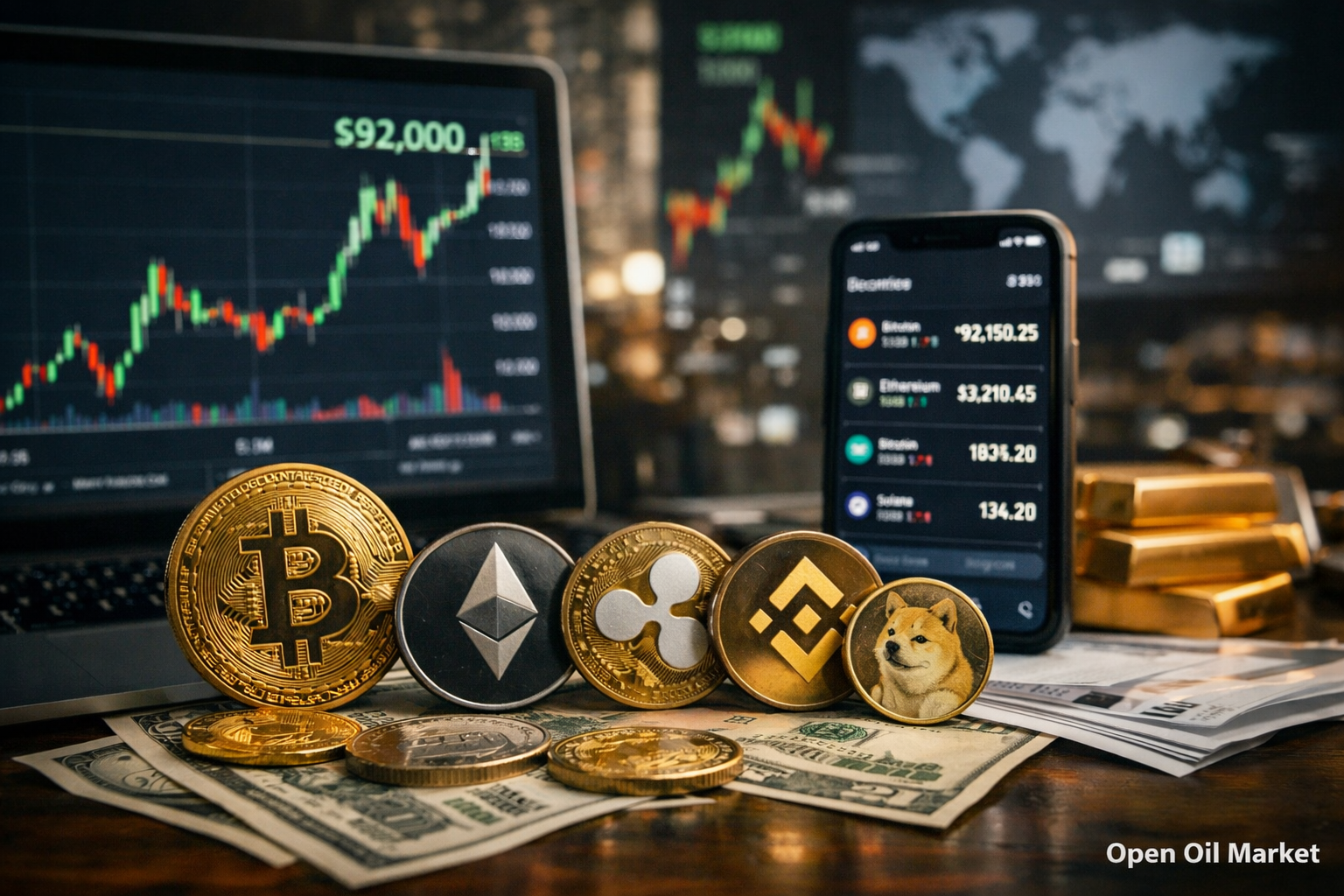
Bitcoin (BTC) is holding steady around the $92,000 mark following a recent correction. Earlier in January, the flagship cryptocurrency approached the psychologically significant level of $100,000, breaking historical records; however, due to the latest news on tariffs, it was unable to maintain its gained positions. Over the past 24 hours, Bitcoin has decreased by approximately 3%, once again showing high correlation with traditional risk assets. The short-term drop in price highlights the testing of BTC's role as "digital gold": investors, amid uncertainty, preferred to shift to defensive assets, and the price of BTC declined alongside stock indices.
However, Bitcoin's fundamental indicators remain robust. Transaction volumes on the network remain high, and long-term holders are not in a rush to part with their accumulated coins. During the correction, many large investors viewed the price pullback as an opportunity to buy in. Technically, Bitcoin is consolidating below recent peaks, forming support in the range of $90,000–$92,000. The coming weeks will be telling on whether bulls can drive the price back to six-figure values, or if the market will enter a phase of deeper correction.
Ethereum: Increased Network Activity
Ethereum (ETH), the second-largest cryptocurrency by market capitalization, is trading above $3,000, experiencing a similar correction of about 3-4% in the last 24 hours. The current price of ETH is near $3,200 after attempts at recovery last week. Despite the pullback in prices, on-chain metrics for Ethereum are showing positive dynamics. The Ethereum network has recorded a sharp increase in activity: the number of daily active addresses and transaction volumes have significantly increased, indicating heightened usage of the platform for decentralized applications.
The transition of Ethereum to the Proof-of-Stake algorithm continues to meet expectations—network support remains stable. The queue for validators to exit staking has completely reduced to zero, reflecting participants' confidence in the ETH ecosystem and a lack of frenzied desire to leave the staking protocol. Conversely, the queue for new validators remains long, indicating sustained interest in participating in network maintenance. Overall, fundamental improvements and extensive adoption of Ethereum create a basis for price recovery once external market factors stabilize.
Altcoin Market
Major altcoins in terms of capitalization generally followed Bitcoin's dynamics, showing mixed results. The capitalization of the second tier of the cryptocurrency market remains substantial, and investors are closely monitoring the leaders in this segment. For instance, Binance Coin (BNB) is holding around $925 after a slight decrease, continuing to play a key role in the ecosystem of the largest cryptocurrency exchange. Ripple (XRP) is fluctuating near $2.00, down nearly 4% over 24 hours, but remains at high levels. Solana (SOL) has dropped to approximately $134 (–6% in a day), reflecting the high volatility characteristic of smart contract projects; nevertheless, Solana maintains its position in the top 10.
Top 10 Popular Cryptocurrencies
- Bitcoin (BTC) – around $93,000; the largest cryptocurrency acting as digital gold and a sentiment indicator for the entire market.
- Ethereum (ETH) – around $3,200; the second-largest coin, a foundational platform for smart contracts, DeFi, and NFT ecosystems.
- Tether (USDT) – $1.00; leading stablecoin pegged to the US dollar, providing liquidity and payment stability in the crypto market.
- Binance Coin (BNB) – around $925; the native token of the largest crypto exchange Binance, used within the exchange's ecosystem and the BSC network.
- Ripple (XRP) – around $2.00; one of the oldest altcoins designed for fast international payments, actively used by financial companies.
- USD Coin (USDC) – $1.00; another popular stablecoin released by the Centre consortium (Circle), widely used for value storage and transactions.
- Solana (SOL) – around $134; a high-speed blockchain platform for decentralized applications, attracting developers with scalability and low fees.
- Tron (TRX) – around $0.31; a blockchain platform known in the entertainment and content space, and widely used for stablecoin issuance.
- Dogecoin (DOGE) – around $0.13; meme cryptocurrency that gained broad notoriety due to community and influential support, used for transactions in online communities.
- Cardano (ADA) – around $0.37; a promising blockchain platform developed with a scientific approach aimed at creating scalable decentralized applications.
Institutional Interest and Exchange-Traded Funds (ETFs)
At the beginning of 2026, the cryptocurrency market is receiving support from significant players in the financial sector. Institutional investors, who previously stayed on the sidelines during periods of heightened volatility, have become more active. A significant event was the record fundraising for Bitcoin ETFs: in the last week, Bitcoin spot exchange-traded funds attracted a record $1.4 billion. The return of capital inflow into such funds indicates an increasing trust from traditional investors in crypto assets. Simultaneously, interest in futures products has also grown: the total open interest in Bitcoin futures has recovered by more than 10% as market participants begin to build up risky positions again following the recent downturn.
In addition to ETFs, institutional participation is evident through direct and indirect investments. Corporations continue to increase their cryptocurrency reserves, while some pension funds prefer an indirect approach—such as investing in shares of crypto asset-holding companies (like MicroStrategy, known for its large Bitcoin holdings). Such actions signal that digital assets are increasingly perceived as a legitimate investment class. Experts from leading financial firms also note that the industry is on the brink of structural changes: analysts at Fidelity believe that the integration of cryptocurrencies into the traditional financial system could accelerate significantly in the near future.
Regulation and Global Adoption
The regulatory environment surrounding cryptocurrencies continues to gradually improve worldwide, creating conditions for broader adoption of digital assets. New laws and regulations are being implemented in several jurisdictions to strike a balance between innovation and investor protection. For instance, starting in January, the comprehensive EU regulatory framework (MiCA) comes into force, establishing uniform rules for crypto companies within the European Union and enhancing market transparency. Progress is also being observed in Asia: for example, Kazakhstan has officially approved the legal framework for operations with digital assets, aiming to become a regional hub for cryptocurrency mining and trading. These steps indicate state interest in attracting high-tech businesses and tax revenues from the rapidly growing blockchain industry.
At the same time, in the largest economy in the world—the United States—regulators continue to discuss the optimal approach to overseeing the crypto market. Concurrently, the traditional financial sector is beginning to implement distributed ledger technologies: the New York Stock Exchange is testing a securities tokenization platform, while banks are adopting blockchain to speed up payments. Central banks in a number of countries are also exploring the possibility of launching their own digital currencies (CBDCs) to modernize the monetary system. All these trends indicate that cryptocurrencies are increasingly integrating into the global economy, while supervision and trust from regulators are simultaneously strengthening.
Market Prospects
Overall, sentiments in the cryptocurrency market remain cautiously optimistic. Much will depend on external factors: the easing of geopolitical tensions and the softening of monetary policy could restore risk appetite and provide momentum for renewed growth in crypto assets. At the same time, the return of institutional capital and the development of regulated infrastructure create a more solid foundation for the market, while technology progress supports long-term investor interest. The cryptocurrency market is likely to maintain volatility in response to external events; however, with each cycle, it becomes more mature: global investors gain experience, cryptocurrency adoption spreads, and their positions in the global financial system gradually strengthen.