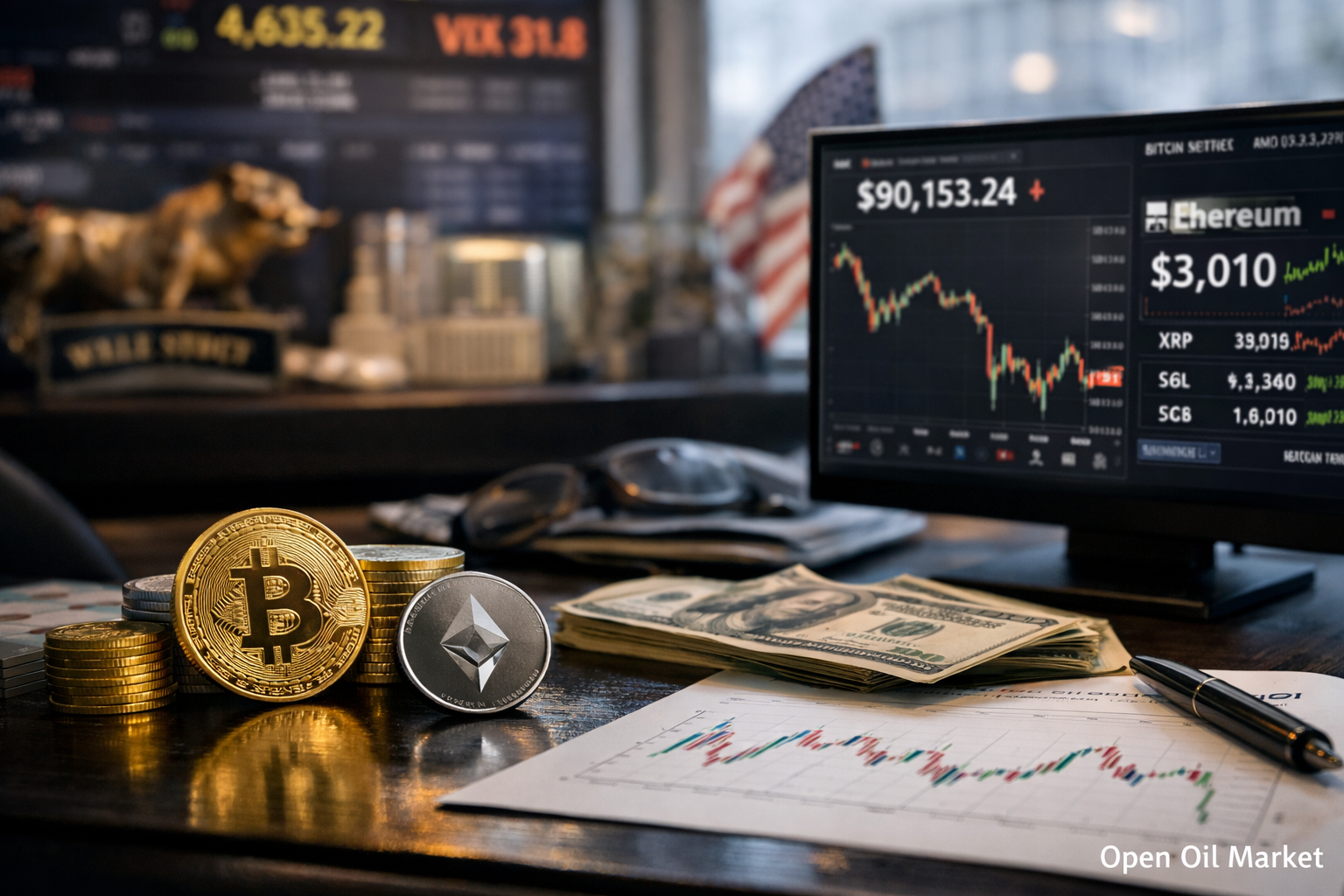
Cryptocurrency News for Friday, January 23, 2026: Bitcoin Holds Key Level, Ethereum and Altcoins Recover, Institutional Investors Buy the Dip
As we approach the end of the week, the global cryptocurrency market is attempting to stabilize after a significant correction in recent days. Bitcoin (BTC) is hovering around the critical threshold of $90,000, which is pivotal for the market's future direction. Ethereum (ETH) and several other leading altcoins are searching for support levels to recover from recent declines. The overall market capitalization of the cryptocurrency space has shrunk to approximately $3 trillion amid heightened macroeconomic uncertainty, and the "Fear and Greed Index" has dropped into the "fear" zone, reflecting a cautious investor sentiment. Nevertheless, large institutional players are seizing price dips to increase their positions, providing support for the market and instilling hope for a near-term stabilization.
Bitcoin Struggles at the $90,000 Level
The flagship cryptocurrency, Bitcoin, is trading near $90,000 as the week draws to a close, retreating from its historical maximum of around $100,000 reached earlier in January. Over the past few sessions, BTC has experienced a prolonged decline of approximately 10% from its peak, marking the longest pullback in the past year. Pressure on Bitcoin has been attributed to a general decrease in risk appetite across global markets, driven by geopolitical and economic factors prompting sell-offs in various asset classes, including digital assets. However, the ~$90,000 mark serves as a key support level – as long as BTC remains above this threshold, the market stands a chance of avoiding a deeper descent. Some analysts are indicating early signs of a "bottom" formation: technical indicators are suggesting oversold conditions, and larger investors have started actively acquiring coins at current prices. Successfully defending the $90,000 area could pave the way for Bitcoin's recovery, with the nearest target for bulls being the psychological barrier of $100,000, surpassing which would restore more confident bullish sentiment in the market.
Altcoin Market: Stabilization After Decline
Alternative cryptocurrencies (altcoins) have also undergone significant downturns alongside Bitcoin; however, by Friday, initial signs of stabilization have emerged. Ethereum (ETH), the second-largest cryptocurrency by market capitalization, had previously dipped below $3,000 but is now attempting to find a foothold around this level. Over the past week, ETH has lost roughly 5%, reflecting the vulnerability of altcoins amid the overall market correction. The broader market has also faced pressure: the vast majority of the top 100 tokens found themselves in the "red zone" in recent days, with investors partially reallocating funds into stablecoins in search of refuge from volatility. For instance, XRP (Ripple’s token) stabilized around $1.85–$1.90 after a continuous seven-day decline; Binance Coin (BNB) fell approximately 6% over the week, landing in the $840–$850 range; Solana (SOL) retraced to about $130, despite recording a record ~70% of staked coins in the network. However, should Bitcoin sustain its current levels, the selling pressure on altcoins may ease – many of them could find a local bottom and transition towards a cautious recovery. Investors are closely monitoring BTC's movements as an indicator: the stabilization of the leading coin often signals a return to buying in the altcoin segment.
Top 10 Most Popular Cryptocurrencies
Currently, the top ten largest and most popular cryptocurrencies by market capitalization include the following digital assets:
- Bitcoin (BTC) – The leading cryptocurrency, dominating the market with around 60% of the total capitalization. BTC's price remains close to $90,000; following a powerful rally in 2025, Bitcoin is undergoing a correction from its historical maximum but continues to confidently hold the top position, setting the tone for the entire crypto market.
- Ethereum (ETH) – The second-largest crypto asset and a foundational platform for smart contracts (decentralized finance, NFTs, and other applications). The current price of ETH is approximately $3,000; while Ethereum faces pressure following Bitcoin, it retains a key role in the industry. Many experts anticipate that interest in Ethereum will grow in 2026 due to network developments (new updates, scalability) and expanded use cases.
- Tether (USDT) – The largest stablecoin pegged to the US dollar (1 USDT ≈ $1). The market capitalization of USDT is approximately $80 billion; this stablecoin is widely used by market participants for risk hedging and preserving capital during periods of high volatility – in times of uncertainty, funds flow into the digital dollar, sustaining its stable position in the top three.
- BNB (BNB) – The native token of the Binance ecosystem (the largest cryptocurrency exchange and Binance Smart Chain). BNB's price is around $850; due to its wide usage on the Binance platform and associated services, BNB remains securely within the top five cryptocurrencies. The token has recently seen some declines amid the overall negative market sentiment, yet it continues to play a crucial infrastructural role in the crypto ecosystem.
- USD Coin (USDC) – The second-largest stablecoin issued by the Centre consortium (Circle) and fully backed by reserves in US dollars (capitalization of approximately $50 billion). USDC is widely utilized for transactions, trading, and on DeFi platforms as one of the most reliable digital dollars. During market upheavals, demand for such stable coins increases, confirming their significance for the industry.
- XRP (XRP) – A cryptocurrency associated with fintech company Ripple (solutions for international payments). XRP is trading around $1.90; after Ripple's notable victory against the SEC in 2025, this token experienced a significant price surge, returning it to the list of leaders. The current market correction has somewhat diminished XRP's gains, but it maintains its position thanks to an active community and its usage in payment applications.
- Solana (SOL) – A rapidly growing blockchain platform focused on high-speed and high-throughput transactions. SOL's price is around $130; Solana has secured a place in the top 10 due to the explosive development of its own ecosystem (DeFi, NFTs, etc.). Notably, a record ~70% of the total supply of SOL is engaged in staking, reflecting community trust and the long-term engagement of holders.
- Tron (TRX) – A blockchain platform popular in Asia for smart contracts and decentralized applications, also known as a basis for issuing stablecoins and facilitating rapid fund transfers with minimal fees. TRX's price fluctuates around $0.30; the active usage of the Tron network (including operations with USDT stablecoins) allows this token to maintain a position among the largest cryptocurrencies in the world.
- Dogecoin (DOGE) – A meme cryptocurrency initially created as a joke project, but over time gained mass popularity. DOGE's price stands at approximately $0.12; despite its ironic origins, Dogecoin remains one of the most capitalized coins. Its price is characterized by high volatility and heavily depends on community sentiments and celebrity mentions, yet the loyalty of its fan base and its long history allow DOGE to maintain its place in the top 10.
- Cardano (ADA) – A blockchain platform for smart contracts that is developing with an emphasis on a scientific approach and phased technological updates. ADA's token trades around $0.36; the project continues to implement technical improvements (for instance, recent upgrades have enhanced network scalability), sustaining investor interest. Thanks to steady ecosystem development and an active community, Cardano remains among the leaders in the crypto market.
Geopolitical and Macroeconomic Factors
External conditions continue to significantly influence the sentiments of crypto investors. At the World Economic Forum in Davos (taking place January 19–23), geopolitical issues have taken center stage: an unexpected escalation of trade disputes between the U.S. and Europe has triggered concerns about a new wave of protectionism. The U.S. President's ultimatum to the EU at the forum (regarding Greenland and potential tariffs) prompted sharp reactions from European leaders. Such confrontational rhetoric has placed transatlantic relations on the brink of a trade war, heightening investor anxiety worldwide. As a result of this geopolitical noise, market participants have started to avoid riskier assets (stocks, cryptocurrencies) and are shifting into traditional “safe havens.”
Furthermore, macroeconomic factors are exerting additional pressure on the crypto market. U.S. and EU government bond yields remain elevated, reflecting expectations of tightened financial conditions. Precious metal prices have reached new highs: gold has surpassed its historical record, climbing above $4,600 per ounce, while silver has also significantly appreciated. Simultaneously, the VIX volatility index remains at recent monthly highs, signaling increased uncertainty in financial markets. Ahead of the upcoming Federal Reserve meeting (scheduled for late January), investors are exercising caution – expectations for further commentary on interest rates and inflation are tempering risk appetite. Collectively, geopolitical tensions and a stringent macroeconomic backdrop have led to a "risk-off" environment, during which cryptocurrencies temporarily lose appeal for some global investors.
Investor Sentiment and Volatility
Recent events have considerably influenced the sentiments of cryptocurrency market participants. The Fear & Greed Index, having fallen into the “fear” territory, indicates a prevailing caution: investors are concerned about a possible continuation of the correction. Since the start of the week, the total market capitalization of cryptocurrencies has decreased by approximately $200 billion, though the decline paused in the last day. Volatility remains high: sharp price fluctuations have led to mass liquidations of margin positions. According to analytical services, excessive leverage was largely eliminated during the recent days of sell-offs – more than $2 billion worth of positions were liquidated, which, on one hand, exacerbated the short-term decline, while on the other, cleansed the market of overheating. Many short-term speculators have exited the market, while long-term investors are holding their positions, hoping for fundamental growth factors. It is worth noting that the current decline (around 10–15% from recent peaks) appears relatively moderate in the historical context of cryptocurrency cycles. Several experts point out that compared to past "crypto winters," this decline is so far shallow, and the market is demonstrating signs of maturity – broader institutional participation and the existence of regulatory frameworks are softening the amplitude of the downturn. Nevertheless, in the short term, the sentiment remains fragile, and any new negative news could once again heighten volatility.
Institutional Investments and Adoption
Even amid the current volatility, interest from large players in digital assets remains high. The cryptocurrency industry continues to attract long-term investments and integrate into the traditional financial system:
- American corporation MicroStrategy, one of the largest corporate holders of Bitcoin, increased its BTC reserves by approximately $2 billion this week, taking advantage of the price declines. According to the company, it now owns around 3% of the total Bitcoin supply – demonstrating institutional business trust in cryptocurrency even during downturns.
- Another treasury firm, Bitmine, made a notable purchase of Ethereum, increasing its holdings to an equivalent of ~3.5% of the entire circulating supply of ETH. This move indicates that institutional investors see long-term value not only in Bitcoin but also in leading altcoins and are willing to bolster their positions during price dips.
- In the U.S., discussions are progressing regarding a legislative initiative dubbed the Clarity Act, aimed at creating clear rules for the crypto industry. Despite temporary delays in acceptance (last week, the bill faced obstacles in the Senate), market participants expect that it will be passed in the foreseeable future. The introduction of understandable regulatory frameworks (for example, for crypto exchanges and stablecoins) could significantly enhance market transparency and attract new institutional players.
- Traditional financial institutions continue to implement solutions related to crypto assets. Major banks and exchanges are launching products for investments in digital assets – from spot Bitcoin ETFs (several of which are now operational in the U.S., backed by leading firms with total assets in the tens of billions of dollars) to platforms for trading tokenized securities. Concurrently, central banks are exploring the possibilities of digital currencies: for example, in China, the functionality of the state-backed digital yuan (e-CNY) is expanding, indirectly stimulating interest in fintech solutions globally. Such initiatives indicate that, despite short-term price fluctuations, the integration of cryptocurrencies into the global economy is steadily continuing.
The combination of these factors confirms that large investors and organizations perceive the current correction more as an opportunity rather than a threat. Institutional capital entering the industry and the development of infrastructure (regulation, new products, services) are laying the groundwork for future growth in the cryptocurrency market.
Outlook and Forecasts
The key question currently facing market participants is how prolonged the current correction will be and what will follow it. The future prospects of cryptocurrencies will largely depend on the external backdrop and Bitcoin's ability to hold above key levels. An optimistic scenario suggests that the correction is of a short-term nature: following a necessary "breather," the market may return to growth. For this, a relaxation of external negativity is desirable – de-escalation of geopolitical conflicts and milder signals from central banks (slowing interest rate hikes or more favorable economic forecasts) could restore confidence among investors. In this case, Bitcoin could attempt to rise again above the $100,000 mark in the coming weeks, which would pull the entire cryptocurrency market up.
However, a pessimistic scenario also exists: if the pressure from negative factors intensifies, the decline could deepen. In the event of a breach of support around $90,000, analysts do not rule out a drop in Bitcoin to the ~$75,000 area and below. In an extremely negative scenario, levels down to $50,000 have been cited, although such a drastic decline would require an exceptional confluence of adverse circumstances. For now, however, the market displays relative resilience: the current pullback is significantly less than typical "bearish" cycles of previous years, and long-term investors and institutions continue to believe in the potential of cryptocurrencies. Many observers view the trend as a phase of market healing – the exit of speculative capital and the transition of assets into more "robust hands." As external turmoil calms and volatility decreases, the cryptocurrency sector may receive a growth impetus based on accumulated fundamental factors. The expansion of institutional participation, technological development of blockchain platforms, and new use cases (from global payments to asset tokenization) are forming the groundwork for the next bullish market phase in the future. Consequently, most investors are currently adopting a wait-and-see approach, ready to increase their investments as soon as signs of sustained stabilization and trend recovery appear.